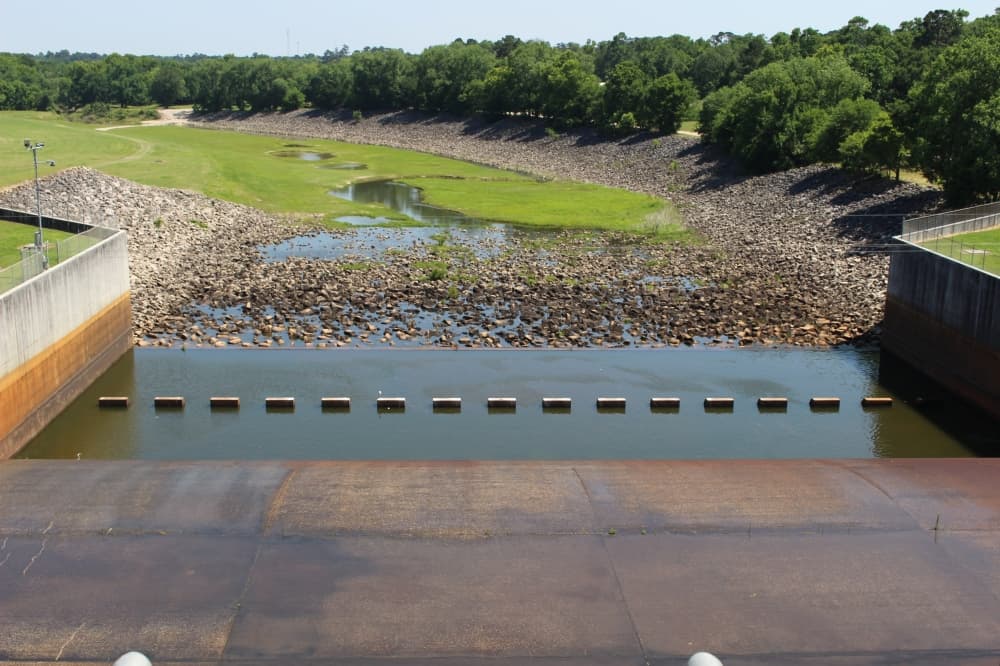
The city of Houston and Coastal Water Authority are planning to add 11 new spillway gates to the Lake Houston Dam to increase its release capacity. Simultaneously, through a partnership between the city of Houston, the San Jacinto River Authority and the city of Humble, a study is being conducted to determine the most effective way to operate Lake Conroe and Lake Houston's dam gates once the 11 new gates are installed.
The project
Lake Conroe has five gates to release water, which compares to Lake Houston's current four. The SJRA is conducting this study to find the most effective way to prerelease water once the new gates are added.
"We want to make sure that what they do down there [Lake Houston] is synced up with what we do up here [Lake Conroel." SJRA Division 1 engineer Matt Barrett said.
As the lakes' protocols become more in sync, the SJRA also hopes to determine if there are any mutual benefits in prereleasing water to limit flooding downstream before a storm event.
Residents in downstream areas have spoken about the damaging effects they believe the Lake Conroe dam's prereleases can have near their homes. One of these residents is Kingwood local Bob Rehak, who tracks Lake Houston-area flooding through his website www.reduceflooding.com.
"In the past, there have been releases from the Lake Conroe dam that were mistimed, too large, too much, too fast. And it all boils down to: they were trying to protect the properties behind the dam at the expense of properties downstream," Rehak said.
Lake Conroe was designed as a water supply reservoir, not a flood control reservoir, said Heather Ramsey, SJRA director of communications and public affairs. The lake has a protocol known as "active storm management," which allows dam operators to lower the lake in response to major weather events. However, the decision to lower the lake is not made by the SJRA but by the city of Houston, which legally owns two-thirds of the lake's water.
Citizens who live closer to the lake tend to support lake lowering pre-releases as it allows the lake to remain full after any floods, Barrett said.
How we got here
Lake Conroe was originally built in 1973 through a partnership between the SJRA and the city of Houston. The lake was designed to store water to support local agriculture and other industries, but is now also used for recreational purposes, per SJRA study documents. Lake Houston's dam was built in 1953 and currently operates with four spillway gates, Barrett said. The proposed 11 new spillway gates will increase the dam's discharge capacity from 10,000 cubic feet per second to 78,000 cfs upon completion. The additional discharge capacity for the dams will also help reduce flooding upstream.
Managing the impact
The following charts are a breakdown of the Lake Conroe and Lake Houston water levels during five major storms. The lake level is measured by MSL (mean sea level), which represents the height of the ocean compared to land. Through the joint operational study, SJRA officials are working to create an updated baseline and communication plan for pre-releases. Barrett said that within the general study, SJRA is working with the city of Houston to create a new forecasting system.
The tool would be implemented whenever a rainstorm arrives and through predictive weather forecasts, along with various stream and rain gauges in the river basin. The system will be able to tell Lake Houston officials how much water is coming.
"We use that data-both predicted and on-the-ground rainfall-to tell them how much water is coming toward Lake Houston," Barrett said. "Then, how high Lake Houston can get and how much water they anticipate would need to go out, so it can help them make decisions on operating."
When it comes to operations, Lake Conroe recovers from storms and prereleases differently than Lake Houston due to their respective locations. As the top of a watershed, Lake Conroe naturally acts as the starting point of the river system. Meanwhile, Lake Houston is located at the bottom of the watershed and has six additional watersheds that feed into it. Out of the seven total watersheds, the Lake Conroe dam is the only major control structure upstream of Lake Houston, SJRA officials said.
In response, Barrett said it naturally takes Lake Conroe longer to recover from prereleases in comparison to Lake Houston, since it doesn't receive much water from other watersheds.
"Lake Conroe actually slows down the water going downstream, so if Lake Conroe were not there, the flow coming downstream would be faster, more of a peak flow," Barrett said.
What they're saying
"We hope to eliminate overzealous dam releases that flood property downstream," Rehak said. "The purpose isn't to do another study; it's to protect downstream residents."
"Our No.1 priority is protecting the integrity of the dam. Our second priority is to protect the lake water as a drinking water supply," SJRA General Manager Aubrey Spear said.
Going forward
SJRA will host multiple meetings for the public throughout the study process; the first meeting was held on March 5 in Humble. Barrett said they hope to be able to reveal data regarding Lake Conroe pre-releases at the second public meeting later this year. Ramsey said that any member of the public who would like a question or statement to be considered as part of the study can submit it through the SJRA’s website. As for the study itself, it is currently estimated to be completed by December 2027, Barrett said.
"When implemented, the results of this particular study should not only provide peace of mind to the residents who live in fear of river flooding, but provide the framework to actually mitigate river flooding as much as possible," Humble City Manager Jason Stuebe said.