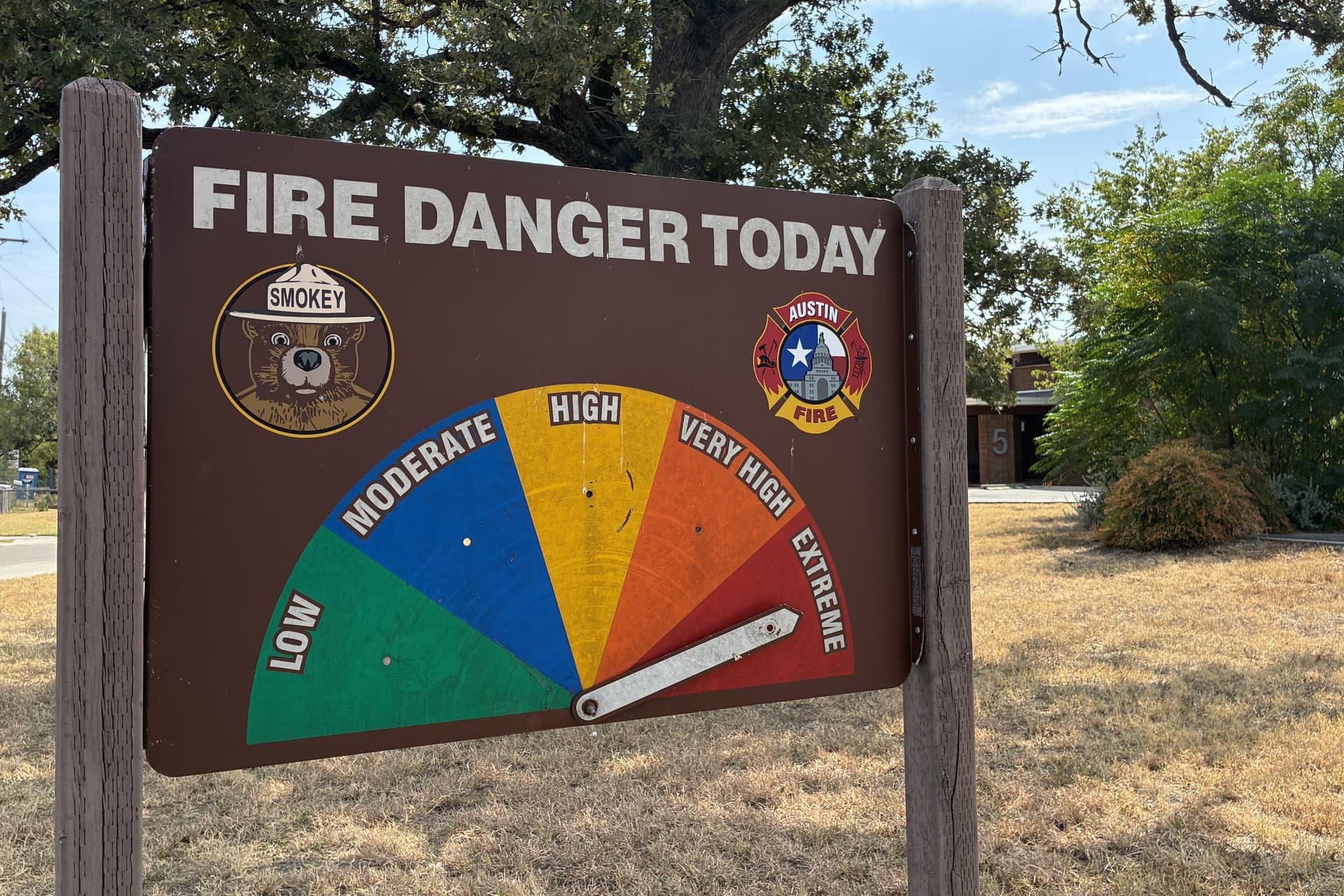
A wildfire risk warning sign stands outside a Travis County fire station as the county remains under a burn ban amid hot, dry conditions this fall. (Jessica McLaren/Community Impact)
Austin has the largest concentration of at-risk homes of any metro area outside California, with more than 100,000 properties and $49.2 billion in reconstruction cost value exposed to wildfire, according to Cotality's 2026 Wildfire Risk Report, released Aug. 12.
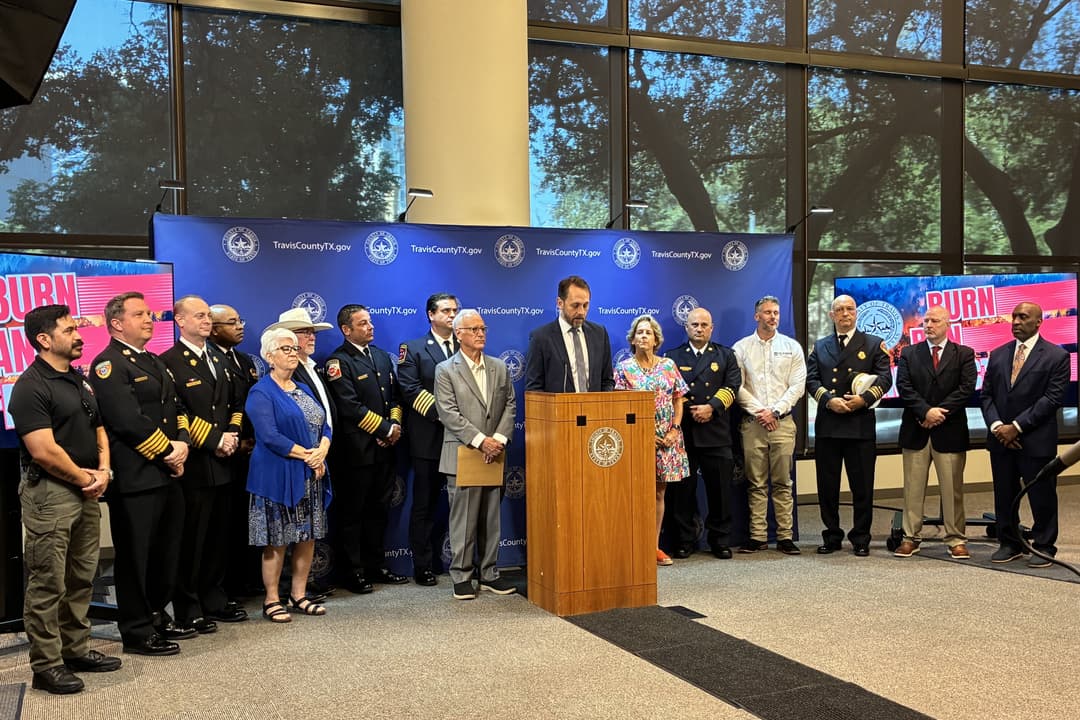
Austin Mayor Kirk Watson cited the report at an Aug. 25 press conference with Travis County Judge Andy Brown, as the county remains under a burn ban with hot, dry conditions keeping wildfire risk elevated heading into fall.
The risk
Wildfire risk isn't limited to heavily wooded, sparsely populated areas, said Jeff Kennedy, assistant chief with the Austin Fire Department, at the conference.
"The reality is that wildfires can and do happen in and around large urban cities," he said, noting embers can travel up to a mile and ignite homes, schools or businesses far from the original fire.
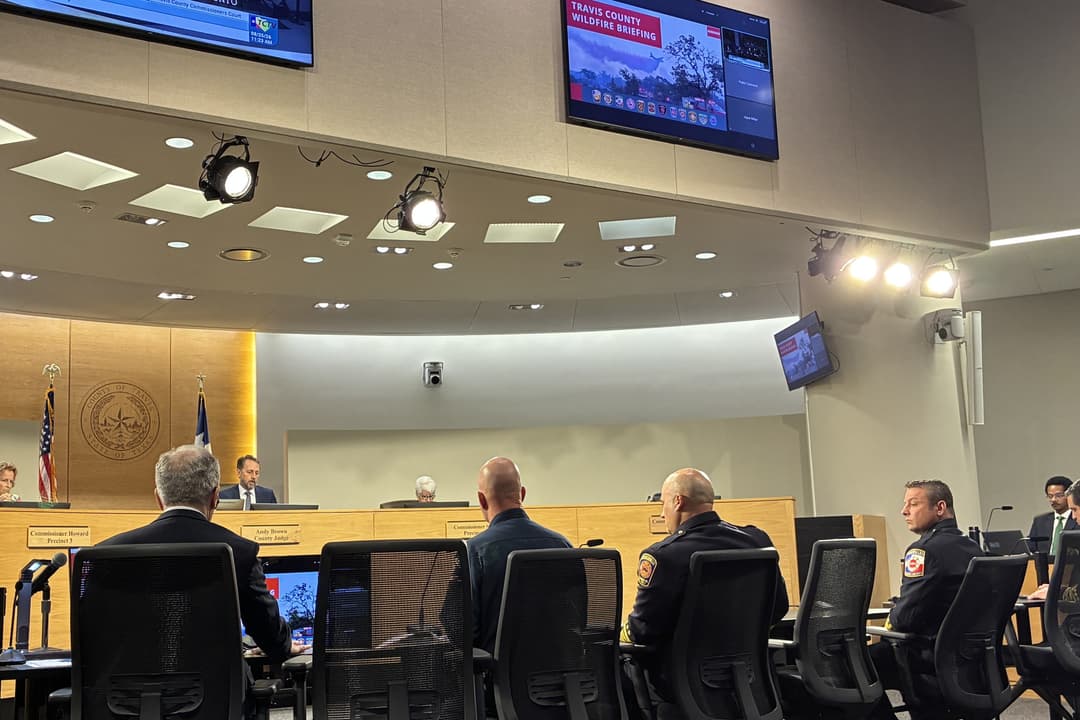
Earlier that day, several Emergency Service District chiefs told Commissioners Court that as of the morning of Aug. 25, about 21% of western Travis County was abnormally dry, 67% was in moderate drought, and 10% of the far eastern county was in severe drought extending into Bastrop County.
ESD fire chiefs briefed the court on wildfire mitigation, preparedness and response ahead of the county's Aug. 25 press conference. (Jessica McLaren/Community Impact)
A live fuel moisture reading taken 18 days earlier measured about 114% of average countywide, though Bailey said current conditions may have pushed that lower since. He said the county expects elevated fire risk to continue into mid-to-late September.
Aug. 26 marked the region's 12th straight day of triple-digit heat, the 29th of the summer, and followed a weekend that hit a record 107 degrees, according to the National Weather Service.
“Hot, dry weather pulls moisture out of grasses and out of vegetation. And when those fuels dry out, a single spark can become a wildfire,” Brown said.
Brown said most wildfires are preventable and asked residents to avoid outdoor burning during the ban, never toss a lit cigarette from a car, check that trailer chains aren't dragging on pavement, avoid parking or driving through dry grass, and take extra care with welding, cutting or grinding.
Travis County Judge Andy Brown and Austin Mayor Kirk Watson addressed wildfire risk and the countywide burn ban during an Aug. 25 press conference. (Jessica McLaren/Community Impact)
"One small mistake can have devastating consequences," he said.
"We can't overstate the critical importance of the warning systems. ... Receiving these messages can literally be the difference between life and death," Watson said, urging residents to register at WarnCentralTexas.org.
The ban
Travis County's burn ban has been in effect since Aug. 11, prohibiting outdoor burning countywide, including open fires, brush burning, bonfires, and outdoor burning of trash, leaves or debris, per the Travis County Fire Marshal's Office. The ban stays in place until lifted by Commissioners Court based on weather conditions and fire risk.
Residents can sign up for free burn ban status text alerts by texting TCBURNBAN to 888777, as stated on the department website.
Did you know?
Travis County uses a network of 13 AI-equipped cameras funded by Austin Energy that detects smoke and alert officials, Bailey told Commissioners Court at the Aug. 25 briefing. In some cases, the system has flagged fires seven to eight minutes before the first 911 call came in, he said.
Why it matters
The county's current wildfire preparedness push traces back to the Sept. 4, 2011 Steiner Ranch Fire, said Robert Abbott of Lake Travis Fire Rescue, at the press conference. This year marks the fire's 15th anniversary.
"We don't celebrate this as a celebration. We don't call it an anniversary," Abbott said, "but we do celebrate the fact that we have learned quite a bit from those events."
He said current conditions closely resemble those leading up to the 2011 fire, and that the county has since improved staffing, training and technology, alongside ongoing community education from homeowners associations, cities and county representatives.
Abbott said preparedness starts at home, with defensible space around a house, and with being ready either to evacuate or to shelter in place, since evacuation isn't always the right call.
"Not every incident dictates an evacuation is required," he said.
Watson added that the 2011 fires prompted lasting regional coordination and led the AFD to train every firefighter in wildfire response, which he said isn't standard elsewhere in the state.
Learn more
The AFD offers free Structured Ignition Zone Evaluations, in which a wildfire advisor walks a property and gives guidance on hardening a home against wildfire, Kennedy said, along with a do-it-yourself version of the tool and a Ready, Set, Go action-plan guide, both on the ATX Wildfire Hub.
Watson also recommended bookmarking austintexas.gov/alerts, enabling Wireless Emergency Alerts in a phone's notification settings, keeping a battery or hand-crank weather radio on hand, and designating an out-of-area contact in case of evacuation.
Additional guidance on hardening homes against wildfire is available at the city’s Ready Central Texas website.
Hays, South Austin nears first-ever 'Stage 4 Emergency’ drought declaration