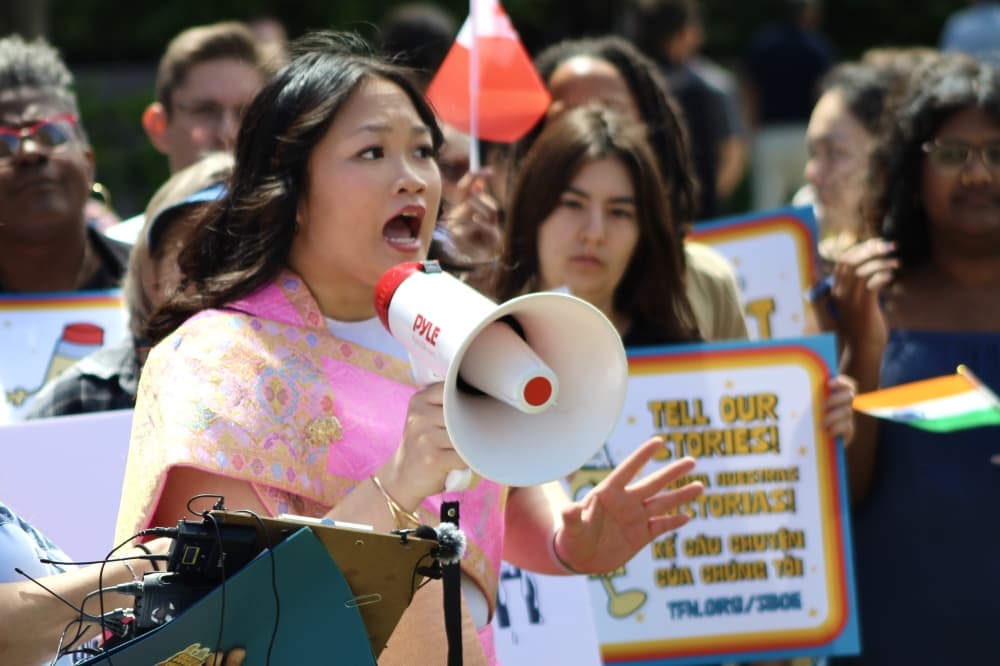
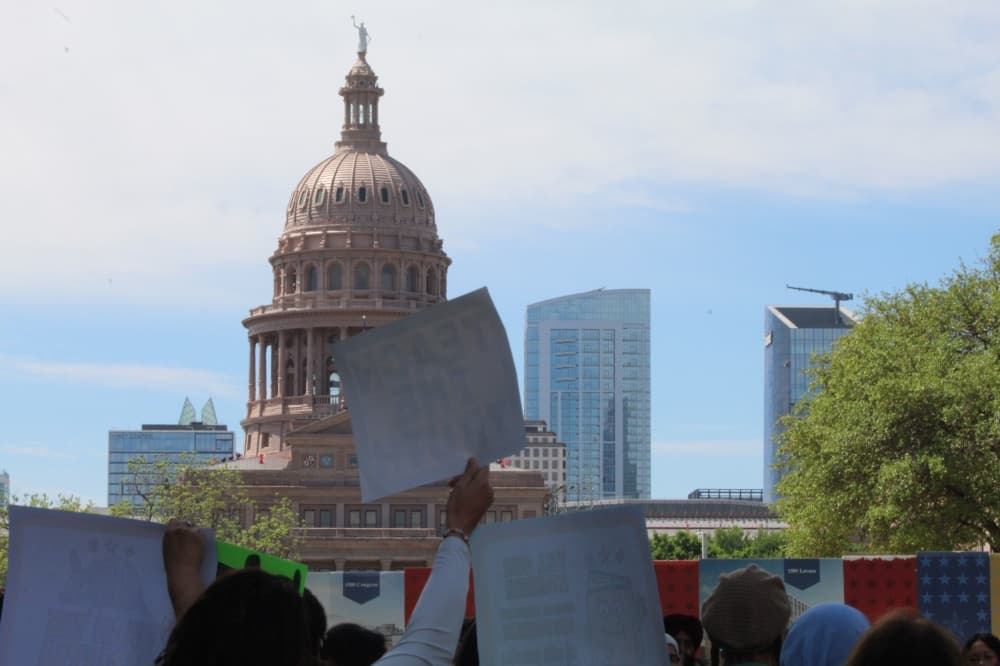
Texans hold a rally on the Capitol Mall as the State Board of Education prepares to debate a plan to rewrite the state's social studies curriculum standards April 7 in Austin. (Hannah Norton/Community Impact)
Texas education officials are currently overhauling the state’s social studies curriculum standards, with policymakers, teachers, parents and historians clashing over how students should be taught about the history of Texas, the United States and the world.
The big picture
The rewrite is part of a periodic review of the Texas Essential Knowledge and Skills, or TEKS, for social studies, which dictate what the state’s 5.5 million public school students should learn at each grade level.
The Texas State Board of Education heard more than seven hours of public testimony on the process April 7. Around 100 people spoke, with a majority expressing concerns about the amount of proposed content or the way the standards were written. Board members said hundreds of Texans also reached out to them about the proposal.
The standards revision comes amid low student proficiency in the state social studies assessment, which eighth grade students take each spring. In 2025, 30% of Texas eighth graders met or exceeded grade-level expectations on the social studies portion of the State of Texas Assessments of Academic Readiness, or STAAR. Social studies scores dropped after the COVID-19 pandemic and have remained relatively stagnant in the past three years, state records show.
Sixty-eight percent of high school students who took the U.S. History STAAR in 2025 met or exceeded expectations, according to state data.
But dozens of parents, students and educators who testified at this week’s SBOE meeting said they thought the proposed curriculum changes would shift Texas backward, not forward, by making students less informed about the world around them. They called the rewrite “politically-driven” and said the proposal focused too heavily on white, Christian historical figures from North America or Europe, overlooking perspectives from people of color and other world regions.
Those who testified in favor of the proposed standards stressed the importance of promoting Texan and American values, arguing that students should have a deeper knowledge of “the ideas that shaped our country” than that of other cultures.
“Ultimately, this is a curriculum for Texas students,” said Donald Frazier, a historian at Schreiner University in Kerrville and one of nine advisers appointed by the SBOE to guide the revision process.
Some testifiers also said there were an “overwhelming number of standards” proposed, which they worried would limit teachers’ ability to provide in-depth instruction and tailor their teaching plans based on students’ needs.
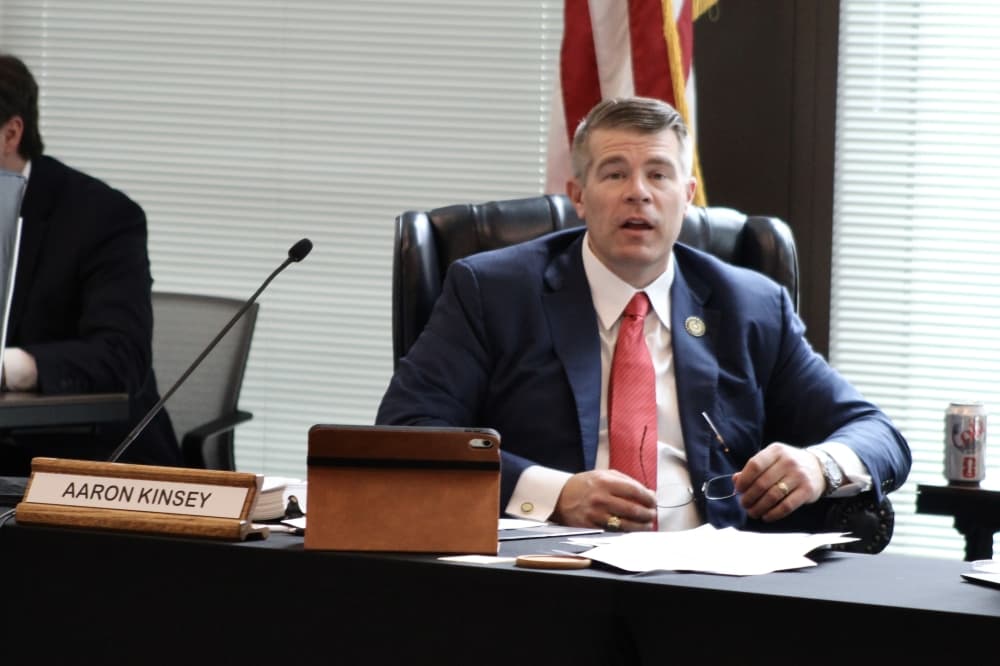
“We've heard two messages from content advisers, testifiers and work group members: We need specificity, and we have too much content,” SBOE Chair Aaron Kinsey, R-Midland, said April 9.
Aaron Kinsey, a Midland Republican who chairs the State Board of Education, sits during an April 7 board meeting. (Hannah Norton/Community Impact)
The process
The State Board of Education reviews standards for all curriculum areas every 15-20 years. Board members began revising the social studies standards in 2022, but records show they voted to delay that work until 2025 amid pressure from some conservative critics.
The board approved a framework for social studies classes, which would prioritize Western civilizations over other subjects, in September and signed off on a 54-page list of topics for the new standards in January. This week, board members began reviewing the full draft curriculum, which is over 100 pages long and contains detailed descriptions of what they expect Texas students to learn throughout their social studies education.
The draft was largely written by the group of content advisers, which includes Frazier and other scholars, professors and consultants. Just one of the nine advisers is a public school educator, which some testifiers said was “concerning.”
The SBOE, which has the final say on the curriculum changes, was taking an initial vote on the plan as of press time and is scheduled to adopt the final standards in June. Once they are approved, the new curriculum requirements will be rolled out to classrooms in 2030.
As written, the plan would reduce the amount of time students spend learning about world history and cultures in favor of more Texas-focused subjects. Democratic board members and other critics of the proposal have pushed to include a more diverse set of perspectives to ensure all students feel represented in the curriculum, while Republican board members and proponents of the changes said students’ education should be centered around American exceptionalism, state history and Christianity.
The GOP-led education board includes 10 Republican members and five Democrats, all of whom are elected by Texas voters.
On April 8 and 9, board members made dozens of amendments to the curriculum standards for each grade level, including changes to when students would learn about certain historical figures or events, adjustments to how teachers would be expected to explain concepts to students, and clarifying edits for phrasing or grammar. The board did not make large-scale changes or additions to the topics students would be expected to learn while in school, despite requests from some students, parents and educators.
Vattanna Kongdara, a sophomore at Elgin Early College High School, speaks during an April 7 rally outside a State Board of Education meeting. Kongdara, who is of Cambodian descent, said she does not frequently feel represented in her history classes and does not want other students to feel the same way. (Hannah Norton/Community Impact)
What they’re saying
Sameeha Rizvi, a recent University of Texas at Austin graduate and policy coordinator for the Texas chapter of the Council on American-Islamic Relations, was one of the first people to testify on the social studies rewrite April 7. She urged the board to include more detailed information about world religions, including Islam.
By focusing on Western civilizations in the social studies standards, “we aren't protecting students—we are denying them the right to see the full picture and decide for themselves how to interpret it,” Rizvi said.
“I love our state story, but I am here because the proposed TEKS don't just limit our history, they wipe it away based on political fear rather than academic fact. ... I ask you all to listen to [those testifying] with clear hearts and open minds to ensure that the next generation of Texans receives an education as honest and as diverse as the state itself,” she added.
Some Texans pushed back on requests to include a broader set of perspectives in the curriculum standards, telling board members they should prioritize lessons on the nation’s founding, Texas history and what it means to be a U.S. citizen.
“The social studies TEKS will influence more than 5 million Texas students and what they will learn,” said Lori Segal, a Southlake parent who said she supported the proposal drafted by the content advisers. “The standards you as a board set forth will shape textbooks and classroom instructions for years to come, and it's essential that they reflect historical accuracy rather than the political pressures or noise from any group or ideology.”
Lisa Badgwell, with the Texas-based National School Chaplain Association, said Texas students should learn about “what unites America and Americans, not divides us.”
“Our classrooms should be places where students can learn accurate accounts of history grounded in documents like the Declaration of Independence, the U.S. Constitution and the Bill of Rights, and the rich history of Texas,” Badgwell said April 7. “It's important that students understand the ideas that shaped our country, including the influence of Western civilization, the contributions of our founding fathers, and the historical role of faith in shaping moral and civic values.”
During an April 7 rally outside the SBOE meeting, Vattanna Kongdara, a sophomore at Elgin Early College High School, said she has struggled in her history classes because she felt “invisible” and did not see herself represented in most lessons. She said that changed when her AP World History class learned about the Cambodian genocide, during which millions of Cambodian citizens were killed in the late 1970s by a communist group called the Khmer Rouge.
“As a grandchild of Lao refugees who fled Southeast Asia during that era, it was the closest I've ever come to learning of my own family's history in school,” Kongdara said. “When we strip diversity from our curriculum, we don't just lose history, we lose a chance to understand each other. Social studies exist to help us become engaged, informed citizens, and that only works when students can see themselves in the curriculum.”
Quinn McCall, a legislative liaison for the Texas Classroom Teachers Association, said there was too much content in the proposed social studies standards.
“A concise set of TEKS permits a teacher to use their professional judgment and knowledge of [their] students to tailor instruction, meet students where they're at and bring them where they need to be by the end of the school year,” he said. “The proposed changes ... would likely deny teachers the opportunity to [decide] the most compelling way to present the standards for their students. All teachers in every subject struggle with keeping their students engaged, and in social studies, peppering them with necessarily brief lessons on a wide range of topics is a sure way to lose their interest.”
Stephanie Bauer, a former teacher from the Rio Grande Valley, echoed McCall’s concerns, adding that overhauling curriculum requirements “without the adequate training and planning time will ... increase [teacher] turnover rates.”
Bauer said the proposed standards also lacked the stories of women and people of color involved in shaping Texas and American history.
“You may not realize that this sends the wrong message about whose stories matter,” she said. “We owe it to our students to create standards that are thoughtful, inclusive and properly supported.”