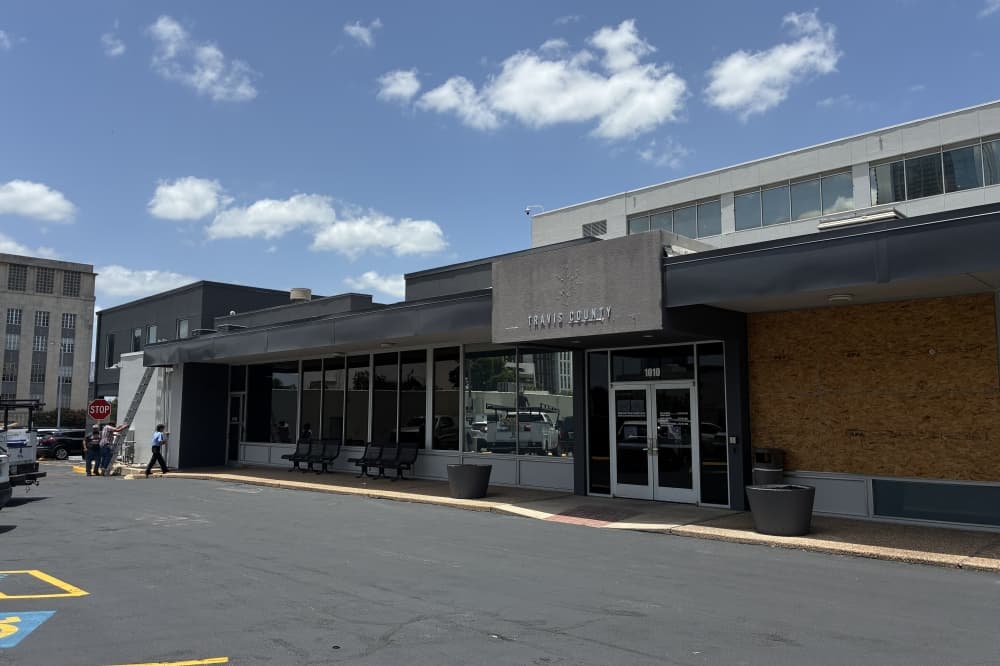
Travis County is struggling to meet its constitutional obligation to provide attorneys to residents who can't afford one, as the private contractor that handles the majority of public defense cases has lost half its attorney roster over the past decade.
"This has been a problem that's years in the making, and it's going to take us some years to get out of it," Geoff Burkhart, the county's Community Legal Services executive, told Commissioners Court on June 24.
Preliminary budget investments addressing the shortage will be available in late July, Budget Director Travis Gatlin said.
How it works
Anyone charged with a felony or jailable misdemeanor who cannot afford an attorney must be provided one by the end of the first business day after a defendant requests counsel, per the Sixth Amendment, Texas constitution and state criminal codes.
Texas is among 14 other states that place the burden of funding public defense primarily on counties, Burkhart told commissioners—a disadvantage he said is compounded by the Texas Property Tax Reform and Transparency Act, or SB 2, which caps the county's ability to raise property tax revenue.
Statewide, counties and the state spend about $400 million annually on public defense. The Texas Indigent Defense Commission, which oversees and partially funds indigent defense, contributes only 10%. Counties shoulder the other 90%, Burkhart said.
Travis County has two options in meeting this obligation as stated on its website: through its Public Defender's Office, which it uses 20% of the time, or via the Capital Area Private Defender Service, a nonprofit that manages a pool of private attorneys.
The joint venture is made up of the Austin Criminal Defense Lawyers' Association, the Austin Bar Association and the Travis County Criminal Judiciary, according to the nonprofit’s website.
The problem
CAPDS's attorney roster has fallen from roughly 250 attorneys a decade ago to about 125 today—significant given that 80% of Travis County's public defense cases flow through the private bar, Burkhart said.
The problem extends statewide: 27% of the criminal defense bar in Texas has been lost over the past decade, he said, but the situation is worse locally.
He cited multiple recruiting challenges, including a shortage of law schools compared to other counties, a lack of public defence pipeline infrastructure and insufficient support in starting one’s own law firm.
The share of law graduates from The University of Texas at Austin going into large firms has climbed from roughly 5%-10% to nearly 50% as the school has risen in national rankings, Burkhart said.
"Those young lawyers are going out to California, New York, Chicago, Houston, Dallas," he said. "They're not sticking around Austin as much."
Travis County's entry-level public defender salary of $85,500 also remains below Harris County's $93,000 starting salary, according to previous Community Impact reporting.
What it means
Chief Public Defender Adeola Ogunkeyede told commissioners the shortage is ultimately a question of quality, stating PDO attorneys averaged 124 cases at 16.8 hours per case each year across a standard work year.
"Nobody would hire that attorney," she said. "You would walk away, whether the case was a trespass or a murder."
The number of aggravated felonies—second-degree and above—filed in Travis County has nearly tripled over seven years, adding complexity to caseloads even as attorney numbers have shrunk, Ogunkeyede said.
She described a recent client satisfaction survey that found PDO clients rated their representation higher than CAPDS clients. Clients consistently reported feeling more likely their attorney spoke up for them, more likely to understand what was happening in court and more likely to feel heard, according to county documents.
CAPDS Executive Director Bradley Hargis attributed part of that gap to support services PDO clients receive, like social workers, case managers and paralegals, that CAPDS clients largely don't. He also noted investigator fees for CAPDS contractors have not increased in more than six years.
Community advocates described the human stakes during public comment.
Hans Maverick of Grassroots Leadership told commissioners about a PDO attorney who took calls outside normal business hours to help a client get released from jail in time for Mother's Day, and another who spent hours reviewing body camera footage frame by frame.
"Every person facing a criminal charge deserves prompt, effective support, not just any attorney," he said.
What’s next
Burkhart presented nine potential solutions ranging from $50,000 to more than $4 million, including expanding the PDO, paying CAPDS attorneys a monthly retainer, raising the attorney fee schedule, creating a pipeline through internships and fellowships, hiring a recruiter and offering loan forgiveness.
Funding options include TIDC grants, the county budget or an SB 2 carve-out that lets counties exceed normal property tax rate caps specifically for public defense, he said.
However, Gatlin told commissioners criminal attorney fees are already projected to run $1.5 million to $2.2 million over budget this year. The preliminary budget will include PDO investments and CAPDS funding adjustments, including a cost-of-living increase and county health insurance, he said.
Both Burkhart and Ogunkeyede said the work will span multiple budget cycles.
"We didn't get into this hole in one year," Ogunkeyede said. "We won't get out of it in one year."