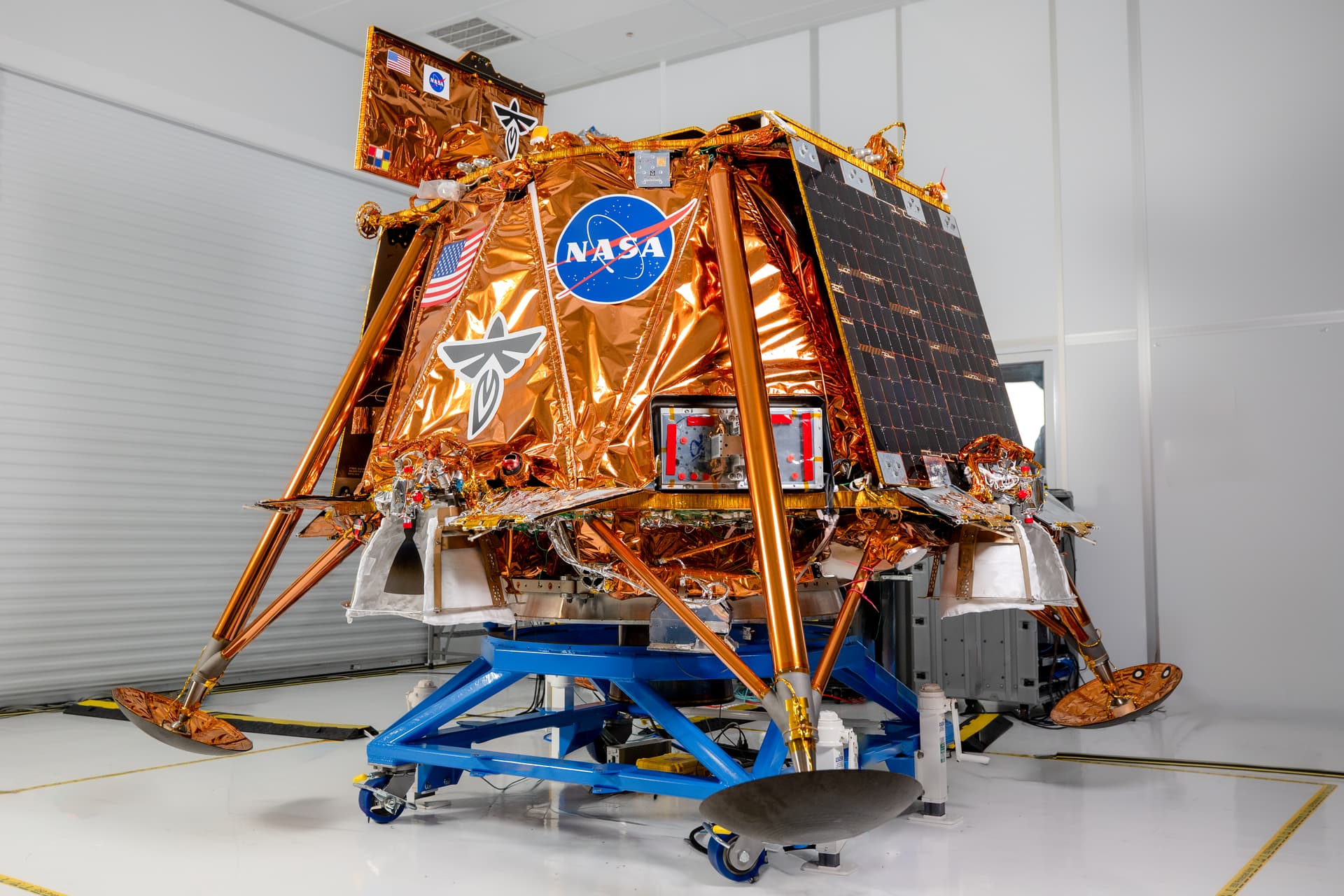
A Firefly Aerospace lunar lander sits in a cleanroom facility at the company’s Cedar Park headquarters. (Courtesy Firefly Aerospace)
Cedar Park’s aerospace and defense industry is growing rapidly, with the largest local aerospace company expanding further and new companies establishing operations in the city.
Cedar Park's most prominent aerospace company is Firefly, which became the first private company to land a robotic vehicle on the Moon.
Firefly recently kicked off an expansion that will allow it to build more spacecraft at one time, which will be key to its increased collaboration with NASA on the agency’s Moon Base program, company leaders said.
At the same time, Firefly founder Tom Markusic is setting out to establish a new company in Cedar Park that aims to break new ground in a different sector of the aerospace industry.
Meanwhile, city leaders have made expanding the aerospace and defense industry a high priority, working with Williamson County leaders to establish the Central Texas Spaceport Development Corporation and granting incentives to attract and retain aerospace and defense companies.
Local officials see the aerospace and defense industry as an important part of the city’s future, providing jobs and tax revenue to pay for public infrastructure and services.
How it started
Cedar Park’s emergence as an aerospace and defense hub began with Firefly Aerospace, which established operations within the city in 2017. Firefly, which produces space technology including launch vehicles, lunar landers and orbital vehicles, became the first commercial company in the world to successfully land on the moon when its Blue Ghost lander touched down in March 2025.
In late 2025, Firefly announced plans to expand its Cedar Park headquarters. In September 2026, Firefly opened a new cleanroom, a facility four times the size of its existing cleanroom that company representatives said will expand its ability to produce moon landers and orbital vehicles.
The completion of the cleanroom is a key step toward increasing access to the moon with “high-cadence” trips in reliable spacecraft, a news release states. That access will support NASA’s Moon Base program, which aims to build a long-term outpost near the moon’s South Pole, as well as the growing commercial economy on the moon, the release states.
What’s next
Firefly founder Tom Markusic is launching a new company, Frontera Space, also to be headquartered in Cedar Park. Frontera’s goal is to build spaceplanes—vehicles that can take off from and land on a runway and do not require single-use rockets to launch—Markusic told Community Impact.
“It’s really hard. If it was easy, someone else would have done it,” Markusic said. “It’s possible from a physics perspective, and what Frontera will prove is that it will be possible from an engineering perspective.”
The factors that led Markusic to base Frontera in Cedar Park were similar to those that led him to bring Firefly to the city in its early days, he said. Those factors include not only the area’s business climate and talent pool, but also the quality of life in Cedar Park.
Dig deeper
A combination of factors, including the growth of Firefly and the efforts of the Cedar Park Economic Development Corporation, has led other aerospace and defense companies to establish operations in Cedar Park, Chief Economic Development Officer Arthur Jackson said.
Those companies range from companies that provide specialized parts or services to other aerospace companies, like Machine Sciences Corporation and Elite Metal Finishing, to weapons manufacturers like Aeon, which designs and produces advanced missiles and the software that guides them—all three of which received incentive deals from the Cedar Park Economic Development Corporation.
There is a great deal of overlap between the aerospace and defense sectors due to their shared use of the same technology, Markusic said.
“This sort of thing we do is what we call dual-use technology. It can be used for friendly exploration … but it can also be used for weapons systems,” Markusic said.
City officials have built a strategy to further expand the industry in the city with a goal of expanding the supply chain for companies like Firefly, Jackson said.
One way in which the city has promoted the growth of the industry is through incentive deals, in which the city gives companies grants, tax breaks or other benefits to encourage them to do business in Cedar Park.
“We’re a one-stop shop,” Jackson said. “You come here, you do your incentives through us, you find your site through us here in the city, you find your utilities … permitting, zoning. You can do all that right here in one building. We don’t outsource any of that.”
Firefly Aerospace's new cleanroom facility will be used to build lunar landers and orbital vehicles, a company representative said. (Courtesy Firefly Aerospace)Courtesy Firefly Aerospace
What they’re saying
The expansion of the aerospace and defense industry in Cedar Park is a point of pride for local leaders, Mayor Jim Penniman-Morin said.
“Our philosophy is that if you have a great quality of life in your community, you're going to attract great talent and then great companies are going to follow them,” Penniman-Morin said. “So by being the most comfortable place to live in Texas, maybe the country, you have people who are willing to focus on and tackle some of the hardest problems in the solar system.”
The industry’s growth brings benefits to Cedar Park residents, including well-paying jobs and tax revenue that the city can use to enhance its services, Jackson said.
Local leaders are also proud to support companies that work with the U.S. military, Penniman-Morin said.
“With a majority-veteran city council … I think we feel a special connection to our soldiers, sailors and airmen—knowing that we’re helping build products that are going to help keep them safer and make them more effective in their jobs makes us feel good,” he said.
Going forward
In 2025, the city and Williamson County launched a partnership to establish the Central Texas Spaceport Development Corporation, which aims to promote the local space industry in part through funding for spacecraft-related infrastructure and development.
The long-term goal of that partnership is to build a campus in Cedar Park that will serve as a hub for the industry, Jackson said.
That campus will include a Sensitive Compartmented Information Facility, or SCIF, which is a secure room or building for handling sensitive information that conforms to standards set out by the federal government’s National Counterintelligence and Security Center. That means defense contractors could handle information and communications related to sensitive national security matters at the spaceport, Jackson said.
Talks are currently underway with developers regarding sites in Cedar Park for the spaceport and construction could begin as early as the first quarter of 2027, Jackson said.