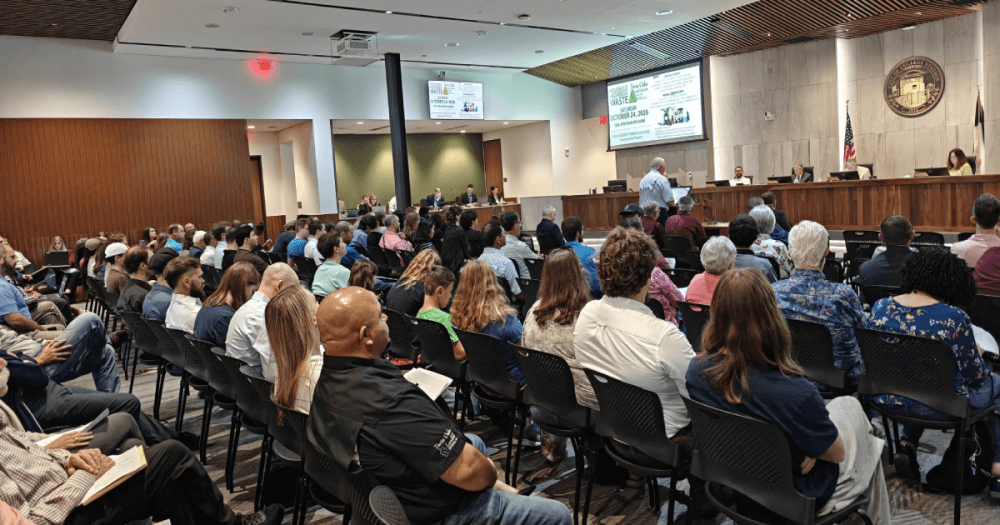
College Station residents gathered at City Hall July 23 to speak out against the use of Flock Automatic License Plate Recognition, or ALPR, cameras at the City Council meeting. (Rhett Brady/Community Impact)
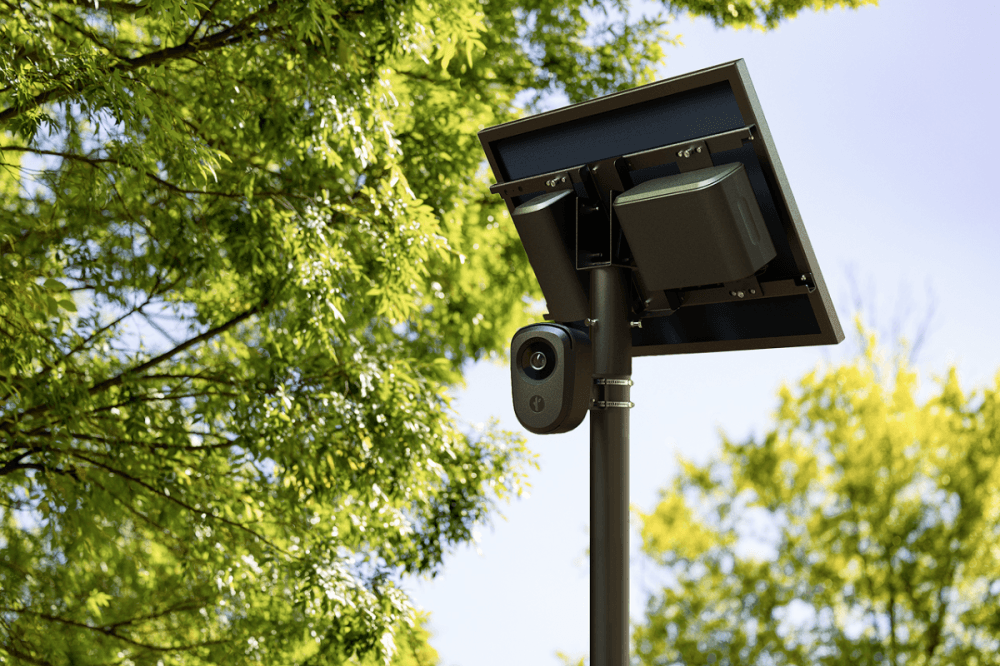
College Station residents debated the city’s use of Flock Safety's Automatic License Plate Recognition, or ALPR, cameras during a July 23 City Council meeting, with speakers raising concerns about privacy and data security while others pointed to the technology’s role in solving crimes and finding missing people.
What you need to know
Flock ALPR cameras have been in College Station since 2025, and the College Station Police Department was approved for a grant application in April that helped continue funding for the camera system. The technology has been criticized by privacy advocates and local residents over data security, privacy and potential misuse. Several Texas cities have reportedly canceled contracts with Flock Safety, according to the Electronic Frontier Foundation.
CSPD Chief Billy Couch presented to the council regarding the cameras, what they do, how they’ve helped police officers and statistics on crime reduction since the cameras' installation. Couch was joined by Ian Leslie, an account executive and public affairs representative for Flock, to answer questions from council members.
Couch clarified various concerns of residents at the beginning of his presentation. He said the cameras do not:
Use facial recognition
Use vehicle occupant identification
Use audio recording
Share police information with Flock
Couch also brought up various cases the cameras have helped solve or brought to light. The cameras have been attributed to helping find missing persons and stolen vehicles, and find suspects in assaults. He also clarified that for investigations, the cameras can only be used by those who have been approved to use the system, with everything being tracked in case of malicious intent.
“Two-person authentication is required to enter the system,” Couch said. “It is not an untrained individual who is borrowing the system. They have to input their data, which includes the identification of the particular person who is running that search.”
The following statistics were provided by the College Station Police Department during the July 23 presentation and reflect activity within that time period unless otherwise noted:
Vehicle scans in the last 30 days: 763,148 unique plates
Average daily reads: 25,438
Total Flock searches by CSPD: 277
Real time alerts Jan. 1-July 17:
Warrants identified: 293
Stolen vehicles: 67
Missing persons: 9
Those against
Residents signed up to speak at the meeting, with some in favor of the use while others opposed.
John Hamilton, a resident and member of the anti-Flock camera organization DeFlock BCS, said he was insulted when the CEO of Flock referred to those who oppose the cameras as domestic "terrorists." He said he was also concerned about the safety of residents' data and the security of the cameras.
“Flock can access the data at any point. More importantly, search data and live maps could not appear on Google search results if it was end-to-end encrypted,” Hamilton said. “They lie to the public and city councils as a marketing tool.”
Resident Ivan Svrcek raised concerns about the potential misuse of information collected through license plate technology. He referenced previous data breaches involving other companies as an example of the risks which could arise if sensitive information is improperly accessed.
“We have received letters saying that our Social Security number has been compromised, that data is now [open-source intelligence],” Svrcek said. “They have calls and references in their system with references to dark data.”
Duke Blaney, a Texas A&M University student, said the issue of Flock cameras has brought everyone together regardless of ideology or beliefs.
“Your job as city leaders and as former students is to preserve the liberties so that the Aggies of today can study in peace and prepare the next generation to be leaders and innovators,” Blaney said. “You’re supporting something so universally hated that it has united the far-left, far-right, moderates, independents and non-citizen residents. No one wants this.”
Those in favor
Chuck Fleeger, executive director for the Amber Alert Network of the Brazos Valley, said the cameras have been used to help find missing persons, and getting rid of them would put more of the population at risk of never coming home.
“Having the license plate available immediately opens this technology to contribute to ascertaining the location and safe recovery of missing children and adults,” Fleeger said. “To restrict or disallow access to this technology would, without a doubt, jeopardize efforts to safely locate the missing from among us and could have disastrous, unintended consequences.”
Christopher Morgan, vice president of the College Station Police Officers Association, said the association expressed support for the use of the cameras for public safety.
“These cameras are not about surveillance, nor are they the forfeiture of civil liberties. They are about giving law enforcement an all-important and effective tool to help solve crimes and give back to communities,” Morgan said. “Flock cameras are exactly that. They are a tool and a resource to be leveraged.”
Residents gathered at the City Council meeting to talk about their concerns with Flock cameras. (Rhett Brady/Community Impact)
What the council is saying
City Council questioned Couch and Leslie about the safety of the cameras and the artificial intelligence technology Flock uses. Council member Melissa McIlhaney said AI is moving very fast with technological advancements and was concerned about its utilization.
“Are we notified when things change, and new opportunities are available, or new risks are identified?” McIlhaney questioned. “The thing I’m worried about is the next level, what’s coming down the pipe.”
McIlhaney also questioned what a prosecutable offense was for the possible abuse of the Flock camera system. Brazos County District Attorney Jarvis Parsons said officers would face numerous offenses for misuse and breach of computer security, along with discussing the benefits of Flock for criminal justice.
“I have a very small slice of this pie. Does it have a beneficial criminal justice aspect? Yes, it does,” Parsons said. “Does it also help to exonerate people who are innocent of crimes? It also does that, too, because if someone is making an accusation that this is the vehicle, we can see if that person is telling the truth or is mistaken.”
Council member Bob Yancy said he was thankful for the people who showed up to the meeting and for their advocacy, even if no action can be taken.
“It’s our job to watch them, and we are,” Yancy said. “This thing could get solved for us by the courts because there are active cases everywhere and we may lose the ability to contract with these guys. Watch carefully, and I’m good where we are right now.”
Council member Mark Smith, who brought up the Transparent and Responsible Use of Surveillance Technology Act legislation the city of Austin recently passed, said the council should look into a similar idea and told a personal story of how he felt unsafe with his Amazon Alexa.
“This is the world we live in. I have a phone, but I got rid of the Alexa in my house because she started asking me to repeat things because she didn’t understand what I had said,” Smith said. “I wiped it clean and donated it to Goodwill. I hope somebody enjoys it.”
Mayor John Nichols said he was happy with the turnout and having Leslie there to answer questions, but wanted to remind the public the city has policies when it comes to safety and data retention.
“If, in fact, there is abuse, we have policies for everything we do,” Nichols said. “It isn’t just ALPR. It’s a lot of other things police officers are required to do as part of their job. They have to be overseen by people who have guidance on the policies that are put in place.”
What’s next
Nichols said the council could not take action on the issue during the July 23 meeting but expects Flock and ALPR technology to return for future discussion. He also thanked residents for attending and voicing their concerns.