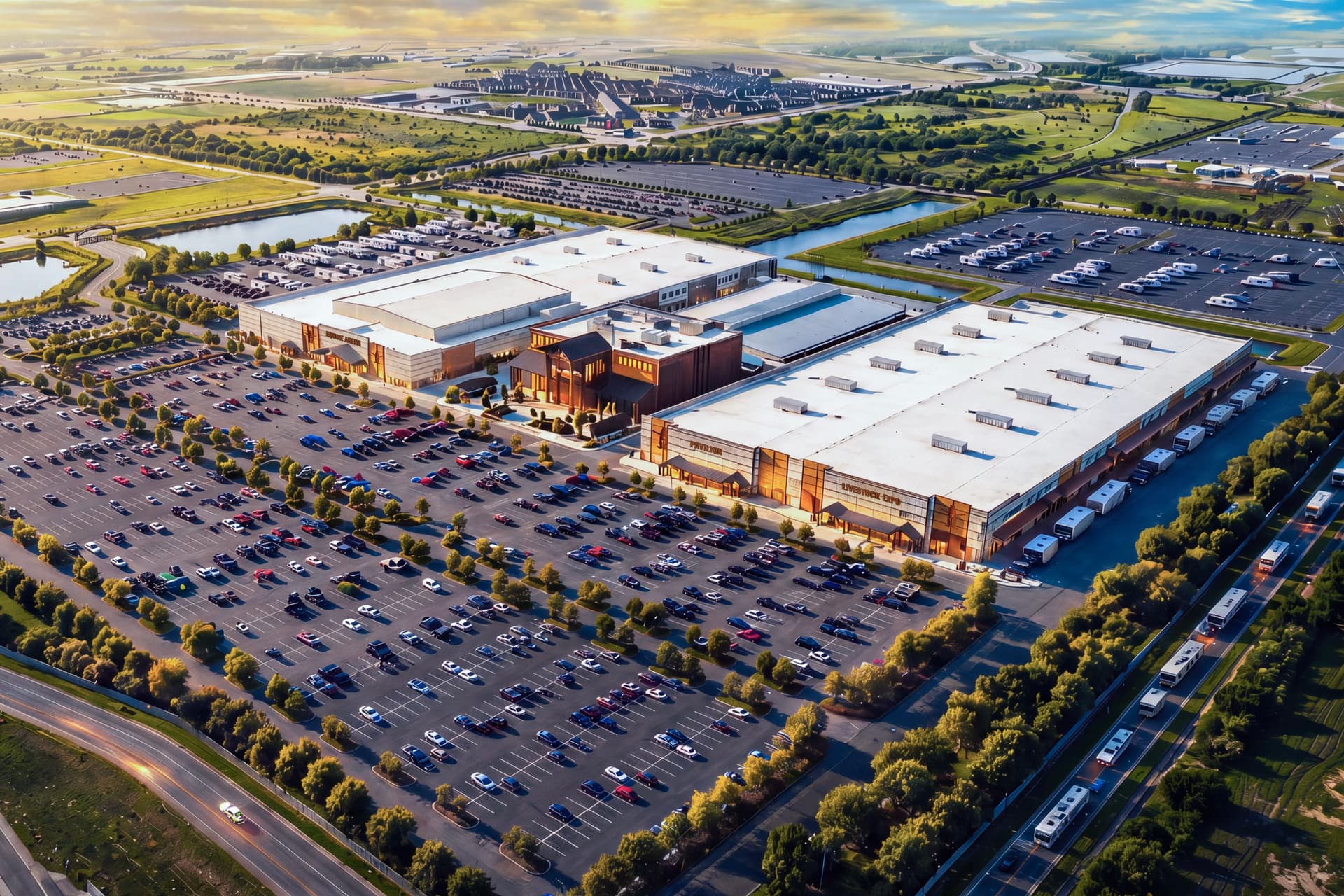
The Farm represents the largest single facilities investment in the Houston Livestock Show and Rodeo's more than 90-year history, according to a Sept. 17 news release. (Rendering courtesy HLSR)
The Houston Livestock Show and Rodeo is expanding its footprint roughly three miles south of its home at Reliant Park.
On Sept. 17, HLSR officials broke ground on a historic 1-million-square-foot agricultural complex known as The Farm, which stands for “Furthering our Agriculture and Ranching Mission.”
The $300 million project aims to increase the organization’s capacity to serve Texas youth, exhibitors and spectators year-round by bringing all horse shows, youth programming, agricultural education and community events under one roof.
Peter McStravick, HLSR’S Chief Strategic Planning Officer, emphasized that this expansion will supplement the Rodeo’s existing operations by creating more space and more engagement opportunities beyond the regular season. It will not, however, relocate the Rodeo or any of its major offerings from Reliant Park.
Assessing the need
Before The Farm’s inception, McStravick said HLSR leadership had known about “major condition issues” with Reliant Arena for some time that affected the enjoyability of activities hosted there.
This aligned with a facilities condition assessment conducted by the Harris County Sports & Convention Corporation in 2019, which concluded that the arena had exceeded its useful lifespan and should be demolished and replaced by 2026, McStravick explained.
Prior coverage from Community Impact in August 2025 also indicated that Reliant Park as a whole was in need of $2 billion worth of repairs, not including the $500 million already in deferred maintenance.
Therefore, when it came time to develop The Farm’s layout, McStravick said that improving mobility, connectivity and quality of accommodations through more efficient site access points was the main priority for HLSR leadership.
“Right now at Reliant Park, it’s very congested and crowded,” McStravick said. “But [at The Farm], we’re going to have so much more space and opportunity for people to really enjoy the moment versus having to fight traffic.”
The four-quadrant complex is slated to feature enhanced agriculture and equine facilities, dedicated event spaces and interactive program areas and increased parking around its property along Hwy. 288. Additional features include:
1,100 livestock pens
4,000 arena bowl seats
2,000 pavilion seats
Approximately 140,000 square-foot event and education center
The Equine Arena is among the intentionally designed spaces that will comprise The Farm's equine building, HLSR officials confirmed.Rendering courtesy Houston Livestock Show & Rodeo
While the Houston Livestock Show and Rodeo's main attractions will remain at Reliant Park, a handful of competitions and events will transition to the new facility to optimize space and improve the guests' experience, officials said. Events and activities that will be moved to the Farm include:
All Horse Show Competitions
Non-haltered cattle sales, including the All Breeds Bull and Commercial Female Sale and the Junior Commercial Steer Auction
Various Livestock Shows, including the Junior Market Lamb; Goat, Poultry and Barrow Shows; Open and Junior Breeding Sheep; Junior Breeding Gilt Shows; and Rabbit, Llama and Alpaca and Poultry Shows
On the other hand, these activities will remain at Reliant Park:
Junior Market Auctions and Registered Cattle Sales
Final Judging and Champion Drives
Fan-favorite traditions, such as the RodeoHouston Super Series Competition, Star Stage concerts, carnival, Champion Wine Garden, Mutton Bustin’, pig races and more
The local impact
Part of the project’s agricultural scope involves splitting 900,000 square feet of air-conditioned space between The Farm’s livestock wing and equine wing, HLSR Chief Mission Officer Julie Bass said.
The climate-controlled space will include 800 horse stalls, 60 wash bays and more than 200 recreational vehicle hookups to streamline processes related to animal handling throughout the complex.
For Bass, however, the most exciting prospect presented by The Farm is the ability to use its amenities year-round for activities outside of competitions.
By eliminating the time constraints of the annual three-week-long Rodeo, Bass said that HLSR officials will have greater flexibility to create in-depth educational demonstrations for patrons that showcase the work associated with raising an animal. This will, in turn, make them better equipped to serve local schools across Greater Houston, she said.
What the experts say
Educationally, the HLSR distributes millions in scholarships, grants, auction premiums and certificates every year to hundreds of Texas youth, according to the nonprofit’s website.
Bass told Community Impact that more than 30,000 students participate in the HLSR annually.
Among its current scholars, Texas 4-H scholars alone represent 52 counties, while scholars from the National FFA Organization hail from 57 different chapters.
For the past decade, Vanessa Brossman-Collier has served as the advisor for the Bellaire FFA Chapter based at Bellaire High School.
She explained that her organization helps students turn agricultural education into a practical pathway for growth through instruction, hands-on experience, leadership and service.
We want to be a destination for equine programming and competition throughout the state, and even beyond that where people think of this as a state-of-the-art facility where they can come and showcase their animal." —Julie Bass, Houston Livestock Show and Rodeo Chief Mission Officer
She believes participation in HLSR teaches disciplined preparation, consistency, teamwork, ethical animal care, recordkeeping and professionalism on a larger scale.
By the numbers
Brossman-Collier hopes The Farm strengthens the financial pipeline that supports FFA students and has a ripple effect on their ability to obtain scholarships in the future.
“By more students gaining meaningful agricultural experiences, more donors seeing their impact year-round and more FFA members receiving support for college, technical training, or agricultural careers,” Brossman-Collier said.
The big picture
While it was not specified how many jobs The Farm will create for the city of Houston, upon completion, McStravick anticipates it will employ many people year-round to meet the needs of the vast facility.
The project will be privately funded, mostly by the HLSR. As such, it will place no financial burden on the wallets of Harris County taxpayers, according to The Farm's official website. This commitment by the organization highlights one of the most significant private investments in Texas agriculture to date, project officials said.
“[The Farm]’s a place where young people will learn, compete and see a future for themselves,” Harris County Commissioner Rodney Ellis said in a statement. “I am proud to support this investment, and thankful that the Rodeo chose to build it [in Precinct One].”
Looking ahead
With construction of The Farm’s livestock building now underway, HLSR officials estimate the entire project to be completed by March 2029 in time for that year’s Rodeo season, per the project’s website.
McStravick said the next milestone in the project’s timeline involves completing the design process for all four quadrants of the complex. HLSR leadership did not provide specifics on when the process is expected to wrap up at the time of publishing.
More Development news from Bellaire - Meyerland - West University