Budget season for Hays CISD will start with the announcement of cuts on March 30, following the voter rejection of a higher property tax rate in November.
Since 2021, HCISD has been pulling from the fund balance, which serves as the district’s savings account, to maintain operations while waiting for increased state funding. In June, the state approved approximately $8 billion in public school allocations, but district officials said it’s not enough.
With rising costs and stagnant funding, officials must now consider budget cuts.
“There’s not anything we can cut that isn’t going to hurt,” HCISD Chief Communication Officer Tim Savoy said. “But I know that the focus is going to be on what cuts are the least disruptive to the very basic product we deliver: education. But they’re all going to hurt.”
By the numbers
The Texas Education Agency provides a basic allotment of $6,215 per student to public school districts. This is a $55 increase—provided by House Bill 2 in June—from the previous rate of $6,160, which was set in 2019.
Basic allotment is calculated on attendance rather than enrollment, so HCISD budgets with a 93% attendance rate. Savoy said the state would need to provide approximately $7,000 per student to compensate for inflation.
While education state funding has maintained a similar rate, the U.S. dollar has less spending power. According to the U.S. Bureau of Labor Statistics’ CPI Inflation Calculator, one dollar today has the same buying power as 77 cents in 2019.
“We still have to buy the same goods and services that we always have ... yet utility costs have gone up, fuel has gone up, everything,” Superintendent Eric Wright said. “Just like your own personal budget. The same holds true for the school district.”
To maintain operations and services amid inflation and rising costs, HCISD has been pulling from the fund balance since 2021, which has diminished to an estimated $20 million. This is roughly $47 million lower than suggested by the TEA, according to district documents.
The board of trustees called for a Tax Ratification Election in August to raise the property tax rate and increase district funding. While the proposed rate of $1.2746 per $100 of valuation was a 12 cent increase, it remained lower than fiscal year 2022-23 rate of $1.3423. The proposition ultimately failed at the polls in November, and the current tax rate is the same as fiscal year 2024-25.
Looking ahead, the district intends to pass a surplus budget to start rebuilding the fund balance, which should be approximately $67 million to cover payroll and bills during months when the district is waiting for taxes and state funding payments to come in.
While Wright said that they cannot yet announce specific cuts, the district aims to absorb as many as possible through attrition and turnover—meaning vacant positions will likely not be replaced.
Previously released documents indicated officials would consider cutting staff, increasing class sizes, cutting special programming and increasing fees in order to create a surplus budget.
Breaking it down
In May, six months before rejecting a proposition to raise the tax rate, voters passed the largest bond in the district’s history—at almost $1 billion. Savoy said he doesn’t think the TRE failure reflects the community’s support for public schools.
While bonds provide funding for new facilities and materials, that money cannot be used to maintain and operate those facilities once they are open. Payment for teachers, staff and operational costs comes from the maintenance and operations portion of the tax rate and state funding.
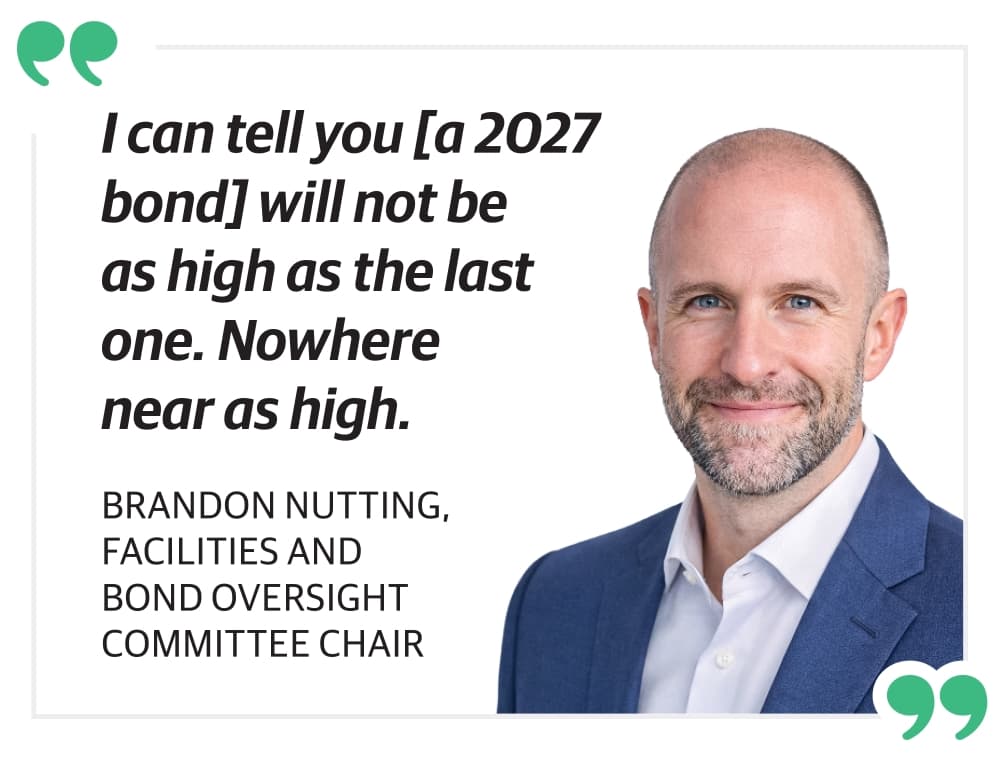
Brandon Nutting, HCISD Facilities and Bond Oversight Committee chair, said due to continued growth, the district anticipates presenting a bond package to voters every other year. By late April, the committee will begin reviewing demographic data and projects left off the 2025 package to prepare a 2027 bond package.
“The number one issue is going to be Middle School No. 7,” Nutting said.
On Jan. 26, district officials approved a zoning map to address capacity issues at several campuses. However, Savoy said the long-term solution for overcrowding at McCormick Middle School would need to come in the form of a new middle school. District-wide rezoning will likely begin in the fall of 2029, around when Comprehensive High School No. 4 will open, according to Nutting.
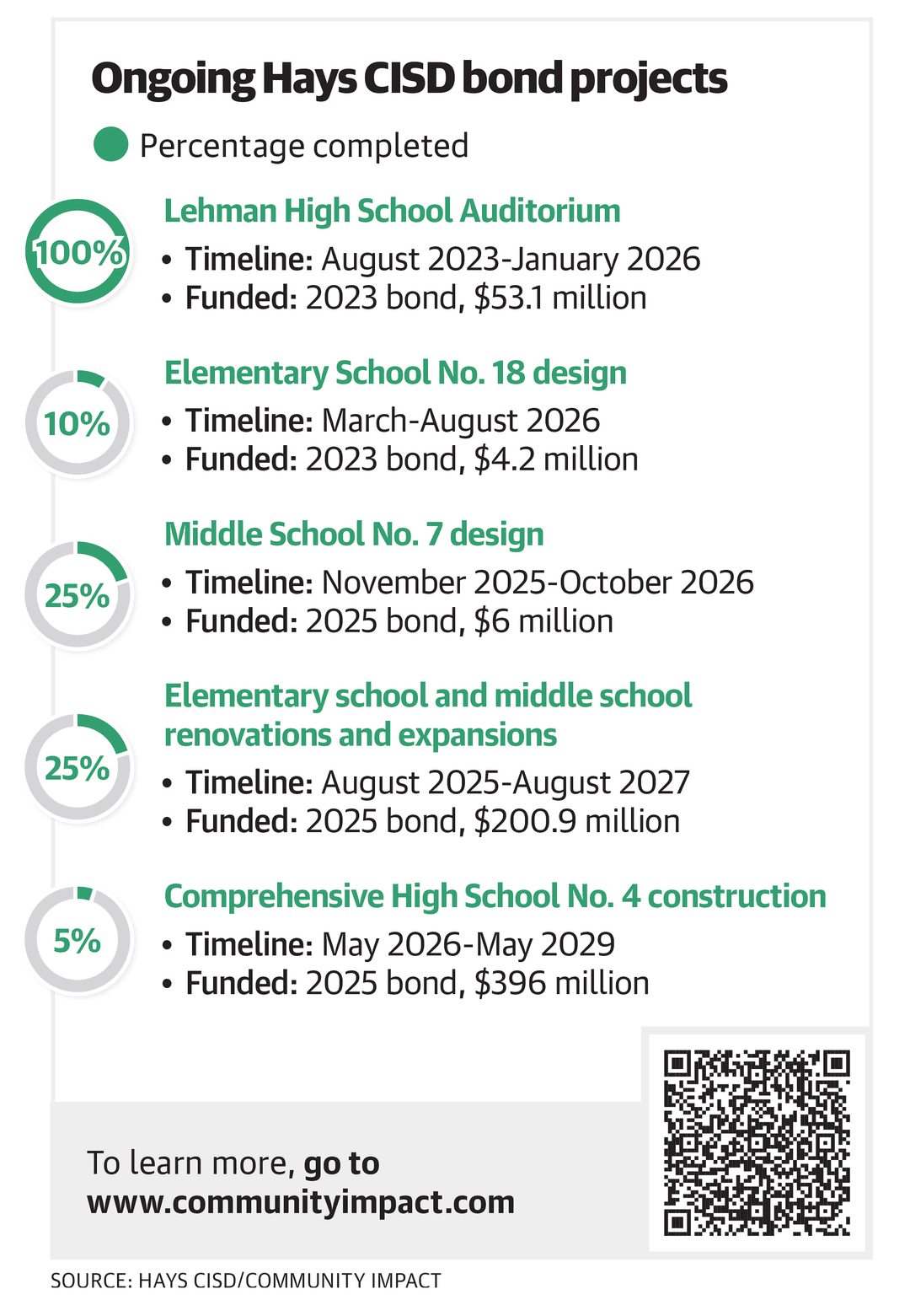
The 2025 bond provided funding for projects such as Comprehensive High School No. 4, elementary and middle school renovations and expansions, and the design for a new middle school. Hays CISD has numerous ongoing bond-funded projects.
Measuring the impact
Rapid growth in the area has also presented challenges for the district. According to the United States Census Bureau, the population of Hays County grew from 157,000 in 2010 to 241,000 in 2020, then to an estimated 292,000 in 2024.
Wright said since he started in 2018, the area has added roughly 3,500 new homes and 600-1,000 students per year. If growth rates continue, he said the district will serve approximately 80,000 students by 2067.
“Trying to open up schools and take care of our growth with less money has been really, really challenging,” Wright said.
As of 2023-24, the ratio of teachers to students is 1:15.5, according to the most recent HCISD federal report card. This ratio may increase if teaching positions are lost to attrition or budget cuts in the coming months. Budget cuts will also make it difficult to offer competitive rates for teachers, something that officials say they want to be able to do.
Looking ahead
Wright said that over the next five years, he would like to continue efforts to keep up with growth and to provide more internship and externship opportunities for students—partnering with more local businesses to learn which soft skills are most valuable.
“To me, the school should be a reflection of the community,” Wright said.