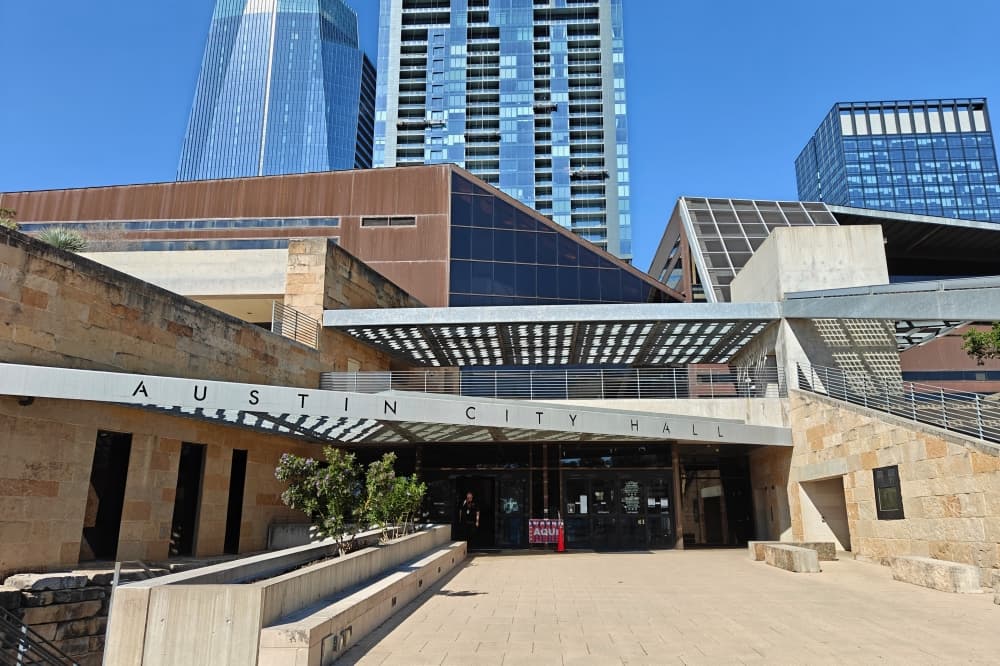
Austin officials authorized continuous third-party audits of citywide operations and services, a process partly prompted by the outcome of last year's Proposition Q tax rate election.
Mayor Kirk Watson, who's promoted a civic performance review since election night in November, said City Council's unanimous vote for the concept Feb. 26 will make Austin better.
“It’s a major step in an effectiveness, efficiency and innovation agenda for our city," Watson said. "We don’t know of any other city that’s doing it this way where it’s a systemic, citywide, ongoing, independent efficiency assessment or audit. And never before has Austin done this."
The gist
The city auditor's office is now tasked with starting up the ongoing "comprehensive efficiency assessment" program. City Auditor Jason Hadavi will oversee the initiative, to be handled independently by an external consultant.
The audit will analyze Austin's overall city government organization, public programs and services, third-party contracting practices, and financial comparisons to peer cities. Public progress reports will be made at least semiannually, and all project recommendations, results and other information will be posted online.
As improvements are suggested throughout the review, city management and department leaders will have to detail how those changes will be made—or why they disagree. City employees will also be able to share feedback on possible improvements along the way.
Given the broad scope of a citywide assessment, Hadavi previously said a multiyear process would likely yield the best results. The work is set to repeat indefinitely into the future, although the council-approved ordinance calls for at least three-year gaps between each full audit cycle.
The cost
After council's vote, Hadavi said his office would quickly start the procurement process for a firm to lead the assessment. A contractor could be approved after this summer's budgeting process and before the current fiscal year 2025-26 ends in September.
The audit doesn't have a set price tag, and Hadavi previously said early cost estimates likely wouldn't be released to keep bidding competitive. Initial work can be covered through his office's current budget, he said, and more funding would be dedicated over the coming years as the project ramps up.
What they're saying
The push for an audit has been framed around voters' clear stance against Proposition Q. Several officials have pointed to the tax election's rejection by a nearly 2-to-1 margin as a referendum on City Hall's spending, transparency and overall fiscal discipline.
Watson said the audit stems from a desire to "safeguard public confidence," and council member Krista Laine said the plan responds to residents' expectations for responsible spending.
"This ordinance ensures that an organization-wide efficiency assessments begins without delay, is completed with full transparency and occurs on a predictable schedule," she said.
The program was also framed as a needed step to cut or streamline city obligations in the face of tighter financial conditions. Council member Marc Duchen likened the audit to a "controlled burn" to avoid a more catastrophic fire down the road.
“I’m worried that a more severe downturn could lead to a lot of painful decisions. It could lead to huge cuts to social services, it could lead to fewer police and firefighters on duty, it could lead to park closures and public layoffs," he said. "I hope that doesn’t happen, but my sense is that it would be wise to prepare for that.”
The other side
The new assessment program's creation coincides with a similar effort outside City Hall.
The Save Austin Now political action committee, which contributed to anti-Proposition Q efforts last fall, is now running a petition campaign for a ballot measure to mandate third-party city auditing. Its petition calls to enshrine that requirement in Austin's charter.
City officials can revise the new ordinance with supermajority support—at least nine votes from the 11-member council dais. If voters were to approve SAN's measure, another election would be needed for any edits to the charter.
That proposal would result in some comparable outcomes as the council-adopted program. But officials also raised concerns with provisions such as audits paying for themselves through budget savings, which Watson called a potential conflict of interest for a contractor tasked with making cuts. He said council's adopted ordinance avoids "problematic parts" of SAN's effort.
PAC co-chair Matt Mackowiak credited the ordinance's passage as long overdue Feb. 26, but leveled several criticisms at its approach versus his group's, such as ongoing city oversight and the ability for council-led revisions.
Attorney Bill Aleshire, who drafted the charter amendment, said city leaders can back out of their ordinance at any time, while the charter's "people-required audit" would be more firmly in place. He also noted Austinites can sue to ensure charter provisions are met, but can't enforce an ordinance.
"That unlawful unconstitutional; supermajority vote requirement is just a political fig leaf to cover the fact that only a Charter or state law can force the City Council to have comprehensive, Independent audit," Aleshire said in an email.
It remains to be seen if SAN will earn enough support to prompt an election. The group originally targeted this May's ballot, but its petition wasn't completed and submitted before the February filing deadline. Mackowiak said the charter measure will make it to the November ballot.