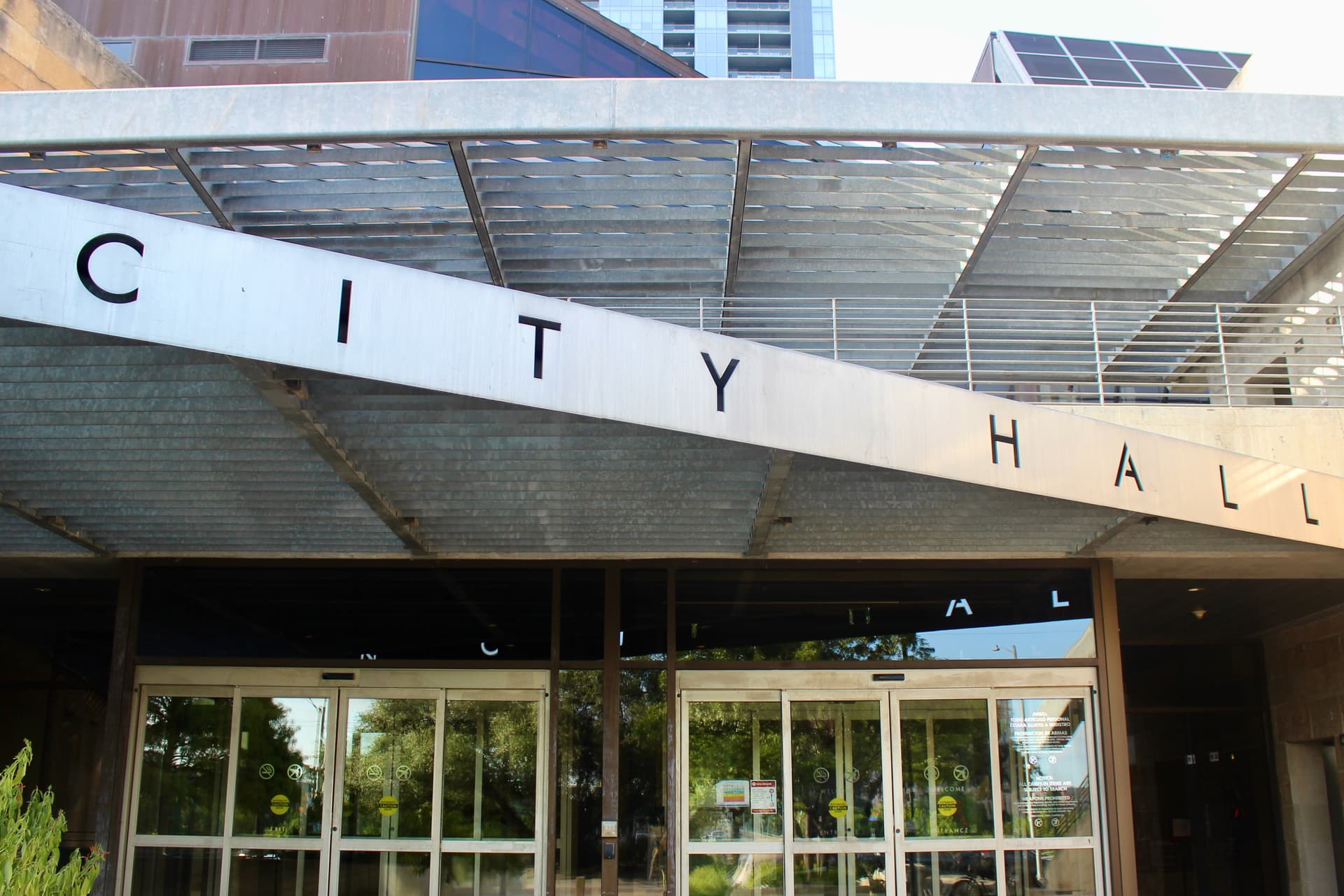
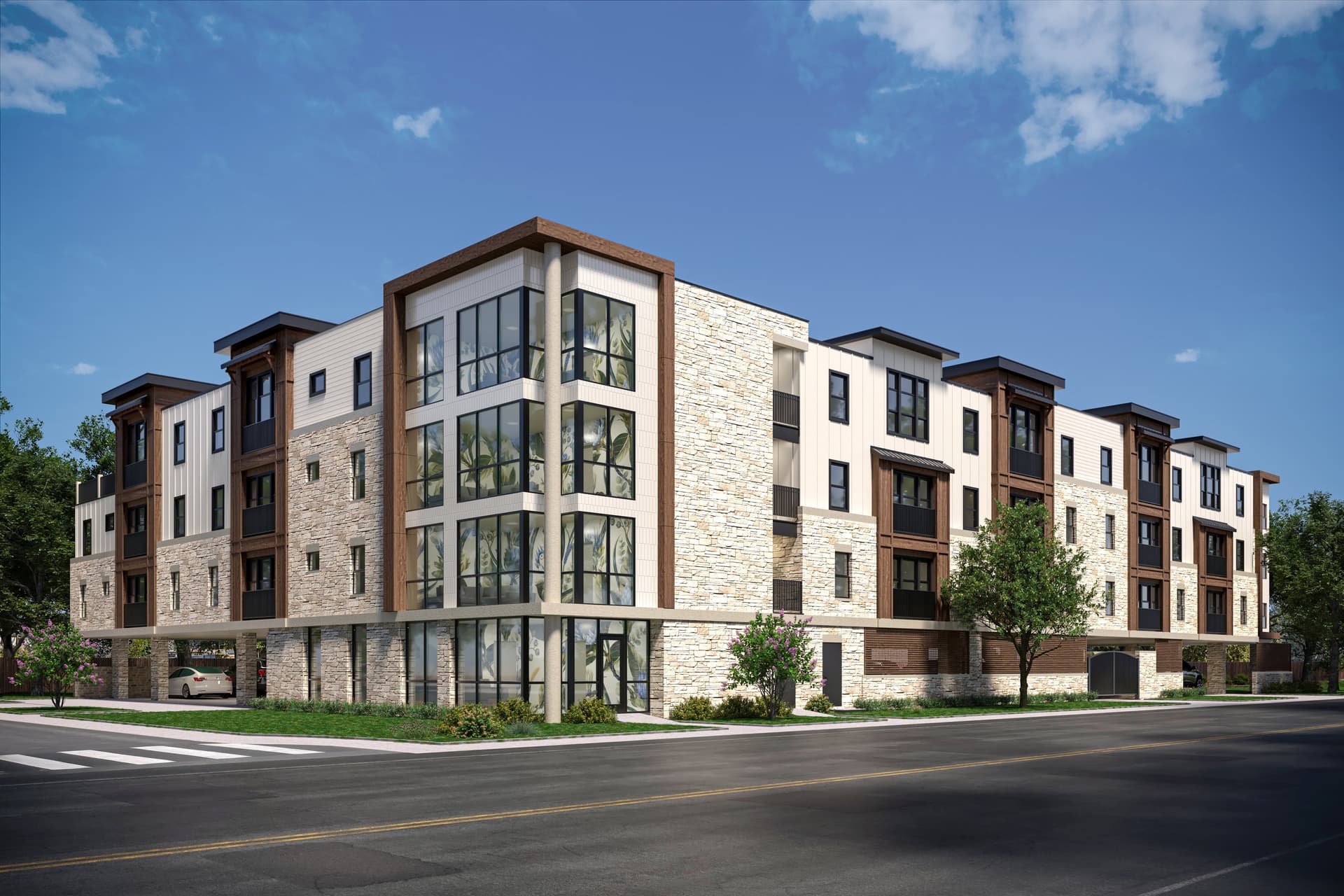
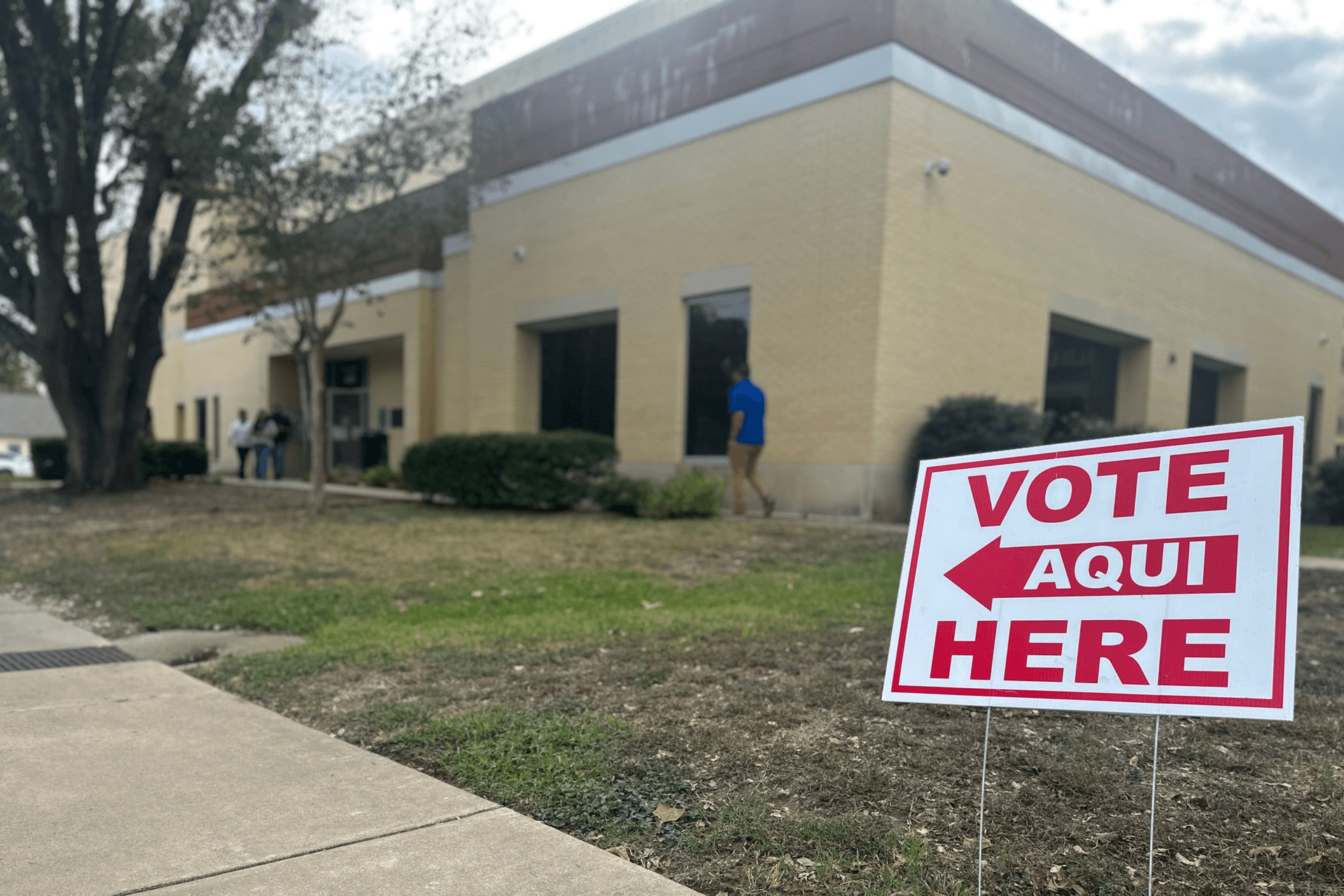
A potential 2026 bond could include funding for transportation, housing, public safety, infrastructure and cultural projects. (Haley McLeod/Community Impact)
City Council is working toward a decision on an anticipated multipurpose bond election this year, and whether to potentially reduce that package's scope or push a vote to a future year.
How we got here
The city previously operated on six-year cycles for comprehensive bonds, with the most recent approved in 2018. That $925 million package has funded affordable housing, libraries and cultural centers, parks, water quality and flood mitigation projects, public safety, transportation and infrastructure, and a new public health center. Voters also approved multipurpose packages in 2006 and 2012.
Off-cycle bond elections were called for transportation and housing in the past decade as well. Austinites approved more than $1 billion for mobility projects in 2016 and 2020 followed by $350 million for affordable housing in 2022.
With the city facing tighter budget conditions and exceeding its typical timeline for another comprehensive bond, council members voted in 2024 to begin developing a multipurpose package to put to voters this fall. That process has involved both city staff and a resident-led bond task force, resulting in a lengthy slate of potential projects to narrow down this year.
The approach
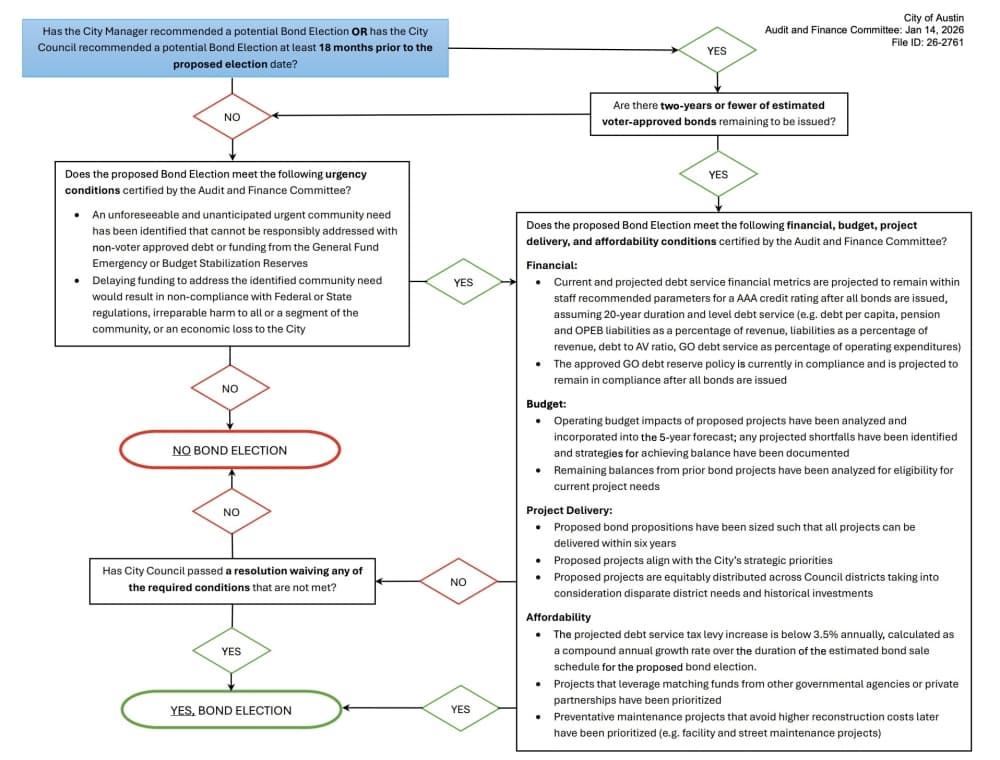
Council is now weighing the size of a potential 2026 package before making an election decision. Officials were briefed about the city's debt capacity and related resident impacts Jan. 14, and are also considering a new framework to determine when bond elections can be called.
“While we’re not under a gun right now to get that done, I do want us to be thinking about that so that the public will know and have confidence that we’re looking at the right questions and trying to approach that the right way," Mayor Kirk Watson said of his proposed bond "decision tree."
City Council is moving to adopt a new policy framework for calling bond elections. (Courtesy city of Austin)
Most of Austin's past bond dollars have been used up as of early 2026, although nearly $400 million in transportation funds and roughly one-third of the latest housing bond remain to be spent.
Financial Services Director Kim Olivares said the recent frequency of one-off elections, rather than the traditional six-year cycle for comprehensive bonds, has been "truly an abnormality" and affected Austin's debt outlook. She noted the 2016 and 2020 mobility measures together eclipsed the total of the comprehensive package from 2018.
Several officials commented on past bond practices, particularly the large amount of transportation dollars that have been slow to get out the door, in relation to the 2026 bond's development. The six-year policy had repeatedly been "violated," Watson said, and recent off-cycle elections now impact the ability to secure more funding.
"I remember people talking about, ‘This is the biggest in the history of the city,'" he said. "Well great, I guess. But now what it’s doing is, it’s hamstringing other parts of the program if we’re going to be disciplined and follow the city policy. It requires some discipline."
Several officials raised questions about the potential total for a 2026 bond, and how much it'd cost residents. Council member Krista Laine said she remains skeptical of a package for this year, while council member Ryan Alter said lagging spending in one priority area shouldn't hold back new support for other civic needs.
For this year, several options are now on the table, including:
Advancing a 2026 bond of no more than $750 million, a cap recommended by city staff
Calling a significantly smaller 2026 bond election, to be followed by a larger comprehensive package in a future year
Delaying any new bond until 2028 or later as current projects and debt issuances continue
The cost
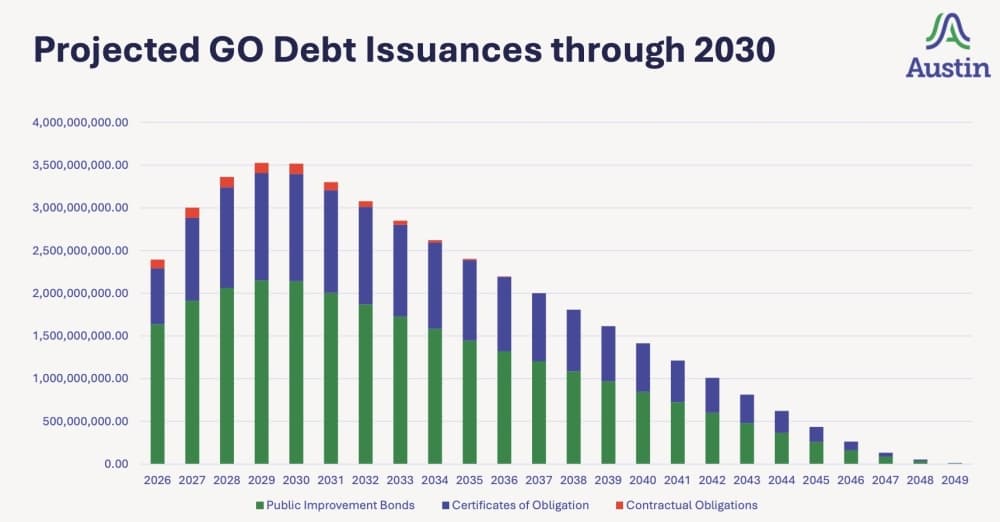
Successful bond elections gradually add to the city's debt, which residents pay for through a portion of their property taxes. Debt is issued as bond projects are developed, and Austin plans for rising issuances through the 2020s.
Without any new bond approvals, Austin's current debt issuances—and related resident costs—will peak at the end of the decade. (Courtesy city of Austin)
The owner of a median-valued home in Austin will pay about $450 in taxes for city debt service this fiscal year. Without any new bonds approved, that total would reach a projected peak of $615 annually by 2030, a more than 36% rise, based on the city's anticipated issuances.
That total could climb higher depending on the scope of a 2026 bond. A $500 million package would increase the annual bill to around $686 by 2030, while a $1 billion package—well above the level recommended by city finance officials—would see the typical homeowner's debt service taxes increase to almost $760.
What's next
Council will discuss the bond decision tree during a Feb. 3 committee session. The policy could be adopted late next month and then used to determine whether a 2026 election should take place. Watson said the tree is now needed after the past decade's irregular bond schedule.
"It is saying to us, ‘We’re going to ask this publicly and we’re going to ask it transparently’ so the public can have confidence that we’re going to follow our own policy, so we don’t end up hamstringing the whole program," he said.
Austin voters have historically approved most city bond proposals. The only failed measures this century were one piece of the 2012 package and 2014's transit and mobility bonds. However, a 2026 package would come at a time of apparent rising opposition to civic bonds and spending increases statewide.
Locally, voters broadly rejected Proposition Q's tax increase last fall. And a majority of all bond elections called by Texas cities and counties last November also failed, according to state reporting, while school district bonds saw better outcomes.
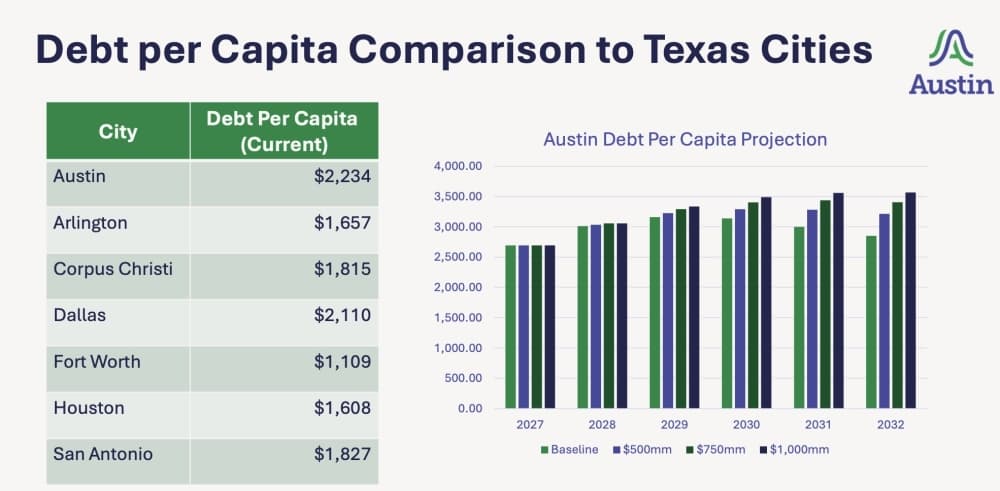
This year's considerations come as Austin already has a higher debt-per-resident ratio than comparable Texas cities, a factor that could affect its credit rating if more bond funding is authorized.
Austin's ratio of debt per resident is higher than other large Texas cities. (Courtesy city of Austin)