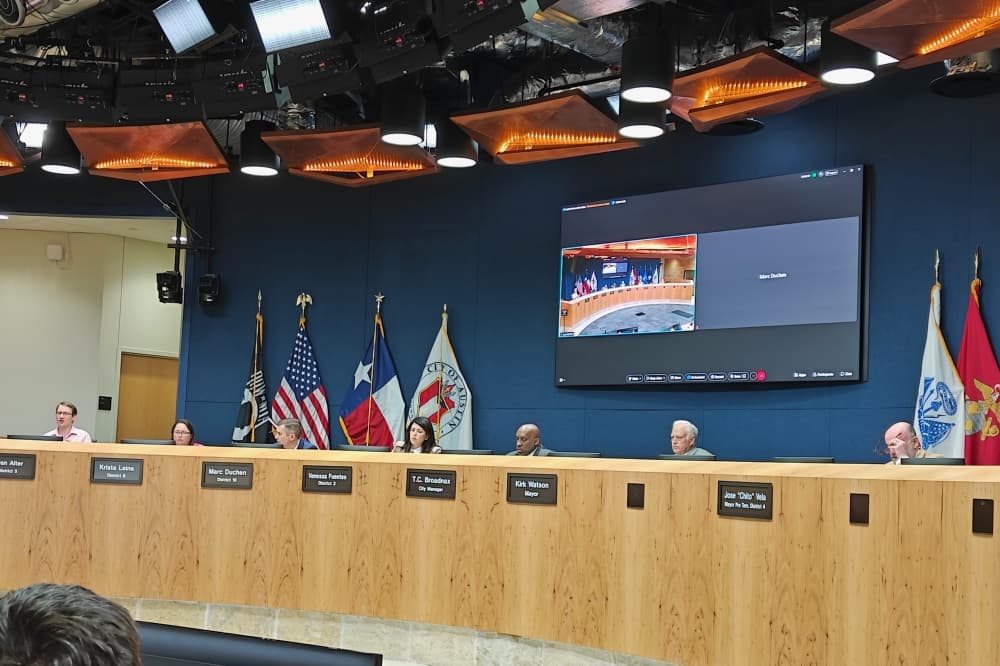
Austin's elected officials are preparing a new policy to govern spending by their offices, and readying a multiyear audit of all city operations and services.
The overview
Voters' rejection of Proposition Q, a tax hike to fund more than $100 million of public services and programs this fiscal year, led several City Council members to respond with commitments to new transparency measures and financial reviews.
Mayor Kirk Watson said the November tax election outcome reflected residents' concerns over affordability and government stability, leading to a call for initiatives like council spending reforms and a citywide audit. Those processes are now being prepared and could be implemented in the coming weeks.
A new council spending policy is now on the table and likely up for official adoption this month. And an ordinance requiring recurring, comprehensive citywide audits remains under review for passage as soon as early February.
That strategy would "safeguard public confidence" and ensure Austin provides services with the best value and efficiency, Watson said, without extending the city beyond its financial means.
"The purpose of this is to provide a program that offers conspicuous independence and a concrete declaration of how we want to achieve those things," he said Jan. 14.
The specifics
As currently drafted, the ordinance would set up a system for "independent, systemic, and continuous evaluation" of Austin's operations, spending and service delivery. The program would be handled internally by the city auditor's office with support from an outside consultant to conduct:
- An overall analysis of Austin's organization, programs, services, policies and operations, as well as the city's work on "continuous improvement and managing organizational change"
- A review of city contracting practices, including findings on standards for contractors' performance metrics, deliverables and accounting
- Cost savings and performance improvement recommendations
- Comparisons to peer cities on efficiency and financial benchmarks
Those wide-ranging reviews would likely take several years to complete, officials said, with at least semiannual public reports to council along the way. Each full assessment cycle would then be followed by a three-year break before a new round of auditing work starts up again.
The new system wouldn't halt city auditors' regular work on a variety of topics of interest, or the other civic efficiency and optimization initiatives. City Manager T.C. Broadnax said the proposal fits "hand in glove" with such work that's already underway, and could involve collaboration between the efforts.
The plan has support across the council dais so far, although changes could be made during deliberations over the next few weeks. Some officials also said they'd like to see estimates for the cost of full efficiency audits before a final vote.
“On the one hand, this is critical for increasing transparency, reestablishing public trust, finding the quantitative measures that will allow us to measure the benefit of the resources that we are dedicating to everything from efficiency to the programs at hand. But, we shouldn’t write a blank check for that," council member Krista Laine said.
Also of note
The push for a citywide audit inside City Hall comes as a different concept is gaining support from some in the community. Save Austin Now, a local political committee that campaigned against Proposition Q last fall, is now promoting a petition to codify citywide audit requirements in Austin's charter.
The charter petition drive follows a similar resident-led effort in 2018. Voters then rejected a ballot measure to require an external efficiency study with nearly 58% opposition.
There are some overlaps between both options this year, but Watson said council's ordinance is his preferred route due to factors like a faster startup timeline that could kick off early this year. If passed, the charter plan wouldn't go into effect until after a May or November election.
He also voiced concerns over some petition provisions like requirements for audit contractors to complete all their work within a year and ensure the entire project is paid for through budget savings, which he said could represent a conflict of interest. Council's proposal is also in the form of an ordinance that could be amended by elected officials, while editing the charter amendment would require a full election process and voter approval.
“You want to be in a position where you might need to make some tweaks in the way it gets done in order to make it an effective audit or efficiency assessment process," he said. "You don’t want to go back to the voters every time in order to make practical fixes that the voters would want you to make."
In other news
New rules for how council offices can spend their annual budgets are lined up for final approval Jan. 22. Austin already has expense rules in place, but the council-specific reforms are under discussion for consistency with other Texas cities and ensuring best practices are followed.
Some remaining issues include how extra office funds could be carried over year-to-year, and whether council members can reallocate some of their rollover funds or overall budgets to other city departments. Some officials have recently used their funding to contribute to the parks system, but Watson said that could also be a sign of budgets that are too big to begin with.
"What I want to make sure is ... the public knows how we’re spending this money, that it’s very transparent, and that we’re not over-appropriating to council offices. If what we’re doing is we’re appropriating so much money to council offices that could be going to parks to begin with, we need to figure out how we do that," he said.
The January discussion also led council member Vanessa Fuentes to reference her past proposal to establish new local service funds for officials to support priority improvements in the neighborhoods they represent. While council unanimously supported that concept in 2024 and a pilot program was outlined last year, it has yet to be fully implemented with no funding yet identified.
“There are district-specific projects in our areas that we know if we’re able to deliver on, we can restore and improve confidence in local government, we can show we’re making positive impacts in our communities," Fuentes said.