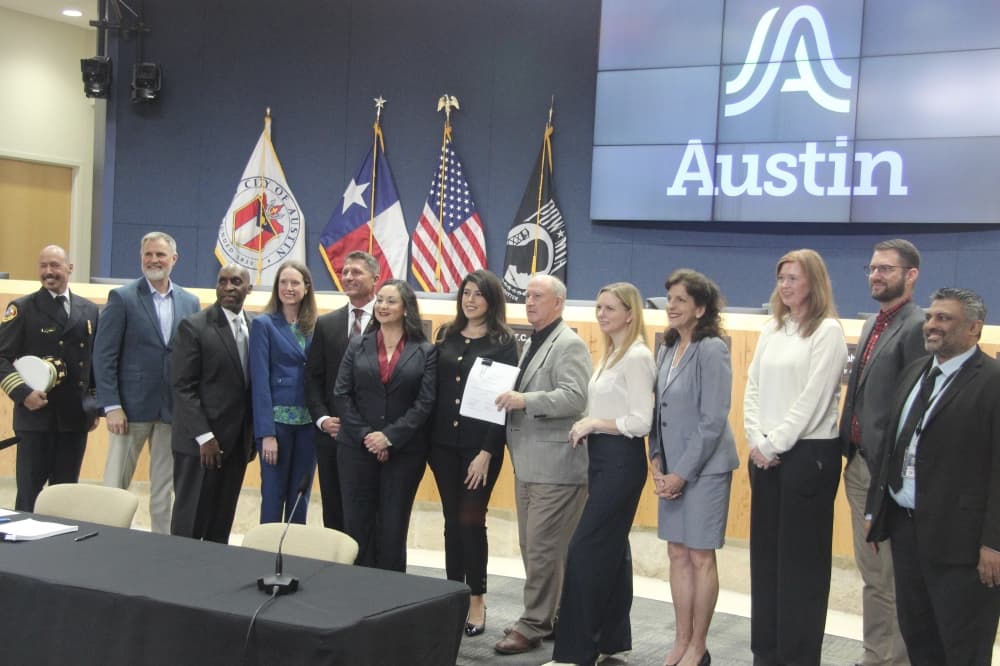
City and Austin Firefighters Association representatives celebrated the signing of a new four-year labor agreement Dec. 18. (Ben Thompson/Community Impact)
Austin firefighters and city officials formally agreed to a new four-year labor contract Dec. 18, capping off months of negotiations while resolving concerns over staffing standards and city finances that temporarily held up a final deal this fall.
“I want to thank the negotiating teams for reaching an agreement that strengthens public safety while implementing a work schedule that prioritizes firefighters wellness. We value our firefighters, and this new agreement demonstrates our commitment to these valued public servants," City Manager T.C. Broadnax said.
The big picture
The new collective bargaining agreement between the city and Austin Firefighters Association, which represents most city firefighters, was unanimously approved by City Council and backed by 72% of AFA members. It comes at an estimated cost of $63 million over the next four years, beginning with a $5.91 million impact for the current fiscal year 2025-26.
Headlining the deal is the creation of the new "Austin schedule" for firefighters. Once implemented in 2027, firefighters will shift from a 24-hours-on, 48-hours-off schedule to a new format of one day on and three days off, followed by two days on and another three days off.
Labor Relations Officer Roxana Stevens called the Austin schedule a "transformative" change for the Austin Fire Department force that will reduce firefighters' weekly hours worked. AFD officials also said they believe it'll support current employees and department hiring efforts.
"The new schedule gives us something to offer that other departments don’t," AFD Assistant Chief Thomas Vocke said. "It’s not any big cities in Texas that have a schedule like this right now, so I think that’s probably the biggest win for us from a recruiting standpoint."
The specifics
Other provisions in the four-year collective bargaining agreement highlighted by Stevens include:
Raising pay across all four years of the agreement, including a bigger Year One boost and larger increase for entry-level positions
Allowing the fire chief to set hiring standards and conduct testing for new recruits in multiple locations at once, potentially opening the process to more applicants
Adding 54 full-time positions to AFD's budgeted force, including 22 this fiscal year
Streamlining AFD's promotions process
Allowing for modified, more rapid hiring of certified firefighters from other departments
“This agreement improves the fire department, it achieves stability and mutual understanding for the next four years, and it addresses the health and wellness of the firefighters that solidifies high-quality fire services for our community," Stevens said.
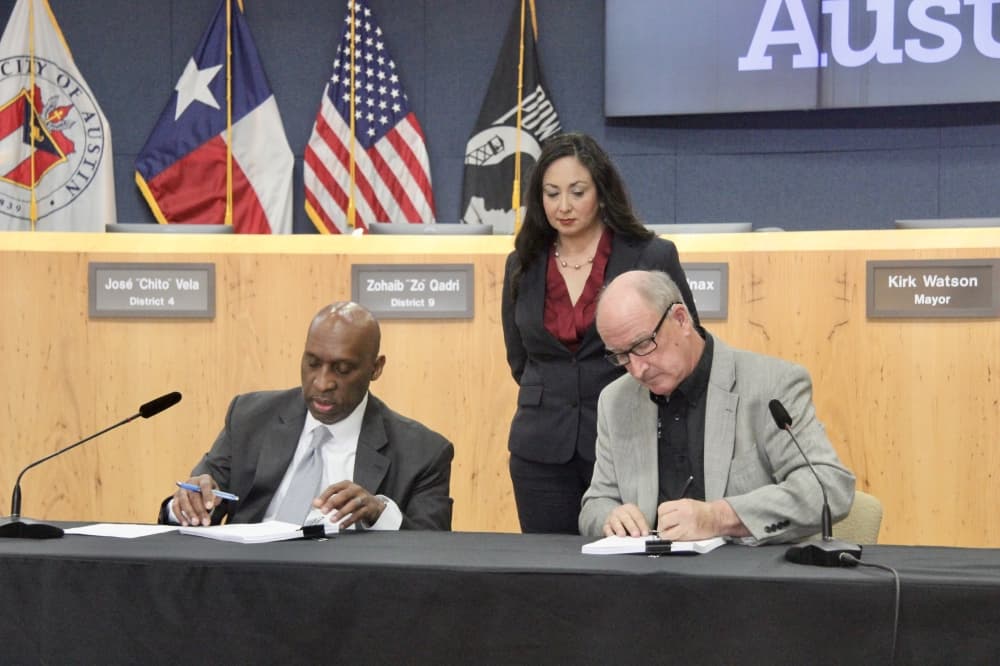
City Manager T.C. Broadnax and AFA President Bob Nicks signed a new labor deal for firefighters at City Hall on Dec. 18. (Ben Thompson/Community Impact)
Also of note
The city and AFA had reached a tentative agreement back in September. However, final approval was delayed this fall after the association launched a petition election campaign regarding a four-person staffing standard for fire engines.
Austin has maintained that fire response policy since 2018 in line with national safety standards. But AFA leaders raised concerns during this summer's budget discussions when the potential for reduced staffing was discussed, although changes weren't implemented. In response, the firefighters association launched its "Safer Austin" petition campaign to permanently enshrine four-person engine staffing in the city charter.
The petition also mandated that changes to AFD operations, like taking engines or fire stations out of service, couldn't happen unless Austin was in a "severe financial crisis." City officials and labor negotiators raised reservations about that language, stating it'd put other public safety response and department funding at risk.
Both sides tentatively agreed to the final framework in early December that resolved those issues for now, leading the AFA to end its campaign. The contract now includes language to maintain current staffing policies and set a new collaborative approach if budgeting issues prompt fire engines or stations to potentially be taken out of service.
That process would require Austin's chief financial officer to declare a "severe financial crisis” impacting city emergency response. Then, both city and AFA representatives would meet to recommend operational changes.
AFA President Bob Nicks credited the city's team for addressing that issue in the final deal.
"We gave management the flexibility they need to really manage a crisis properly, and we get the promises that those won’t be executed or used unless we’re in dire need," he said. "We believe we kept our promise to the citizens—and T.C. [Broadnax] did too—that we’re going to keep fire stations open, we’re going to keep safe staffing standards unless there’s a bona fide emergency. Then we have a framework to work together to try to solve that emergency in the best way possible for the citizens.”
Diving in deeper
AFA President-elect David Gerard said "unforeseen" budgeting issues could arise in circumstances like a severe wildfire season impacting AFD's force and operations, or a public health crisis like COVID-19 that leads to widespread illness or vacancies at AFD.
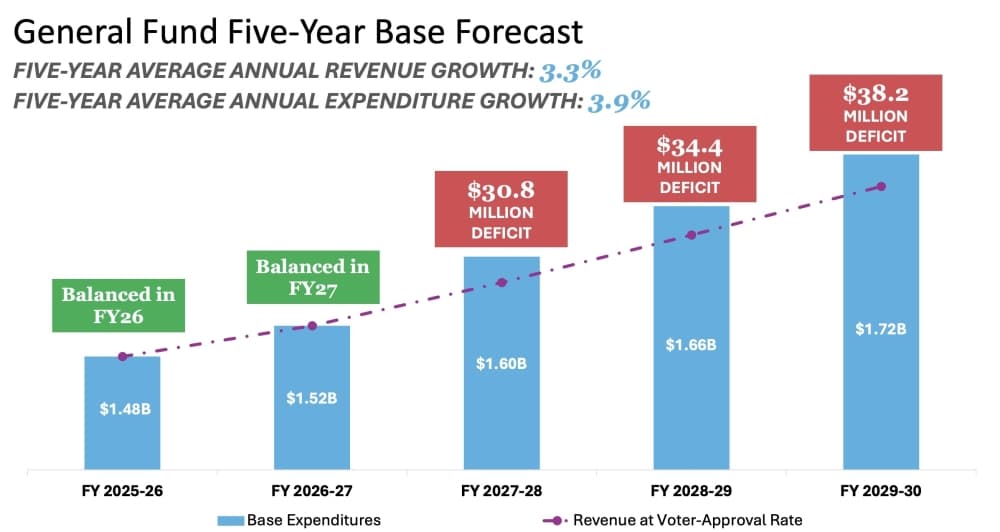
City CFO Ed Van Eenoo said the determination of a financial crisis will depend on factors like external economic conditions and internal budget pressures. Austin is expected to reach budget deficits in the 2020s, based on projections that have accounted for the impact of the new AFA deal, and Van Eenoo said protracted shortfalls could lead to those considerations.
“The more years in a row that you have to deal with a $20 million-$30 million deficit, the more and more difficult that’s going to be," he told council. "So just to say, perhaps a $10 million or $20 million deficit one year might not be a crisis. But two, three years consecutively, it could become a crisis.”
Austin is projected to face general fund budget deficits by the late 2020s. (Courtesy city of Austin)
Another detail
With the December approval of the AFA deal, the city is now under contract with all three of its public safety labor associations. Council member Mike Siegel noted the importance of reaching those "generous" deals amid financial belt-tightening across all city departments. He also said he doesn't want Austin's thousands of civilian workers to feel vulnerability in their roles, and that the city must become "as self-sustaining as possible" through other economic avenues like a newly-announced incentive deal with Southwest Airlines.
"There is a narrative out there post-Prop Q that austerity is here and all we’re going to do as a city is fund public safety and infrastructure. And I think I speak for this council: That’s not our intention," he said. "We want to take care of all of the workers who make our city special. And so we’re going to have to be creative and aggressive to raise revenue to keep pace with labor costs.”