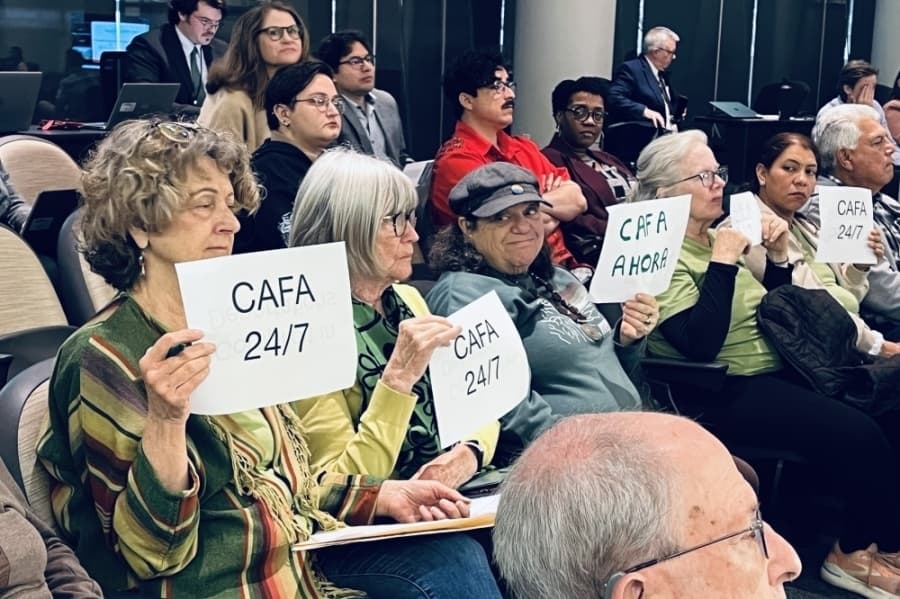
Members from a civil rights advocacy group Austin Sanctuary Network vocalized their desire for Counsel at First Appearance in Travis County during Commissioners Court on Jan. 28. (Haley McLeod/Community Impact)
From public safety programs and tax-funded initiatives to disaster response and community planning, these 15 updates highlight key developments in Travis County throughout 2025.
1. Travis County ramps up CAFA
Travis County commissioners allocated $8.2 million in funding Jan. 28 for additional legal representation services following an individual's arrest, an initiative that has long held local civil rights advocates' attention.
“It's an unconstitutional process that we are facing when we don't have legal representation available at the time of arrest,” said Sommer Alexander, a representative of advocacy group Texas Harm Reduction Alliance. “The right to legal representation is a cornerstone of our Constitution.”
2. Central Health moves towards greater transparency after critical audit
On March 11, Central Health—Travis County’s taxpayer-funded hospital district—announced strides in improving transparency following a critical third-party performance audit from September 2024.
The audit, conducted by Mazars USA, highlighted issues with insufficient documentation and inconsistent reporting methods. The report specifically lists concerns with the fundamental agreements made by Central Health with the Dell Medical School at The University of Texas at Austin.
Commissioners approved a goal of achieving a 50% reduction in roadway fatalities by 2035 and 100% by 2050 on March 11.
The Safe Streets for All initiative—which has been adopted by cities and transportation agencies across the nation—aims to eliminate traffic-related serious injuries and fatalities.
Also referred to as Vision Zero, the county is currently developing its safety action plan.
4. New gun violence program shows early promise, officials say
Homicides in Austin have dropped by 20% since Travis County officials launched a strategic gun violence prevention initiative in 2021, District Attorney José Garza told reporters April 3.
According to Austin Police Department crime data, the number of homicides in the city fell from 88 in 2021 to 71 in 2024. Garza attributed the decline to coordinated efforts by local law enforcement and community partners aimed at reducing gun violence across the county.
5. Report shows 'substantial decline’ in Travis County fentanyl-related deaths
Travis County officials highlighted a 36% reduction in deaths involving fentanyl and a 22% decrease in total opioid-related deaths during a preview April 21 of the annual Medical Examiner’s report for 2024.
6. Travis County officials weigh plans for potential historical district
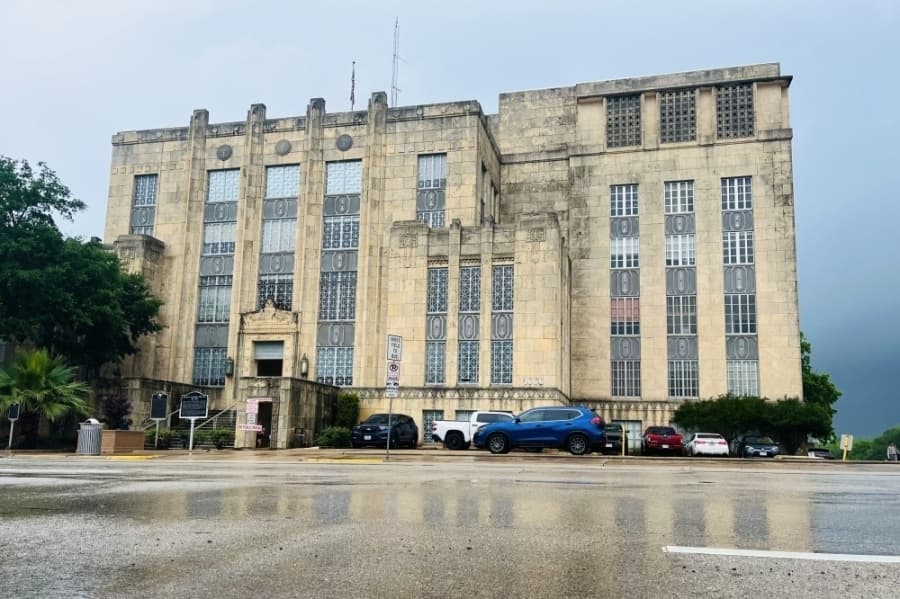
Travis County commissioners are exploring heritage tourism opportunities tied to the nearly 100-year-old downtown courthouse as renovations continue.
Opened in 1931, the Art Deco building is closely linked to Austin’s civil rights history, and county leaders discussed the possibility of repurposing it as a museum and cultural space through partnerships with the city and private sector. Officials also noted the planned Austin light rail station at nearby Woolridge Square Park could help anchor the area as a future “Museum District.”
Opened in 1931, the Heman Marion Sweatt Courthouse has been recognized for its role in the Austin's civil rights movement. (Haley McLeod/Community Impact)
7. Local food truck regulations shift
A bill shifting food truck permitting from local control to state oversight landed on the governor’s desk after the state’s first legislative session, receiving final approval in June. Travis County now stands to lose more than half a million in annual revenue, according to county documents.
State legislators and advocates pointed to potential benefits for small businesses.
Beginning June 1, the Travis County Fire Marshal’s Office moved local burn ban notifications to a new system, enabling residents to opt-in by texting TCBURNBAN to 888777.
The new system will transition from the county’s internal alert platform to Warn Central Texas, a free, opt-in service that will provide notifications when:
A burn ban is issued
A burn ban is lifted
A Red Flag Warning is declared due to high fire danger conditions
Sandy Creek residents stood before Travis County commissioners July 15 demanding more help after severe flooding ravaged neighborhoods across the northwest part of the county over the Fourth of July weekend.
A week later, on July 22, Travis County emergency services officials shared updates on the county’s ongoing recovery efforts and the transition to longer-term support in the affected area.
10. Travis County flooding to cost average homeowner $200 more in taxes
Travis County officials approved a measure July 29 to implement a one-year 9.12% tax rate hike in order to pay for recent severe flooding damages.
The average homeowner can expect to see a roughly $200 increase to their property tax bill, with $72 of that tied to recovery costs from the July flooding disaster.
Due to state and federal disaster declarations following the flood, the county is allowed to raise property taxes without needing voter approval. Normally, any increase over 3.5% would require a public vote, per state law.
The approved higher property tax rate for the fiscal year 2025-26 budget year is roughly three cents more per $100 of property value, at $0.375845 per $100 valuation.
11. Another tax hike for public health services across Travis County
Travis County Commissioners approved Central Health’s 9.3% tax rate increase for fiscal year 2025-26. The agency is serves as the county’s taxpayer-funded hospital district.
The increase is expected to tack on an additional $64 for the average homeowner tax bill. The average Travis County homeowner with a property valued around $515,213 can expect to pay around $608 in property taxes to Central Health.
Dubbed the “year of access” by Central Health officials, the additional funding would expand and speed up health care options for low-income residents.
“Access to care is not just a goal—it’s a lifeline,” Central Health President and CEO Dr. Pat Lee said. “For many in our community, timely and equitable care can make all the difference.”
12. Travis County directs first $34M in funding for child care initiative
Less than a year after voters approved a countywide tax rate hike to expand affordable child care, Travis County officials are rolling out the first wave of local investments for the Creating Access for Resilient Families, or CARES, initiative.
Travis County commissioners approved a contract Aug. 26, allocating $24 million to Workforce Solutions Capital Area. The agency already actively accepts applications from both parents and providers, distributing funding for student scholarships and gaps in provider funding for subsidized slots.
Through this existing infrastructure, the funding commitment is expected to result in child care for 1,000 children ages 0-3.
Alongside the Workforce Solutions contract, the county approved three interlocal agreements with Austin ISD, Manor ISD and Del Valle ISD for pre-K and after-school programs totaling $9.7 million and serving over 2,000 school-aged children.
Families showed support for the tax rate election approved in November 2024, supporting access to affordable child care across Travis County. (Haley McLeod/Community Impact)
13. Travis County eyes site for mental health diversion center
A long-standing effort to establish a permanent mental health diversion center in Travis County is gaining traction. Project leaders are evaluating potential sites and preparing to define the range of services the facility will provide.
The county recently outlined an $86 million earmark in the fiscal year 2025-26 budget intended for future jail diversion and central booking facilities.
The mental health diversion center, spearheaded by Judge Andy Brown, will be an alternative to jail for people who commit nonviolent crimes and suffer from mental illness or substance abuse disorder.
Travis County commissioners approved a series of salary adjustments for judges and elected officials Sept. 9, moves that will affect how the county allocates taxpayer dollars in the upcoming budget.
District judges will see their county supplement rise to the state-allowed maximum of $25,000, up from $18,000—totaling a salary of $200,000. Commissioners also unanimously approved phased raises for associate judges to help with court caseloads, with salaries set to reach $180,000 by 2027.
Travis County’s approved salary increases for judges and associate judges could help its Counsel at First Appearance program by attracting and retaining experienced courtroom staff and reducing turnover—something court employees and justice reform advocates have consistently highlighted to commissioners.
Residents facing the justice system will now see stronger protections, as the Austin-Travis County initiative for Counsel at First Appearance, or CAFA, has been fully rolled out after a phased transition that began in early 2025.
City of Austin officials approved final funding contracts Sept. 25, with the county to provide magistration services at the central intake facility in downtown, where individuals arrested by the Austin Police Department and other state and local law enforcement agencies are taken upon arrest for booking, identification, magistration and other services.
The CAFA program provides legal representation to individuals unable to afford it during their initial court appearance after arrest.