A starry night sky and the atmospheric glow blanket as the International Space Station orbited 263 miles above Earth. (Courtesy Nasa Image and Video Library)
Editor's note: To view this story as it appeared in Community Impact's Leander, Liberty Hill edition, click here.
As explosive growth threatens to spread light pollution, Leander and Liberty Hill are working to make sure their night skies stay dark. Supporters of the efforts say dark skies are beneficial to the environment and residents’ quality of life.
From 2015 to 2025, the average brightness of the nighttime sky over Leander and Liberty Hill increased about 9% per year, according to data from NASA’s Black Marble, a project that compiles satellite data on the night sky. Both cities are taking steps to try to slow that increase.
“We know that growth is going to continue ... so there is no better time than now to do it,” Leander Mayor Na’Cole Thompson said in an interview. “I think it’s something that we need to do as far as keeping the character of the city. We really are a gateway to Central Texas and to the Hill Country.”
Dark sky efforts have seen significant grassroots support in the area, especially in Liberty Hill.
Speaking at the March 25 City Council meeting, Liberty Hill resident Molly Evans called the local campaign in favor of dark skies “a community-led effort to protect Liberty Hill’s character, quality of life, wildlife, pollinators, public safety and health.”
The big picture
In February, Leander began the process of applying for recognition as an International Dark Sky Place by DarkSky International. Liberty Hill was named an International Dark Sky Place in July 2025.
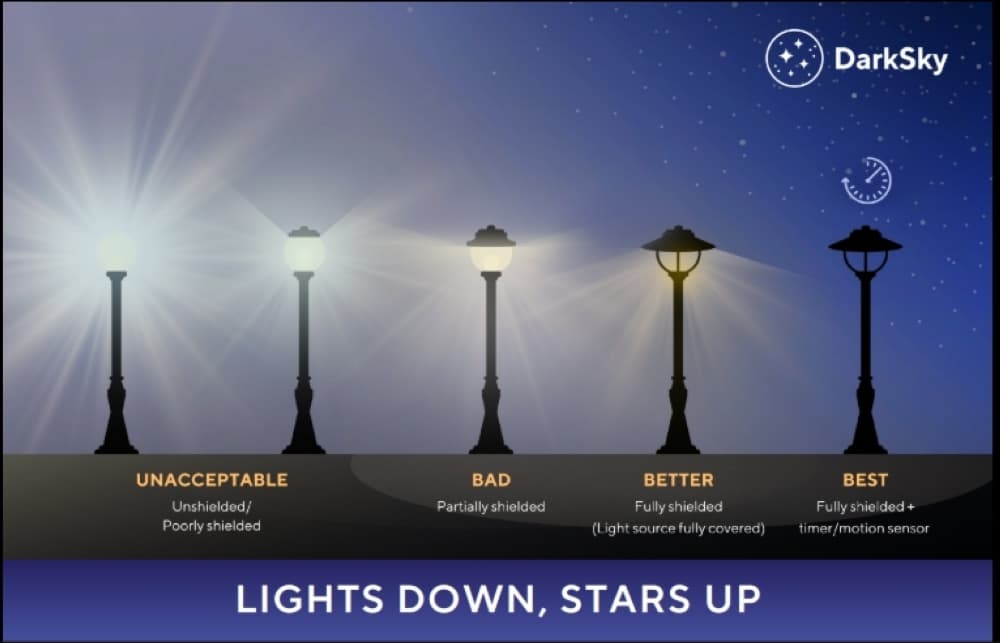
Both Leander and Liberty Hill currently have outdoor lighting ordinances that include stipulations such as warmer light colors, shielded fixtures that direct light downward, limited brightness, restrictions on when outdoor lights may be on, and limits on light that intrudes on neighboring properties.
Organized efforts to light pollution in Liberty Hill began in 2020 with the formation of a community group called Save Our Stars. The city then adopted a dark skies ordinance, and recognition by DarkSky International followed in 2025. Thompson said Leander enacted its ordinance to limit light pollution in 2005, updated it in 2016, and could revise it again as part of the Dark Sky Place application process the city is currently pursuing.
Both Leander and Liberty Hill have city ordinances that dictate proper lighting fixtures to limit light pollution. (Courtesy DarkSky International)
Some context
DarkSky International is a nonprofit organization founded in 1988 whose stated mission is "to restore the nighttime environment and protect communities and wildlife from light pollution."
Michael Rymer, communities program manager for DarkSky International, said the group's work is "all to improve outdoor lighting used at night, to reduce light pollution not just for a better view of the stars, but to cut costs on energy—cut waste in the energy used to illuminate our surroundings at night when we don't need to—and for environmental impact."
One way in which the organization encourages efforts to fight light pollution is by certifying communities, parks and other places as International Dark Sky Places. Rymer said he sees dark sky certification as something undertaken not just by local governments but by residents as well.
Several other communities in the greater Austin area are recognized as International Dark Sky Places, including Dripping Springs, Bee Cave and Jonestown.
Diving in deeper
Scientific research shows that light pollution can have complex and far-reaching effects on the environment and may also affect human health.
"A lot of species travel, reproduce, migrate [and] hunt at night, so our introduction of excessive light at night into their environment is detrimental to their survival," Rymer said.
According to DarkSky International, one of the most significant environmental impacts of light pollution begins with drawing insects out of wild areas. Because many insects are drawn to light, artificial light can bring them out of their natural habitats. This can kill large number of insects, disrupting both the food chain for larger animals and the pollination of native plants.
Also, when insects move toward artificially lit areas, larger animals that prey on them often follow, leading more and more animals out of the wild and into potentially dangerous developed areas. Nighttime lighting also harms birds by disrupting migration patterns and confusing them, leading to collisions with buildings.
According to DarkSky International, research suggests that light pollution may also have detrimental effects on human health, primarily by shifting sleep cycles and disrupting chemical signals like melatonin, a hormone that signals to the body that it's time to sleep.
DarkSky International maintains an extensive database online with thousands of scientific research papers that explore how artificial light at night impacts wildlife, ecosystems and human health.
What they're saying
Lighting ordinances have received broad support in Leander and Liberty Hill. However, some local business owners have criticized the restriction. Keith Bright, owner of Bright Fire Cigars, objects to restrictions on using electronic signs at night.
"The city should not have any say in when I can market my business," Bright said at a March 11 City Council meeting. "I have had many customers tell me they saw the sign at 3 or 4 in the morning and came back when I was open to buy a product."
Pastor Bill Brannan of Life Springs Church said he believes enforcing electronic sign restrictions on churches violates religious liberty.
"I think if everyone understood the value of LED signs for the flourishing of the whole community, we would support the right of churches, schools and businesses to use them," Brannan said.
Supporters of the dark sky ordinance spoke at a March 25 council meeting.
"I've lived [here] 25 years, out in a dark sky community. I just want to sit on my back porch and enjoy the fruits of my labor," said Nick Page, a resident of Liberty Hill's extraterritorial jurisdiction.
Liz Branigan, former mayor of Liberty Hill, said, "I think that [the dark sky ordinance] is the right thing to do, that we should honor the beauty of Texas, the beauty of the Lord's creation, and protect all the little creatures and the things that belong in the night, and all the children who have never seen stars and never really known wonder."
What's next
Michael Chenausky, senior planner with Leander Development Services, said city staff expect a timeline of about two years for the city to receive official recognition as an International Dark Sky Place.
At a February City Council meeting, most of Leander's elected officials said they believe it's worth it because they see dark skies as a long-term quality-of-life issue.
"When we think about where Leander has come from and where we're headed, I think we want to make sure that we're environmentally sound and that we're doing things that improve the quality of life for our residents that live here, and part of that is being able to see the sky at night," Thompson said. "As we think about going forward, what do we want our city to look like?"
Leander City Council approves special use permit for The 75 Oaks