


Breaking it down
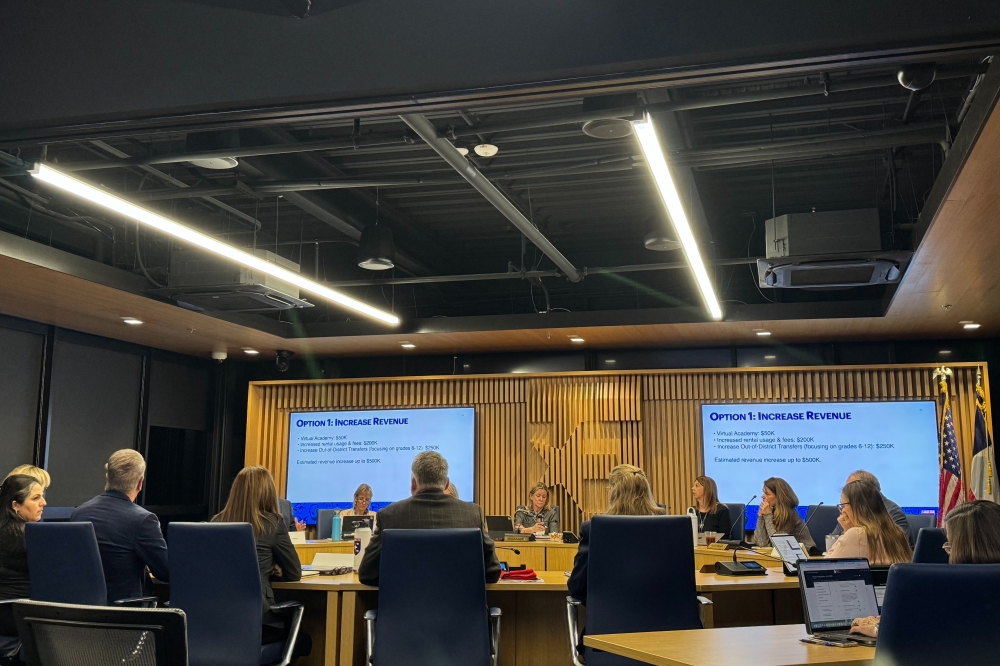
Administration has provided several potential optimization actions, which Chief Financial Officer Chris Scott updated the board during the Jan. 13 meeting.
Budget optimization discussions began in the fall, which included feedback from a community survey on how to least impact students.
"My goal and my hope is that most students wouldn't feel this, that most of what we feel as a district is going to be the adults—the staff, the administration and the teachers who are working really hard to make sure that the experience that the kids have is that Eanes experience we all want them to have," Scott said.
Local revenue increases could provide $500,000 in savings through initiatives such as increasing facility rental usage and fees, rolling out a virtual academy for online classes beginning this summer, and increasing out-of-district transfers within grades 6-12 with the goal of adding at least 30 students above this year's current baseline.
"The other possible revenue initiative that I don't see here fully baked is Valley View [Elementary]," trustee Laura Clark said. "That's an incredibly valuable piece of property and has a great deal of potential for revenue, much more so than I think is reflected in the numbers we're discussing tonight."
Staffing optimization could net between $3.2 million and $4.3 million in savings, which Chief Human Resources Officer Laurie Lee said is a "two-prong process."
This action would consist of a reduction in force in non-campus-based staff across central administration departments and campus-based paraprofessionals, and attrition through retirements or resignations.
This action would not eliminate any student programs, but would impact classroom structures and staffing ratios to 1-23 in third grade, 1-24 in fourth grade and 1-25 in fifth grade.
Secondary grade staffing ratios would also be implemented, which would result in larger class sizes with many classes nearing 30 students and impact elective scheduling.
Freezing salaries and reducing raises could provide up to $1.6 million in savings. However, Lee said EISD salaries are currently $3,000-$5,000 lower compared to 12 other competitive districts.
The board could also decide to hold a voter-approval tax rate election, or VATRE, which would generate $20 million in additional tax revenue by raising the maintenance and operations tax rate. However, EISD would only keep about $3.8 million of the additional revenue, as more than $16 million would be sent back to the state as recapture payments.
"I will go to the polling place and vote 'no' on a VATRE; however, having said that, there is some element that says, 'But should we rob the community from being able to vote on that?'" trustee James Spradley said. "If the board chooses to go after the VATRE, I think we need to move forward with ... a plan that looks like this and have a happy position if the VATRE passes, ... versus the other potential reality—which I think the survey kind of showed us—was we put all of our eggs in that basket and the community says, 'Heck no, I'm not paying more just to send most of it to the state.'"
The options
Based on the optimization actions, district administration put together four potential budget packages to move forward with.
- Package 1: nets $5.3 million-$6.4 million in savings through increased revenue generation, staffing optimization and a salary freeze
- Package 2: nets $4.5 million-$5.6 million in savings through increase revenue generation and staffing optimization, and also includes a 1% salary increase
- Package 3: nets $5.8 million-$6.9 million in savings through increased revenue generation, staffing optimization and a five-penny VATRE which, if passed, would allow for a 2% staff raise
- Package 4: nets $7.5 million-$8.6 million in savings through increase revenue generation, staffing optimization and a nine-penny VATRE which, if passed, would allow for a 2% staff raise
Looking ahead
The board is slated to continue its budget package discussion and could vote on a package at its next meeting Jan. 27.