Georgetown officials recommended changing water utility billing to be based more on usage than a fixed base charge during a March 10 City Council workshop.
This would allow the city to address rising water infrastructure and supply costs, while considering affordability for customers.
What it means
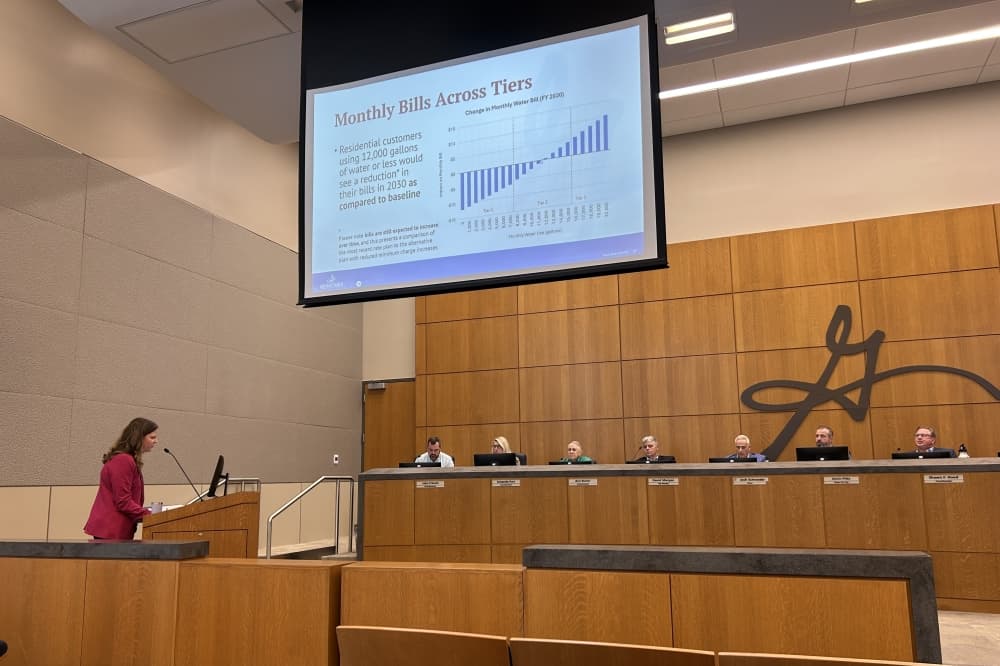
Under the new plan, low-volume water users would see smaller bill increases by 2030, and high-volume users would experience higher costs based on the new pricing tiers.
By implementing billing changes, the city would reduce the total number of increases for the average residential customer and still be able to cover its fixed costs, Georgetown Chief Financial Officer Leigh Wallace said.
“When we shift costs to volumetric rates, those are the users that are driving peak demand and our need for infrastructure,” Wallace said. “If we made a change to this policy then the base rates could be increased more gradually, and the volumetric rates could be increased at a more accelerated pace.”
Why it matters
Right now, residential water rates are projected to increase 9% per year for the next five years, according to city documents.
This is largely due to city water costs—including debt payments, new infrastructure and water procurement—projected to grow from $64.2 million in 2025 to $138 million in 2030, Wallace said.
The new policy would increase base charges by 4% each year for the next five years, and volumetric charges would increase by 14% in the same time frame, according to city documents.
“We’re not saying water bills are decreasing, but they will increase at a slower rate,” Wallace said.
The projections are based on data from December and are subject to change, Wallace said.
Zooming in
Preliminary projections show that a customer using 2,000 gallons of water per month would pay a monthly bill of $67.80 in 2030 under the new policy compared to $76.20 under the current policy.
Meanwhile, a residential bill for 16,000 gallons of water per month would come out to $148.75 per month in 2030, rather than $144.50.
What they’re saying
Council members supported the proposed billing changes because of its focus on affordability, especially for those who use less water.
“We're putting more of the proportion of cost on the higher users and less on the ... folks who are using it just for primarily domestic use,” District 5 council member Kevin Pitts said. “Lower-income folks or folks who don't have much yard, they shouldn't have to see as much of an impact.”
Pitts also noted this rate system supports the city’s housing policy to help people continually afford the cost of living and stay in their homes.
Council members expressed concern about what happens to revenue during drought years when watering is restricted or heavy rain years when watering isn't needed.
“It's something we'll have to monitor, obviously, and if we have to adjust, we'll adjust at the time,” Wallace said.