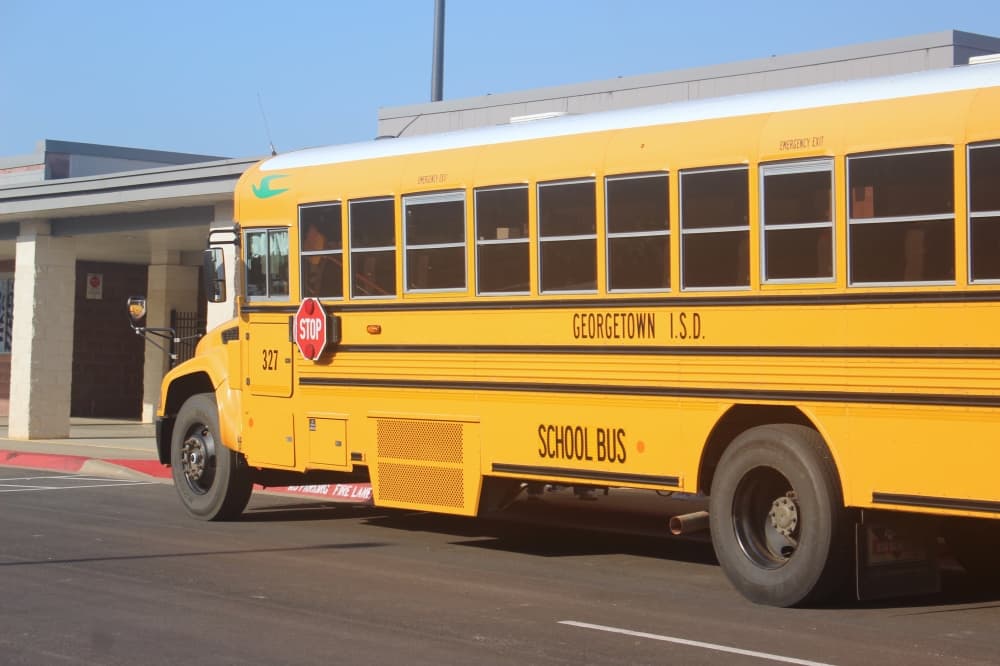
Georgetown ISD is considering purchasing 23 new buses for $4.3 million to meet a new state law.
Senate Bill 546, passed in 2025, requires all public school buses to have three-point seat belts by September 2029.
The update
By August, GISD is expected to have 122 buses in its fleet, 99 of which will have three-point seat belts. All current GISD buses used for daily routes have three-point seat belts, said Clint Pruett, GISD executive director of support services, at a March 30 board meeting.
Fifteen GISD buses will have no seat belts, while eight buses will only have two-point lap seat belts—all of which are spare buses or buses used for trips, Pruett said.
The buses without three-point seat belts are 10-17 years old with an average of 180,000 miles. Due to their age and mileage, GISD is recommending replacing the 23 buses for $150,000-$170,00 each, totaling $4.3 million, Pruett said. Additionally, the price of new buses is expected to increase by around $25,000 per bus starting in 2027 under new emissions regulations, Pruett said.
Meeting the state mandate would be an unplanned expense for GISD using unspent funds or savings from the 2024 bond.
District staff is expected to present a replacement plan recommendation to the board at a future meeting, potentially in April, he said.
Some context
The heightened seat belt standard under SB 546 repealed a previous provision under SB 693 that did not require school buses manufactured in 2017 or earlier to have three-point seat belts. GISD is in full compliance with SB 693, as all buses manufactured in 2018 and after have three-point seat belts, Pruett said.
Sen. José Menéndez, D-San Antonio, said he authored SB 546 after more than 40 Tom Green preschool students and 11 adults were involved in a Hays CISD school bus crash that killed an adult and a child in March 2024, according to previous Community Impact reporting.
By the end of this school year, districts must report how many of their buses are not equipped with seat belts or have two-point or three-point seat belts. Districts must also share the estimated cost to retrofit or replace buses without three-point seat belts.
GISD expects a grant opportunity to become available through the Texas Education Agency after the reporting window closes, Pruett said.
“If a grant comes along, great,” Pruett said. “We can use that to supplement, but we want to have a plan in place regardless of the grant.”
What they’re saying
School buses use a technology called compartmentalization to protect children during a crash through high-padded seats with an energy-absorbing steel frame, according to district information.
“School buses are one of the safest, if not the safest form of transportation, and children are significantly safer in school than any other vehicle,” Pruett said.
Crash investigations by the National Transportation Safety Board have found that "compartmentalization alone is not enough to prevent all injuries and that for some of the children involved, a seat belt could have lessened their injuries or even saved their lives," the NTSB's website states.