



The helicopter will allow Texas Children’s Hospital to provide faster critical care to more patients across Central Texas.
“[The helicopter] represents Texas Children's long-term investment in this region and a commitment to bringing world-class pediatric, neonatal and maternal care closer to home,” said Jeff Shilt, Texas Children's president of Austin and Central Texas, at a ribbon-cutting ceremony Jan. 12.
How it works
Through the new helicopter, Texas Children’s may pick up patients from community hospitals who need specialized pediatric care and transport them to the North Austin hospital. After receiving a call at its transfer center, Texas Children’s may connect the referring hospital to a sub-specialist who will create a personalized care plan for the patient, said Brian Barnett, Texas Children’s director of transport and transfer center.
The mobile intensive care unit is operated by Texas Children’s Kangaroo Crew of registered nurses and respiratory therapists who can begin providing ICU therapies to stabilize patients at their bedside before arriving at the hospital, Barnett said.
The transport team can respond to most critical illnesses, including respiratory illness, seizures and trauma, experienced by a wide range of ages from 22-week-old babies to teenagers and young adults in their adolescent years.
Texas Children’s launched its first Kangaroo Crew helicopter in Houston in February 2025, Barnett said. The expansion to Austin comes as the Texas Children’s Ambassadors Program will donate all funds collected in 2026 to the Kangaroo Crew transport program, said Kacey Cherry, Texas Children's Public Affairs representative.
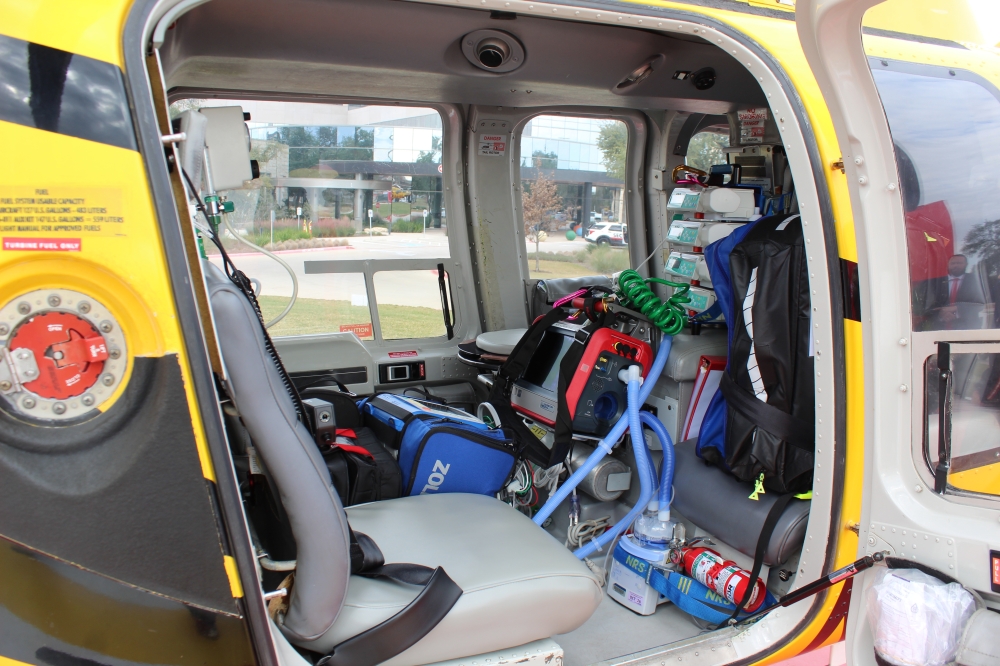
The Austin-based helicopter has allowed Texas Children’s to expand access to pediatric care to families across Central Texas, including rural areas where care options can be sparse, Texas Children’s officials said. The helicopter can travel within a 120-nautical-mile service area, including Waco, San Antonio, Houston and College Station, Barnett said.
“We’re hopeful that this means that we can reach more patients with our world-class care [and] that we can reduce those out-of-hospital times,” Barnett said.
The Kangaroo Crew transport program can reduce travel that would typically require a two-hour drive to a 40-minute helicopter ride, said Chris Hardman, chief operating officer of PHI Air Medical. The faster commute time can be life-saving for patients in fragile, vulnerable conditions, Texas Children's officials said.
“When a child is critically ill, every minute matters,” Shilt said. “This helicopter shrinks the distance between an emergency and expert care, meeting families where they are and moving them quickly to the right teams that can care for them."
What's next
Later this summer or fall, Texas Children’s plans to launch a larger, more advanced helicopter at its North Austin hospital with the ability to travel farther distances, Barnett said. The hospital system is opening a similar helicopter in Houston this week, he said.