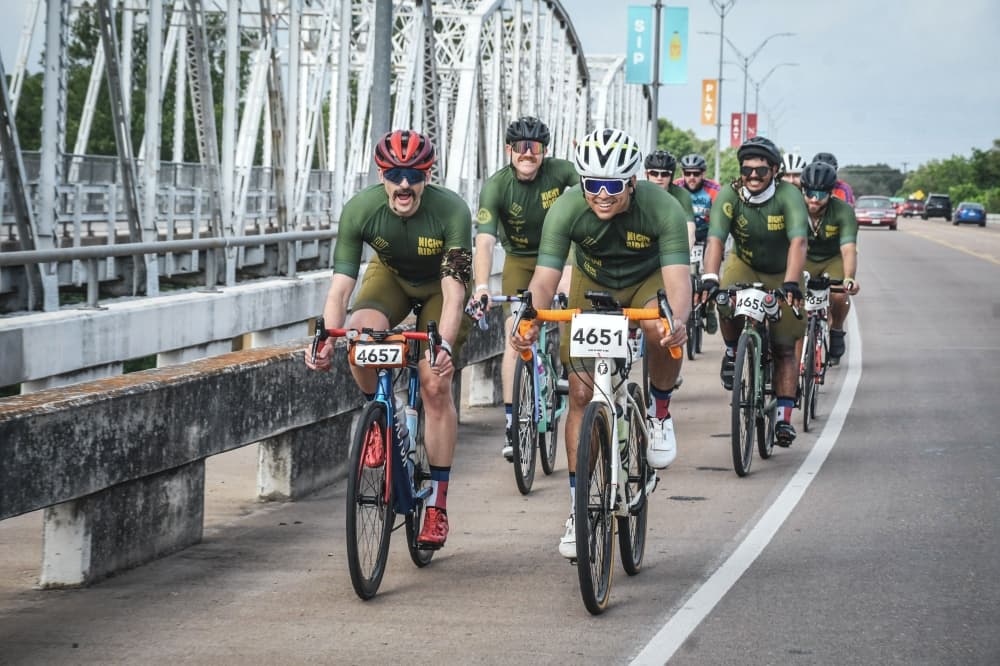
National MS Society officials are hopeful the 42nd annual Texas MS 150 will generate about $11.3 million for multiple sclerosis initiatives, turning a weekend ride into the organization’s largest fundraising effort of the year.
The details
Emily Garcia, the assistant vice president of Endurance Events for the National MS Society, told Community Impact the Texas MS 150—which will run April 25-26—is historically the top fundraising event for the National MS Society.
“There are 49 other bike events that are happening around the country, and ours is the largest by more than double,” she said. “The wonderful thing about our event is that we engage communities all across Texas.”
National MS Society officials noted that the thousands of riders will fan out across five different start lines for the Texas MS 150, including those in:
- Austin
- Bastrop
- Houston
- Waller County
- Bellville
“All of those folks will travel into La Grange on Saturday where we will host a giant party and overnight extravaganza,” Garcia said. “Then everyone will wake up on Sunday and ride their way into College Station where we finish on the Texas A&M University campus.”
Zooming in
The Texas MS 150—which once generated about $20 million annually—is steadily climbing back toward its prepandemic numbers, according to National MS Society officials.
“The COVID-19 pandemic, along with some weather cancellations, really hit us as a charity pretty hard,” Garcia said. “We were sitting at $6 million in postpandemic fundraising, so we have been able to add about $1 million a year. We really are on an upward swing, and have a 10-year goal of hitting $20 million by 2035.”
What we know
The National MS Society is seeking the following ahead of the Texas MS 150:
- In-kind and monetary donations
- Community partnerships
- Sponsors
- Approximately 2,000 volunteers across the entirety of the route
“There’s lots of ways to get engaged,” Garcia said.
The outlook
MS, a chronic disease in which the immune system attacks the protective covering of nerves, can cause a wide range of symptoms—from fatigue and numbness to vision problems and mobility challenges, according to the National MS Society.
Although early diagnosis is critical, it has historically taken years for patients to receive a diagnosis.
“We are now sitting in a space where it takes maybe a few months or up to a year to get diagnosed,” Garcia said. “So the real goal is that people can receive a diagnosis in just a few days as we continue to do more research.”