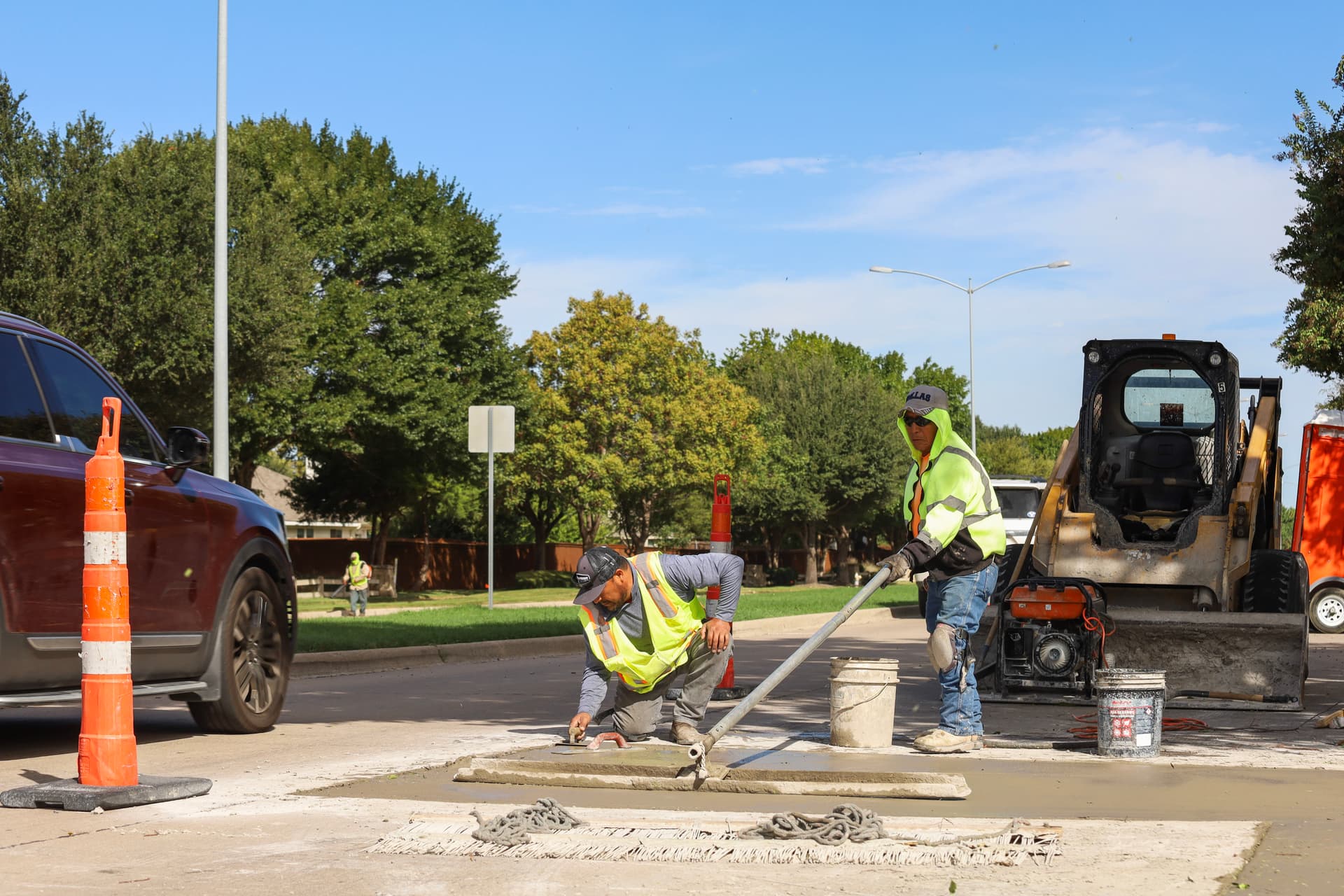
Allen city staff complete roadwork at Angel Parkway in mid-October. (Courtesy city of Allen)
Allen officials have spent more than $7 million this calendar year to repair aging roads and sidewalks, including $2.2 million for work in two of the city’s older neighborhoods.
More than 60% of Allen’s roughly 110 neighborhoods are at least 25 years old, Mayor Chris Schulmeister said. The infrastructure investments are expected to enhance resident quality of life while also preventing more expensive repairs in the future through regular maintenance, city officials said.
“City leaders understand the critical importance of staying out in front of aging infrastructure so that we don’t encounter costly problems down the road,” Schulmeister said in an email.
The big picture
The community's age and having less than 8% of undeveloped land left has prompted Allen leaders to shift focus toward reinvesting in city assets, Allen City Manager Eric Ellwanger said.
“We have to give equal, if not more, focus at this point in our life to rehabilitation [and] reinvestment to make sure we continue to be a vibrant community,” he said.
The 2026 Street and Alley Rehabilitation Project cost $4.87 million and is expected to finish in spring 2027, city staff said. City officials have invested over $12 million in streets and alleys since 2022 as part of the initiative.
A $123,248 project to apply slurry seal treatment to approximately 20,500 square yards of roadway in the Hillside Village neighborhood was completed in June, Allen Communications Manager Kristi Soto said. Work in the Greengate neighborhood is expected to wrap up by winter 2027, per city documents. The $2.15 million project includes replacing 109 ramps, 50 alley approaches and 63% of the sidewalk panels in the neighborhood and surrounding portions of Allen Heights Drive, documents state.
“Any investment that we do now, in theory, avoids a worsening situation or cost down the line,” Director of Engineering Chris Flanigan said.
Diving deeper
Regular construction projects maintain the quality of Allen’s roadways, Ellwanger said.
“For the public, they do need to understand that [in] a community of our size, there is never going to be a point where there’s no construction, like where everything’s done,” he said. “It’s the life cycle of a community.”
In 2022, city staff used federal funding to hire a contractor to drive over 600 miles of Allen roadways to develop a surface condition assessment, which objectively scores and ranks pavement quality throughout the community, Flanigan said.
Instead of targeting the road in the worst condition for improvements first, city staff aim to address road work in the most cost-effective way possible, Flanigan said. Repairing roads when they are still in good condition extends the lifespan of the roadway and can prevent costly repairs due to deterioration, city documents state.
Director of Community Services Steve Massey said city staff try to minimize the impact of construction by grouping projects together, such as replacing roads and water lines at the same time.
City officials are planning to conduct another roadway condition assessment in 2028, Flanigan said.
The cost
Funding for infrastructure projects comes from a variety of sources, such as bonds, the city’s general fund—which is primarily made up of sales and property taxes—and savings from previously completed projects.
Local property taxes and sales taxes combined make up about 68.9% of Allen’s general fund revenue in the fiscal year 2026-27 budget, per city documents.
The city of Allen has a “diverse tax base and solid financial footing,” which helps fund this phase of the city’s development, Schulmeister said. This helps reduce the financial burden of infrastructure projects on residents, Flanigan said.
“The small residential and bedroom communities, they’re relying in some cases, some of these communities, 100% on the residents to pick up the tab,” Flanigan said. “You don’t have sales tax. You don’t have commercial-driven property tax.”
Looking ahead
As city leaders look to the future, asphalt overlays are planned to extend the life of some major roadways, Flanigan said.
McDermott Drive underwent an asphalt overlay in summer 2025 and an asphalt overlay is also planned for Bethany Drive.
“This forward-thinking approach results in less friction with other priorities and allows consistent funding for all the services Allen residents enjoy—parks, trails, public safety, library services and more," Allen Mayor Chris Schulmeister said.