The first wave of Fort Bend ISD’s campus-based mental health centers opened the week students returned from winter break with at least one full-time, clinically licensed therapist per campus serving students at eight schools.
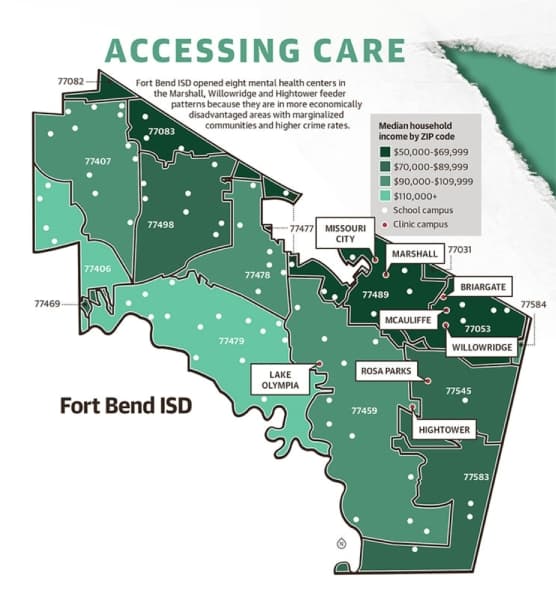
The centers—located at Hightower, Marshall and Willowridge high schools; Lake Olympia, Christa McAuliffe and Missouri City middle schools; and Rosa Parks and Briargate elementary schools—are funded by a $1.5 million grant awarded under the 1984 federal Victims of Crime Act.
Steve Shiels, FBISD’s director of behavioral health and wellness, said by opening these clinics the district is taking a big step in addressing the mental health needs of school-age children, the stigma around mental health and school safety concerns.
“Data shows that in the last five years, the mental health needs of students were just really beyond the scope of what a school was able to deal with well, and that it was a really big challenge for students who are not getting the support that they needed,” Shiels said.
Over the last three school years, FBISD has seen an increase in the number of calls to the FBISD Police Department for assistance handling high-risk mental health crises at school, according to the district’s application for the VOCA grant, which Community Impact Newspaper obtained through a public information request.
In the 2017-18 school year, district police responded to 68 high-risk mental health crises, with 52% of them occurring in the Hightower, Marshall and Willowridge feeder patterns, the feeder patterns with clinics. Additionally, from July 1, 2018, to Feb. 1, 2019, there were 117 calls, with 40% occurring in the identified feeder patterns.
Choosing clinic locations
FBISD chose the locations of the first clinics because they are in historically marginalized communities with high crime rates, according to the district’s VOCA grant application.
While FBISD confirmed in their VOCA application that there is a high demand for mental health services across all 11 of its feeder patterns, it said the demand is especially high in the Hightower, Marshall and Willowridge feeder patterns.
“Those feeder patterns were showing the highest [need] consistently, so that was the reason for that choice,” Shiels said.
Of the district’s 1,044 suicide assessments, 158 were performed in the Hightower, Marshall and Willowridge feeder patterns. School counselors conduct these assessments on students who verbalize or exhibit behaviors indicative of suicide ideation.
The district’s application also provided the Violent Crime Index—which looks at murder and nonnegligent manslaughter, forcible rape, robbery, and aggravated assault in an area—for three of the four ZIP codes with clinics. All three ZIP codes had a higher Violent Crime Index than the national average.
U.S. Census Bureau data shows that the ZIP codes where clinics are located had, on average, lower median household incomes. Additionally, district data showed the average percentage of economically disadvantaged students, or those who qualify for free and reduced-price lunch, in the Hightower, Marshall and Willowridge feeder patterns is 76%, whereas the district average is 43%.