
Every spring, hundreds of thousands of Greater Austin homeowners protest their assessed value in the hopes of reducing their property taxes. However, newly released performance data indicates that homeowners' choices directly affect how much money they actually save and keep in their pockets.
According to a recent study and analysis of more than 400,000 residential appeals statewide, Ownwell outperforms traditional consulting firms where it counts most: net cash savings (property tax bill savings after fees).
Who is saving the most on property taxes in Travis County?
In Travis County, Ownwell and the top four traditional firms filed over 129,000 protests combined for residential properties. Travis County is nearly wrapped up, with Ownwell completing 94% of its 63,084 protests and the other firms completing 92% of their 66,259 filings.
Portfolio distribution in Travis County
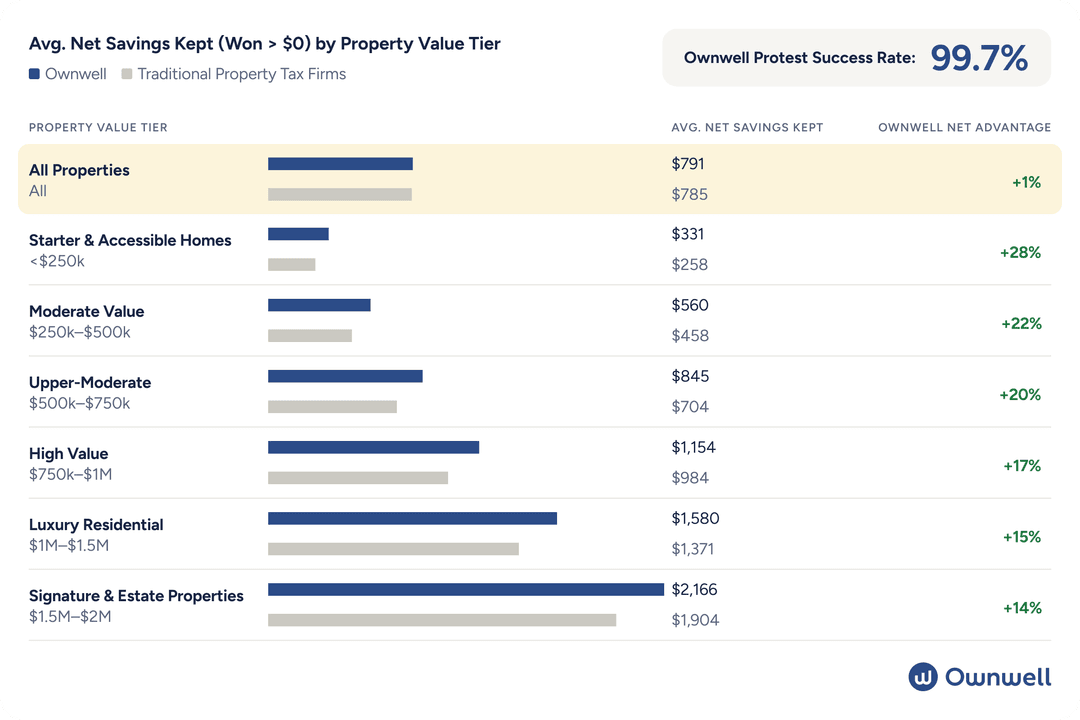
The overall net savings in Travis County ($791 versus $785) illustrates a statistical phenomenon known as Simpson's Paradox, driven by differences in the property mix.
Traditional firms handled nearly twice as many luxury protests, 11,937 properties in the $1 million to $2 million brackets, compared to 6,177 for Ownwell. Because higher-value properties inherently generate much larger dollar reductions, this disproportionate luxury volume pulled up the traditional firms' aggregate average.
However, when comparing apples to apples—homes within identical price brackets—Ownwell delivered 14% to 28% more net savings than traditional firms.
What's the difference between gross reductions and net savings?
In Travis County, traditional firms secured an average gross assessment reduction of 12.1% ($1,308 in gross tax savings), compared to Ownwell's 10.8% (1,055 in gross tax savings). Based purely on those gross figures, traditional firms appear to offer higher returns, but property owners cannot spend gross appraisal reductions.
Fees determine what homeowners actually keep:
Traditional firms typically charge a 40% to 50% contingency fee and often assess minimum fees.
Ownwell operates on a flat 25% contingency fee backed by a zero-savings, zero-fee guarantee.
What this means for local Austin homeowners
As property tax season approaches, Austin property owners don't have to accept higher valuations or surrender half of their potential savings to agency fees.
Choosing an appeal partner with transparent, low-cost pricing can protect hundreds of extra dollars in household savings.
Learn how representation models impact savings statewide by exploring the full 2026 Texas Property Tax Protest Study.
Find out if you’re overpaying on property taxes and how much you could save on your next property tax bill.
Methodology and research standards
This performance study compiles 2026 residential property tax protest records from Central Appraisal District (CAD) open records, Appraisal Review Board (ARB) determinations, and certified property tax rolls.
To establish a clear institutional baseline, the analysis aggregates the volume-weighted performance of the top four licensed property tax consulting agencies by volume in each respective county.
To eliminate seasonal reporting distortion, performance data is strictly restricted to counties where cumulative hearing resolutions reached or exceeded a 70% completion rate for both Ownwell and traditional firms.
Additionally, the study's net savings calculations deliberately exclude the upfront filing charges and minimum account fees that traditional competitors often assess, keeping the competitor net savings estimates conservative.
For a comprehensive breakdown of the tax rate formulas, data verification rules, and fee calculations, review the full methodology in the Texas Property Tax Protest Results: 2026 Agent Performance Data.
Who saved homeowners more in Travis County—Ownwell or traditional property tax firms?
Ownwell saved homeowners more money, delivering an average of $791 in net cash savings compared to $785 for traditional firms. When comparing homes within the exact same property value tiers, Ownwell clients retained 14% to 28% more cash in every bracket.
Why does the study focus on "net savings kept" instead of gross assessed reductions?
Property owners cannot spend gross percentage cuts, so what truly matters is the actual cash a homeowner keeps after agent fees are paid. Because traditional firms typically charge a 40% to 50% contingency fee, they capture a substantial share of any realized tax savings, leaving less money for the homeowner.
How does Ownwell’s fee model work?
Ownwell charges a flat 25% contingency fee in Texas and operates on a strict no-savings, no-fee guarantee. If a protest does not result in an actual tax bill reduction for the property owner, the owner pays nothing.
Can filing a property tax protest increase my assessed value?
No, filing a property tax protest will not increase your property valuation. Under Texas law, the County Appraisal District and Appraisal Review Board cannot increase your home's assessed value because of your protest.
What is the deadline to protest, and what do homeowners need to provide?
The deadline to file a property tax protest in Texas is generally May 15, or 30 days after your county mails your notice of appraised value, whichever is later. You can file a protest yourself, or sign up for representation with services like Ownwell, which typically handle all the necessary paperwork, evidence gathering, and hearing appearances on your behalf.