


Q: How are public schools currently funded in Texas?
Mike White: Public schools are funded primarily through a combination of local property tax revenue and state funding through the Foundation School Program. The state funding formula determines how much funding a school district is entitled to based on a number of factors, such as student attendance, student characteristics, local property values and the district's tax effort. As local property values and tax rates change, the state and local shares of funding can change as well, but the total amount determined by the formula stays the same. In other words, the state determines how much money a school district is allowed to receive, regardless of the funding source.
Q: What's the difference between M&O revenue and I&S revenue?
Mike White: The total tax rate is made up of Maintenance & Operations (M&O) and Interest & Sinking (I&S). M&O revenue pays for the day-to-day operations of the school district, such as payroll for teachers and staff, classroom supplies, curriculum, utilities, transportation, maintenance, safety and other operating expenses. I&S revenue is used for debt service, primarily to repay bonds that voters have previously authorized for facilities and other eligible capital expenditures. Essentially, this might be considered the district’s mortgage payment each year.
The tax rate election on the November ballot concerns the M&O tax rate only. This is not an election to issue bonds, and the district's I&S tax rate remains at 40.1 cents.
Q: What is the history of Bastrop ISD's tax rate?
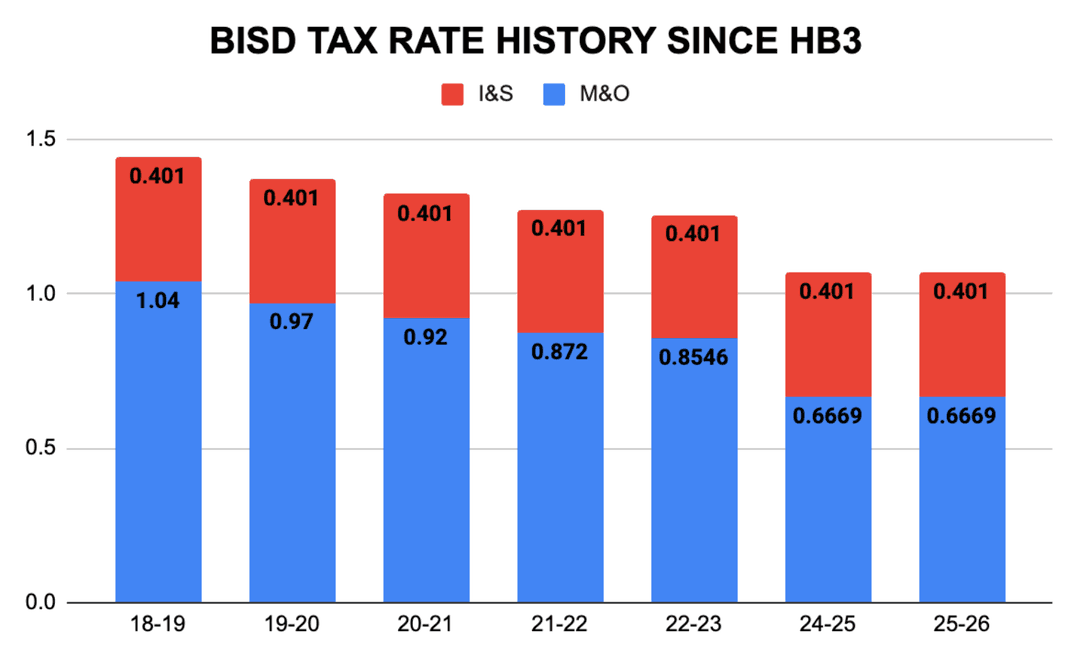
Mike White: BISD's overall tax rate has declined significantly over the last eight years, primarily because of compression to the M&O portion of the tax rate.
In 2018, BISD had an M&O rate of $1.04 and an I&S rate of 40.1 cents, for a total of $1.441. Since then, the M&O portion has declined by 37.31 pennies, bringing the total tax rate down to $1.0679.
Q: How does BISD's M&O tax rate compare with area school districts?
Mike White: Bastrop ISD is on the lower end of area districts we reviewed. Our M&O rate is 66.69 cents. Lockhart, Georgetown, Comal, Taylor, Hutto, Elgin, Smithville and Austin are all higher than ours. Giddings and Hays are in a similar range as Bastrop, and Del Valle is lower.
It is important when making these comparisons to distinguish between M&O and I&S rates. Districts have different debt obligations, property values and voter-authorized tax rates, so comparing only the total tax rate doesn't necessarily provide a complete picture of a district's operating tax effort.
Q: What is a VATRE and why is it required?
Mike White: VATRE stands for Voter-Approval Tax Rate Election. Texas law establishes how much M&O tax effort a school board can adopt without voter approval. Districts generally have a determined “base rate” given to them by the state and then have the choice locally to pursue additional funding through a tax rate election. This could include up to three “golden” pennies and up to nine “copper pennies.” In this VATRE, Bastrop ISD is pursuing the three golden pennies available.
Q: What is a "golden penny," and why does it matter to a school district?
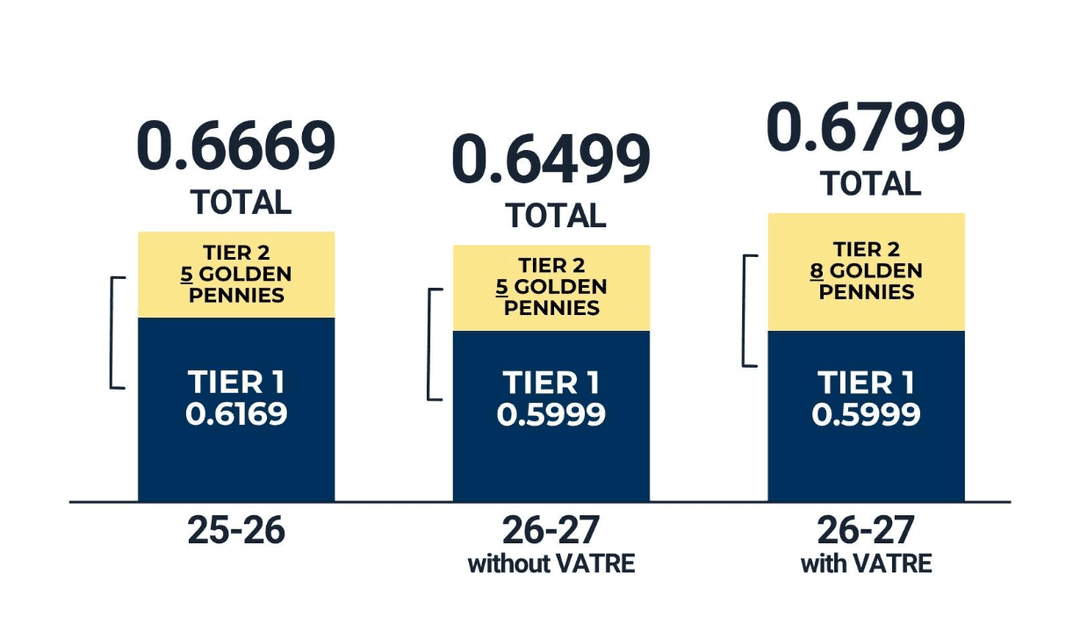
Mike White: The Texas school-finance system has different levels of M&O tax effort. The first tier (Tier 1) is the foundational portion of the M&O tax rate. The state calculates what is known as the Maximum Compressed Rate, or MCR, for each district. For BISD, the MCR declined from 61.69 cents in 2025 to 59.99 cents in 2026.
The next level is called Tier 2, and the first eight pennies of Tier 2 are commonly referred to as "golden pennies" because they receive the highest level of state equalization funding. For BISD, each additional golden penny is projected to generate about $800,000 in local revenue and about $1.2 million in additional state revenue. That's approximately $2 million per penny, which is $6 million annually for Bastrop ISD under the current formula.
Q: BISD currently has five approved golden pennies. How does that compare with neighboring districts?
Mike White: Since BISD has only the first five Tier 2 pennies, this is at the lower end of the area districts included in our comparison. Bastrop, Del Valle and Hays have five Tier 2 pennies each. Georgetown and Lockhart have eight, while Giddings has nine and Comal has twelve. Hutto, Elgin and Smithville each have approximately 14, while Taylor and Austin have 17.
If BISD voters approve the three golden pennies in the VATRE, BISD would have eight Tier 2 pennies.
Q: What Happens To The M&O Rate If The VATRE Doesn’t Pass?
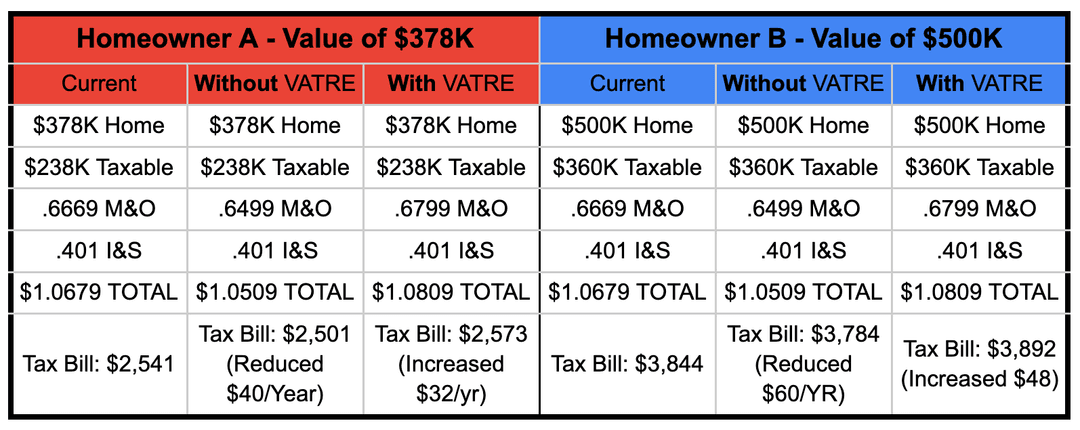
Mike White: If voters don’t approve the additional golden pennies, the M&O rate will decrease by 1.7 pennies, from 66.69 to 64.99 cents. This would be a small savings of about $40 for the year on their tax bill for the average home value homeowner.
Q: If the voters approve the tax rate, how would the additional revenue be used?
Mike White: The district has identified several areas where the additional revenue could be used. Those include improving employee compensation so BISD can remain competitive in recruiting and retaining educators; funding additional police officers and equipment associated with state school-safety requirements; addressing other district and Board priorities related to student achievement and organizational operations; and helping balance the district's General Fund budget.
The three additional pennies are projected to generate approximately $6 million based on current estimates—about $2.4 million from local tax collections and approximately $3.6 million in additional state funding.
Q: What will the impact be for the average homeowner, if approved?
Mike White: The average value for a home in our boundaries is $378,000. With the homestead exemption of $140,000, the taxable value is $238,000. This homeowner would see an increase of about $32 per year if the voters approve the VATRE. Let’s say we have a homeowner with a home that’s $500,000. With the homestead exemption, the taxable value is $360,000. This homeowner would see an increase of about $48 per year if the voters approve the VATRE.
Q: Bastrop ISD is experiencing significant growth and new development. Won't that growth generate additional tax revenue for the district? Why is a VATRE necessary?
Mike White: New development increases the amount of taxable property within Bastrop ISD, but it does not necessarily result in a corresponding increase in the money available to operate our schools. Texas funds school districts through a combination of local property taxes and state funding. As BISD generates more revenue locally because of increasing property values and development, the state's share of our funding generally decreases. In other words, the source of the funding shifts from the state to local taxpayers without necessarily producing the same increase in total operating revenue.
The VATRE works differently because it would allow BISD to access three additional Tier 2, or "golden," pennies that multiply the impact of local dollars. For every $1 generated locally, BISD would receive approximately $1.50 in additional state funding.
Q: What is the timeline for the VATRE election?
Mike White: The board adopted the proposed tax rate and called for the election during its Aug. 13 meeting and public hearing, so the VATRE will be on the ballot for Tuesday, Nov. 3, 2026. Ultimately, while the Board has called for the election, the decision on whether Bastrop ISD may access the three additional Tier 2 pennies will be made by the voters of Bastrop ISD. Between now and then, it’s our responsibility to educate the public about this issue and make sure they have all of the information they need to make an informed decision.
The above story was produced by the Bastrop ISD team with Community Impact's Storytelling team, using information solely provided by the local business as part of their "sponsored content" purchase through our advertising team.