

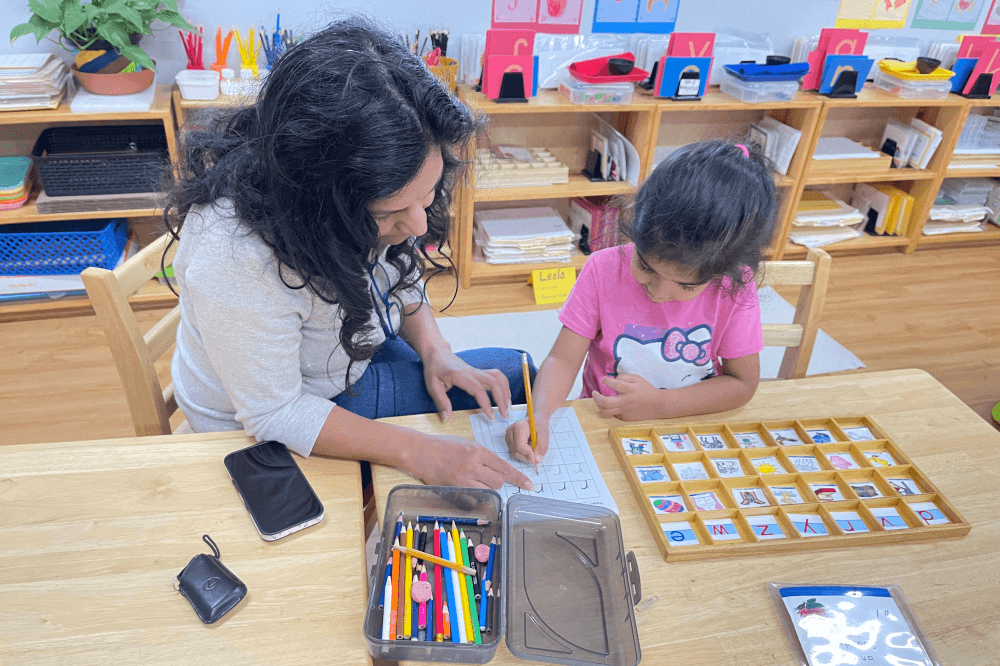
At Aspiring Minds Montessori in Frisco, classrooms are designed to meet students at their individual level, providing support to grow academically while building independence and confidence.
With 12 years in the community, the school has developed a program centered on consistent routines, hands-on materials and highly trained teachers who guide each child’s progress.
Rather than moving an entire class through the same lesson at the same pace, the model allows students to progress individually.
That philosophy, rooted in the work of Dr. Maria Montessori, comes to life through the school’s curriculum.
“Our curriculum was designed with the kids in mind,” Academic Director Roli Kapoor said. “When we were building the school, ... we hired a consultant who had been trained under Dr. Maria Montessori’s son, so we have a lot of add-on activities along with the basic Montessori activities.”
The curriculum uses a structured work cycle and carefully designed classroom materials. Students select activities, complete them from start to finish and return them before moving on, reinforcing both responsibility and focus.
For example, in language arts, children build skills in layers. A student may begin by tracing sandpaper letters with their fingers, then advance to sound recognition through image-based matching exercises. From there, they move into reading and spelling activities that progress toward sentence writing.
Because of this approach, it is not unusual to see students of the same age working at different levels, with teachers guiding each child toward the next appropriate challenge.

The role of teachers in guiding progress
That level of personalization depends on teacher expertise.
At Aspiring Minds Montessori, all teachers are Montessori-trained and hold bachelor’s or master’s degrees, along with teaching certifications. This allows them to track student progress and adjust instruction as needed.
“Our teachers are truly phenomenal,” Operations Director Kim Moore said. “They are well-educated women, and the way they guide the children is beautiful.”
Teachers maintain detailed progress records for each student. This helps them identify when a child is ready to move forward or needs additional reinforcement. Rather than holding students back or pushing them ahead too quickly, the focus is on meeting them where they are.
Consistency also plays a key role. Classrooms follow predictable routines, and staffing remains steady, ensuring children always have access to the same level of support.
Additionally, with both an Operations Director and an Academic Director in place, the school functions with exceptional efficiency and oversight.

Building independence from the start
The classroom structure is designed to do more than support academics; it also helps children develop independence early on.
From the toddler years, students learn how to carry materials, complete tasks and reset their workspace before beginning something new. These routines evolve as they grow, encouraging responsibility and self-direction.
By the time students reach the primary program, those habits translate into stronger focus, confidence, social awareness, self-regulation and respect.
“In the [primary program], they learn not just academics but how to be a good citizen,” Moore said.
A balance of structure and exploration
While core learning happens through Montessori materials, students also have opportunities to explore beyond the classroom routine. Weekly enrichment activities, led by outside specialists, introduce areas like music and yoga, giving children a chance to engage creatively and physically.
Weekly summer programs run in June and July. They incorporate themed activities, interactive experiences and elements of academic structure.
“Each week has a theme. For example, this year we’ll have a ‘Little Olympians’ theme, where the kids will learn about different sports, get an opportunity to play outside and compete in different friendly sports,” Kapoor said.

Seeing the results beyond the classroom
Both Directors said one of the most meaningful indicators of success comes from families after students leave the program.
Some parents have shared that their child’s kindergarten teacher noted how prepared they were, not only academically, but also in their willingness to participate, help others and take initiative in the classroom.
Others return years later to share updates: a reflection of the lasting impression the program leaves on students and families.
Just as important are the everyday moments: children who arrive unsure and gradually gain confidence; students who become eager to share what they’re learning; and classrooms where curiosity drives engagement.
After 12 years in Frisco, that environment continues to be at the heart of the school’s approach, creating a space where children don’t just learn but enjoy the process.
Click here to learn more about Aspiring Minds Montessori, or to contact the team today.

The above story was produced by Senior Multi-Platform Journalist Sydney Heller with Community Impact's Storytelling team with information solely provided by the local business as part of their "sponsored content" purchase through our advertising team.