

For many people, hip or knee pain starts as a minor inconvenience. Maybe it's discomfort during a morning walk, stiffness after sitting at work or difficulty keeping up with family activities. But over time, that pain can begin to interfere with everyday life.
When simple activities like climbing stairs, grocery shopping or getting out of a chair become challenging, knowing where to turn for help can make all the difference.
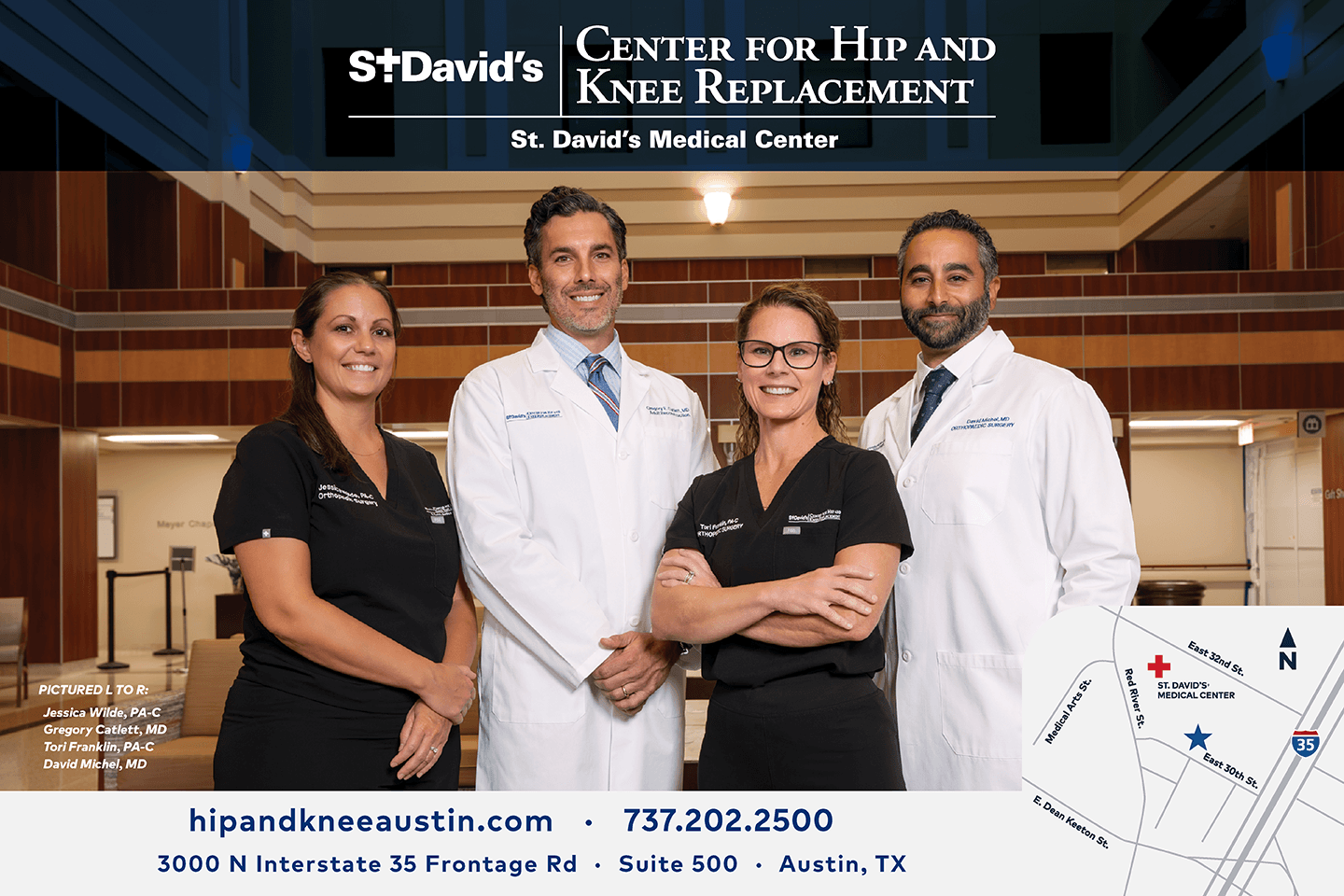
At St. David's Center for Hip and Knee Replacement in Central Austin, orthopedic surgeons Gregory Catlett, MD, and David Michel, MD, help patients find relief from joint pain and return to the activities that matter most to them.
Both physicians have completed advanced fellowship training in joint replacement surgery, bringing specialized expertise and a personalized approach to patients experiencing hip and knee problems.
Finding the right solution starts with understanding the patient
No two patients experience joint pain the same way. For some, discomfort may be manageable with lifestyle adjustments. For others, arthritis or joint deterioration can make even routine activities difficult.
That's why treatment at St. David's Center for Hip and Knee Replacement begins with understanding how pain affects each patient's life, what treatments they've already tried and what they hope to get back to doing.
During an initial appointment, patients typically receive X-rays, review their medical history and discuss their symptoms and goals with the care team.
Importantly, joint replacement surgery isn't always the first—or best—step.
Depending on the patient's condition, treatment may begin with physical therapy, medication, exercise, bracing or injections to help manage pain and inflammation.
Dr. Michel emphasizes that when nonsurgical approaches provide meaningful relief, patients may be able to delay joint replacement until surgery becomes a more appropriate option.
For patients, that means having a physician who considers their individual needs rather than focusing on a procedure alone.
When surgery becomes the right choice, specialized experience matters
For some patients, joint damage progresses to the point where nonsurgical treatments no longer provide enough relief. When pain consistently interferes with daily activities despite non-operative treatments, joint replacement may offer an opportunity to regain mobility and independence.
Both Dr. Catlett and Dr. Michel have completed an additional year of fellowship training focused on joint replacement beyond their five year orthopedic surgery residencies.
Their specialized training allows them to care for patients with a wide range of needs, from routine hip and knee replacements to more complex cases involving significant joint damage or complications from previous surgeries.
The practice offers total hip and knee replacements, partial knee replacements and revision procedures for patients who experience problems with an existing joint replacement.
For example, some patients with knee arthritis may qualify for a partial knee replacement, which addresses only the damaged portion of the joint while preserving healthy structures. Others may benefit more from a total replacement.
The goal is to identify the treatment that best fits each patient's condition, anatomy and long-term needs.
Advanced techniques designed around each patient
Joint replacement surgery has evolved significantly in recent years, giving orthopedic specialists more tools to personalize procedures and support recovery.
At St. David's Center for Hip and Knee Replacement, the physicians incorporate advanced surgical techniques and technology when appropriate, tailoring treatment to each patient's unique anatomy and needs.
For hip replacement patients, one option is the anterior approach, which allows the surgeon to reach the hip joint from the front while minimizing disruption to surrounding muscles and soft tissue.
"It's a very straight shot into the hip with minimal soft tissue disruption, and we're able to [place] the implants in a much more anatomic position, matching the patient's anatomy much better," Dr. Catlett said.
Dr. Catlett estimates that he and Dr. Michel perform approximately 95% of their hip replacements using this approach.
Robotic-assisted technology offers another way to personalize hip and knee replacement surgery. Using advanced imaging and 3D mapping, surgeons can plan procedures around each patient's unique anatomy and position implants with greater precision to better match their natural alignment and biomechanics. This individualized approach may help reduce postoperative discomfort and support a smoother recovery, with the goal of helping patients regain mobility and return to their everyday activities with greater confidence. The physicians also use newer implant techniques when appropriate, including options that allow bone to grow into the implant over time rather than relying on traditional bone cement.
While not every technique is right for every patient, these advancements give the physicians additional ways to tailor treatment to individual needs and help Central Texans return to the activities they enjoy.
Helping patients feel prepared for recovery
For many people considering joint replacement, the biggest questions aren't just about surgery. They're about what comes afterward.
How much pain will I have? How long will I need help at home? When can I get back to my usual routine?
At St. David's Center for Hip and Knee Replacement, preparing patients for recovery is an important part of the treatment process. The team truly prides themselves on patient education.
They help patients understand what to expect before, during and after surgery, including pain management, physical therapy and returning to daily activities.
Advancements in pain management, including non-opioid medications and specialized treatments that temporarily reduce pain signals from nerves around the knee, can help make recovery more comfortable for appropriate patients.
Getting patients moving safely after surgery is another priority.
When medically appropriate, some patients can return home the same day as their joint replacement. According to Dr. Michel, approximately 75% of his patients are discharged the same day, allowing them to begin recovering in the comfort of their own homes.
Recovery timelines vary, but many patients can resume lighter activities, such as grocery shopping or meeting friends for lunch, within a few weeks. Over the following months, patients typically work toward returning to their normal routines.
Throughout the process, the physicians emphasize education, preparation and helping patients feel confident in their recovery.
Helping patients regain more than mobility
For Dr. Catlett and Dr. Michel, successful treatment is about more than replacing a damaged joint. It's about helping patients reclaim the parts of life that pain has taken away.
That might mean taking a walk around the neighborhood, spending time with grandchildren, participating in triathlons, returning to a favorite hobby or simply moving through the day with less discomfort.
The physicians have treated patients with a wide range of orthopedic needs, including individuals with significant joint deterioration and complex medical conditions.
In one challenging case, Dr. Catlett treated a patient whose neurological condition had contributed to severe knee damage and an inability to walk independently. Using robotic-assisted technology, he carefully planned and performed the replacement to address the patient's complex joint condition.
At a follow-up visit, the patient was walking without assistance and reported being free of the knee pain that had previously limited daily life.
While every patient's outcome is different, experiences like these reinforce the importance of specialized expertise and individualized care.
Specialized orthopedic care, close to home
Located at St. David's Medical Center, nationally ranked as a Best Hospital for Joint Replacement (100 Best Hospitals for Joint Replacement™, 2023-2027), St. David's Center for Hip and Knee Replacement provides Central Austin patients access to fellowship-trained orthopedic surgeons and a dedicated team focused on hip and knee health.
For Dr. Michel, caring for patients in Austin is especially meaningful.
Born and raised in the city, he has had the opportunity to treat members of the same community that helped shape his life, including former teachers and other familiar faces from his childhood.
"I just feel really lucky to be back in my hometown, taking care of the community that's taken care of me," Dr. Michel said.
Together, Dr. Michel, Dr. Catlett and their care team focus on helping patients feel informed, supported and confident throughout their treatment journey. Behind the scenes, a dedicated staff supports the physicians by coordinating appointments, answering questions and helping patients navigate their care. The team also prioritizes accessibility and communication, making it easy for patients to connect with the practice and get the assistance they need.
Whether managing symptoms without surgery or restoring mobility through joint replacement, their goal remains the same: helping patients move more comfortably and get back to living life on their terms.
Ready to explore your options for hip or knee pain?
Schedule an appointment with St. David's Center for Hip and Knee Replacement to learn more about treatment options.
St. David's Center for Hip and Knee Replacement
Website: https://hipandkneeaustin.com/
Schedule an appointment: https://hipandkneeaustin.com/providers/
Phone: 737-202-2500
Address: 3000 N. I-35 Frontage Rd., Ste. 500, Austin, TX
Hours: Monday–Thursday, 8 a.m.–4:30 p.m.; Friday, 8 a.m.–1 p.m.
Frequently asked questions
How do I know if I need a hip or knee replacement?
If joint pain interferes with everyday activities or isn't improving with nonsurgical treatments, an orthopedic evaluation may help determine whether surgery or another approach is appropriate.
Can hip or knee pain be treated without surgery?
Yes. Depending on the condition, options may include physical therapy, exercise, bracing and injections to help manage discomfort.
How long does recovery take after joint replacement?
Recovery varies by patient and procedure. Many patients can begin lighter activities within a few weeks and gradually return to normal routines over the following months.
What makes St. David's Center for Hip and Knee Replacement different?
Both Dr. Catlett and Dr. Michel have completed fellowship training in joint replacement surgery. They combine specialized orthopedic expertise, individualized treatment planning and patient education to support patients from their initial evaluation through recovery.