

For patients facing complex neurological conditions, accessing advanced treatment often requires specialized expertise and technology, and having those resources available close to home can make a meaningful difference for patients and their families.
At Central Texas Brain & Spine, physicians work alongside specialized care teams at St. David's North Austin Medical Center to expand local access to innovative treatments for conditions, including:
Movement disorders and epilepsy
Scoliosis and spinal deformity
Brain and spinal tumors
What advanced neurological treatments are available?
One of the advanced treatments available through Central Texas Brain & Spine is deep brain stimulation (DBS). The procedure may help select patients with disorders such as Parkinson's disease, essential tremor, dystonia and medication-resistant epilepsy.
Physicians offer both awake and asleep DBS procedures, incorporating technologies such as robotic assistance and Alpha Omega mapping to support surgical precision.
Additional technologies include:
Diffusion tensor imaging (DTI): DTI helps map important brain pathways when planning procedures for conditions such as brain tumors and epilepsy.
Globus robotic platform: Assists with surgical planning and instrumentation for spinal conditions, including degenerative disease and spinal instability.
Responsive neurostimulation (RNS): An implanted device monitors brain activity and delivers targeted stimulation to help reduce seizures for certain patients with drug-resistant focal epilepsy.
The practice also collaborates with rehabilitation partners, including in areas such as vagus nerve stimulation for stroke recovery.
How is focused ultrasound expanding treatment options?
Beginning in December, Central Texas Brain & Spine physicians expect to introduce MRI-guided focused ultrasound at St. David's North Austin Medical Center, expanding treatment options for eligible patients with essential tremor or Parkinson's disease who continue experiencing tremors despite medication.
Unlike traditional surgery, focused ultrasound does not require incisions, implants or radiation. Instead, the procedure uses high-frequency sound waves guided by real-time MRI imaging to target a small region of the brain called the ventral intermediate nucleus (Vim) of the thalamus, which plays an important role in tremor activity.
By directing energy to this precise location, physicians create a controlled lesion intended to reduce tremors. Each treatment is carefully planned around the patient's unique anatomy and symptoms.
“We believe we will be the only ones in the area using this technology,” Dr. Dhruve Jeevan said. “The goal is to reduce tremors and help patients regain confidence in everyday activities such as eating, writing and drinking.”
How does the practice support patients living with epilepsy?
Central Texas Brain & Spine treats both children and adults living with epilepsy at St. David's North Austin Medical Center. This allows children to have continuity of care as they grow into adulthood, minimizing disruptions and helping them maintain relationships with care teams.
This care includes specialized evaluations, monitoring and treatment, such as advanced surgical and device-based options when appropriate.
The hospital has earned a Level IV epilepsy designation from the National Association of Epilepsy Centers, which is the highest level of accreditation available. This designation recognizes centers providing the most complex medical and surgical evaluations and treatments for patients with epilepsy.
What specialized care is available for newborns and children?
Central Texas Brain & Spine provides specialized care for premature babies and newborns with complex medical challenges at St. David’s Women’s Center of Texas, located at St. David’s North Austin Medical Center, which offers Level IV maternal services to support the highest-risk babies.
Who are the providers behind Central Texas Brain & Spine?
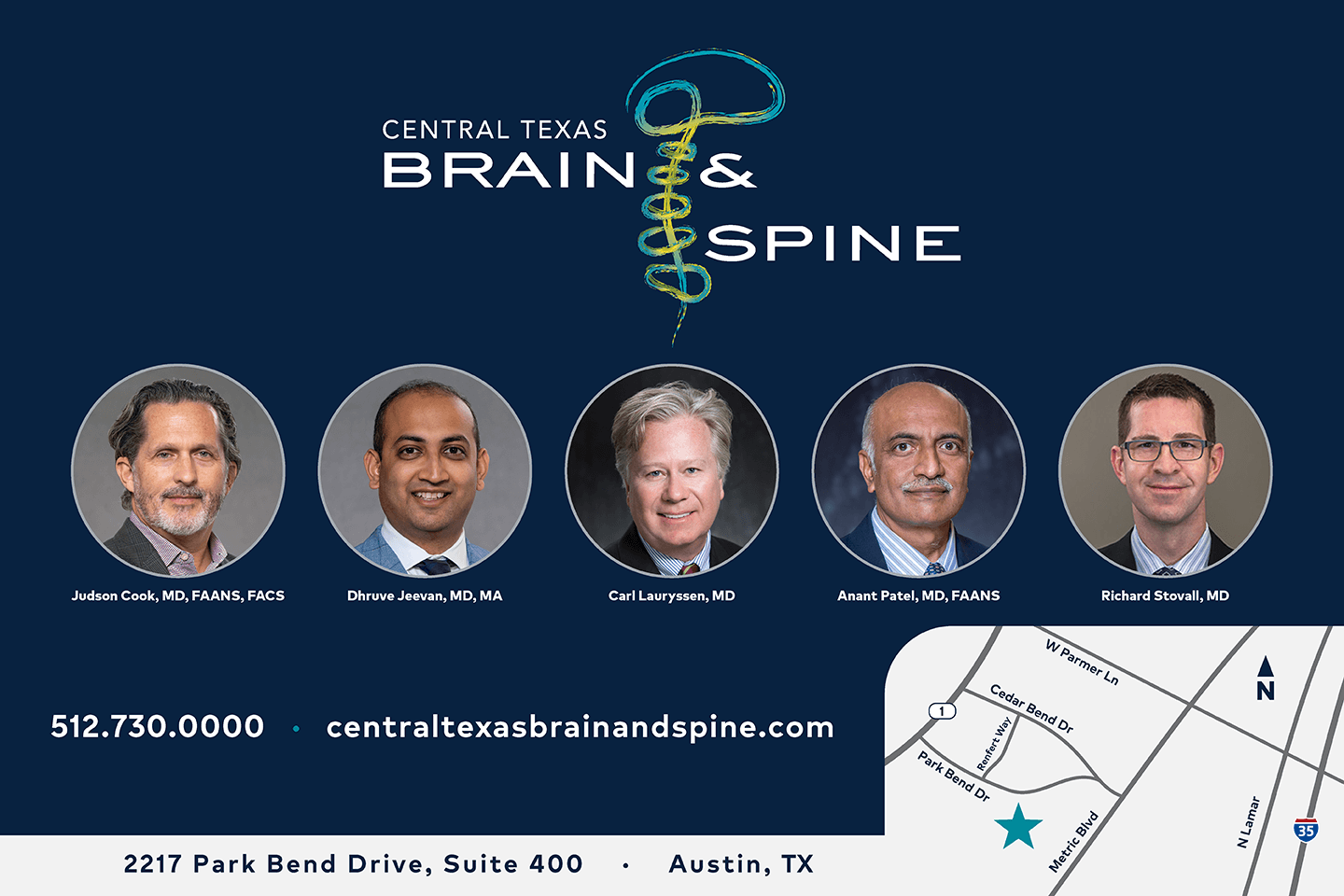
Central Texas Brain & Spine's team includes five neurosurgeons and two physician assistants:
Anant Patel, MD, FAANS: Has helped introduce advanced neurological technologies to Austin since 1998 and is one of a limited number of deep brain stimulation on-site trainers nationwide.
Dhruve Jeevan, MD, MA: A board-certified adult and pediatric neurosurgeon, specializing in the diagnosis and treatment of a broad range of pediatric brain disorders and adult neurosurgery.
Carl Lauryssen, MD: Certified by both American and Canadian neurological surgery boards, Dr. Lauryssen’s research and surgical interests have focused on minimally invasive surgery, motion preservation and sports-related spinal injuries.
Judson Cook, MD: Specializes in spinal reconstruction, revision surgery and neuromodulation, having performed more than 2,000 stimulator procedures throughout his career.
Richard Stovall, MD: Completed his neurosurgical residency at UT Southwestern Medical School and Parkland Hospital in Dallas. His background includes neurological surgery and published medical research.
Gileana Santana, PA-C: A nationally certified physician assistant with clinical and neurosurgical expertise. She earned her master's degree in physician assistant studies from the New York Institute of Technology.
William Whitlock, PA: A board-certified physician assistant with experience in neurosurgery and orthopedic spine surgery, including complex cranial and spinal procedures, surgical assistance and preoperative and postoperative patient care.
What's next for Central Texas Brain & Spine?
Looking ahead, physicians are exploring additional applications for emerging treatments, including the potential use of vagus nerve stimulation for patients with rheumatoid arthritis. This innovation supports Central Texas Brain & Spine’s mission to bring treatment and care options closer to Central Texas residents.
“The hospital is committed to expanding access to specialized care and supporting physicians who bring established innovations to patients,” Dr. Anant Patel said.
Those interested in learning more about Central Texas Brain & Spine can find information here:
Contact the team: http://centraltexasbrainandspine.com/contact-us/
What is the significance of the Level IV epilepsy designation earned by St. David's North Austin Medical Center?
The Level IV epilepsy designation is the highest level of accreditation available from the National Association of Epilepsy Centers.
This designation recognizes centers that provide the most complex medical and surgical evaluations and treatments for patients living with epilepsy.
When will MRI-guided focused ultrasound become available as a treatment option?
Central Texas Brain & Spine physicians expect to introduce MRI-guided focused ultrasound at St. David's North Austin Medical Center beginning in December.
This non-surgical procedure will expand treatment options for eligible patients with essential tremor or Parkinson's disease who continue to experience tremors despite taking medication.
Who are the neurosurgeons and physician assistants on the medical team?
The medical team at Central Texas Brain & Spine consists of five neurosurgeons and two physician assistants.
The neurosurgeons are Dr. Anant Patel, Dr. Dhruve Jeevan, Dr. Carl Lauryssen, Dr. Judson Cook and Dr. Richard Stovall.
The physician assistants are Gileana Santana and William Whitlock.