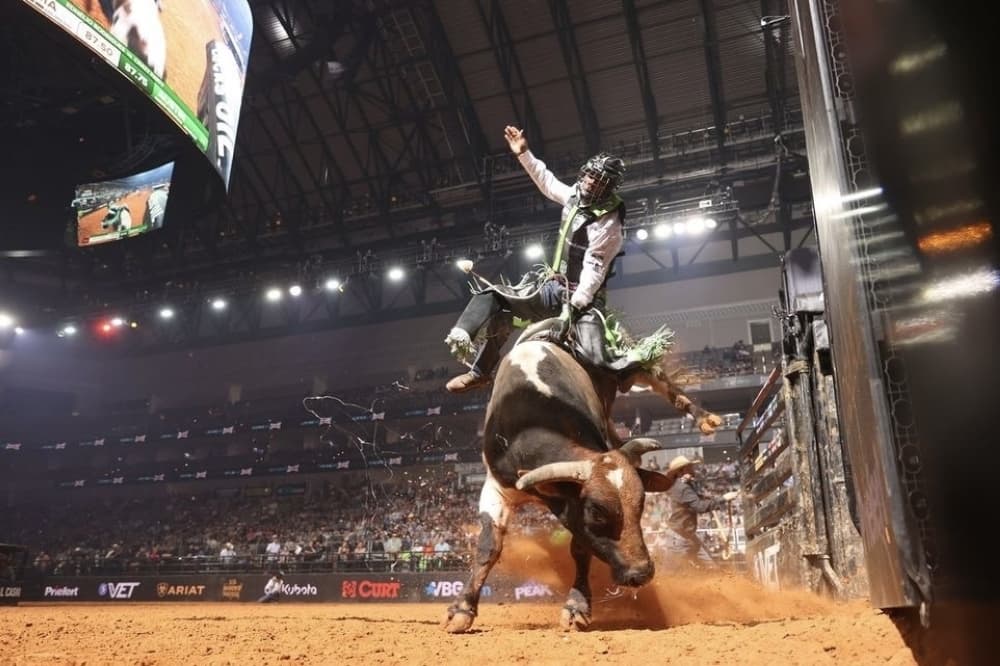
Austin Gamblers, the city’s first professional bull-riding team, has now commenced its fifth season in the PBR Camping World Team Series. The Gamblers were established in 2022 after PBR switched from being an individual sport for 30 years to a regional team format. The Gamblers gave locals another home team to root for and out-of-towners another reason to visit Austin, tourism data shows.
The team kicked off its season July 10 in Colorado, and riders are heading back down south in late August for their only local event of the season: Gambler Days. The three-day bull riding event signifies half a decade of competition, growth and economic impact on city tourism.
The local impact
In 2025, Gambler Days generated approximately $4.5 million in direct economic impact to the Greater Austin region, according to Nathan Kopp, Austin Sports Commission executive director. That impact translated to about 5,800 hotel rooms and $218,000 in local tax revenue.
“It’s not just heads in beds,” Kopp said. “Those people coming into our market are spending money on retail and going to eat at our restaurants and bars. It’s a far greater impact than just our hotel community.”
Respecting the craft
The Austin Gamblers team is composed of eight riders led by head coach Michael Gaffney and CEO JJ Gottsch. One rider, Dalton Kasel, has been with the team since its conception in 2022. Kasel grew up playing sports and watching bull riding on TV, leading him to a 14-year career in bull riding.
“It can be such an enjoyable eight seconds, or it can be the longest eight seconds ever,” Kasel said. “It’s something that we all truly love.”
The 2026 season marks the 25-year-old’s eighth year competing professionally. Many riders retire at a young age; if a bull rider is in their mid-30s, that’s considered a long career, Kasel explained. Some riders, including Kasel, continue their cattle career by working in the stock contracting industry and raising animals for rodeo events. Many have bulls at their house for practice, Kasel said, and his goal is to make a living hauling and raising bucking bulls after retiring from riding.
What they’re saying
Bull riding is typically defined by the eight seconds a rider spends on the bull. However, Oklahoma-based stock contractors, the Drury family, shared what it takes to get a bull to competition. Chad, Jenny and Addie Drury are the faces behind Nothin’ But Try Ranch, which they’ve operated for nearly 20 years. They raise 40-60 bull calves per year for PBR and other rodeo events.
Once a calf is born, the family will start preparing it for competition with a 14-pound dummy. Once the bulls reach 3 years old, the stock contractors will pair them with riders at smaller events, getting them adjusted to travel and exposed to the environment. At PBR events, bulls are typically in their prime between ages 5 and 7, Chad Drury said. Once the bulls are ready to retire, they are sold for riders to use as practice bulls, used for breeding or kept to retire on the ranch.
Some organizations and individuals oppose bull riding, stating that “many rodeo events subject animals to significant discomfort and pain,” through devices including spurs, electric prods and bucking straps, according to Action For Animals Austin.
Gottsch and Chad Drury said that the biggest misconception about bucking bulls is that people tie a rope around the animal’s genitals in order to make it buck. Rodeo workers tie a cotton rope around the bull’s flank, the space between the ribs and hip, meant to create a tickling sensation and entice the animal to kick it off, Chad Drury said.
“I try to get out in front of any perceived animal rights issues,” Gottsch said. “I’ll be happy to sit down and have a conversation with anyone at any time and really walk through the tremendous animal care that these athletes are given—and we really do consider them athletes.”
What to expect
In 2024, Austin Gamblers walked away from the season as PBR World Champions. In August, the team is taking the stage at Moody Center for three days, eight seconds at a time. The event is a high-energy environment stacked with music, fire and smoke, Gottsch said.
“If you’re a hardcore, long-time PBR fan, you’re still coming to watch the best 50 bull riders in the world compete on the 50 best bulls in the world,” Gottsch said. “If you’re someone who’s just intrigued ... you can still come and enjoy bull riding without having to know all the nuances.”
For Kasel, at an event like Gambler Days his adrenaline is fueled by music, lights and, of course, the fans.
“It’s extremely humbling that there’s people [who] ... spend the money that they worked hard for and earned to come watch us so we’re able to do our job,” Kasel said.