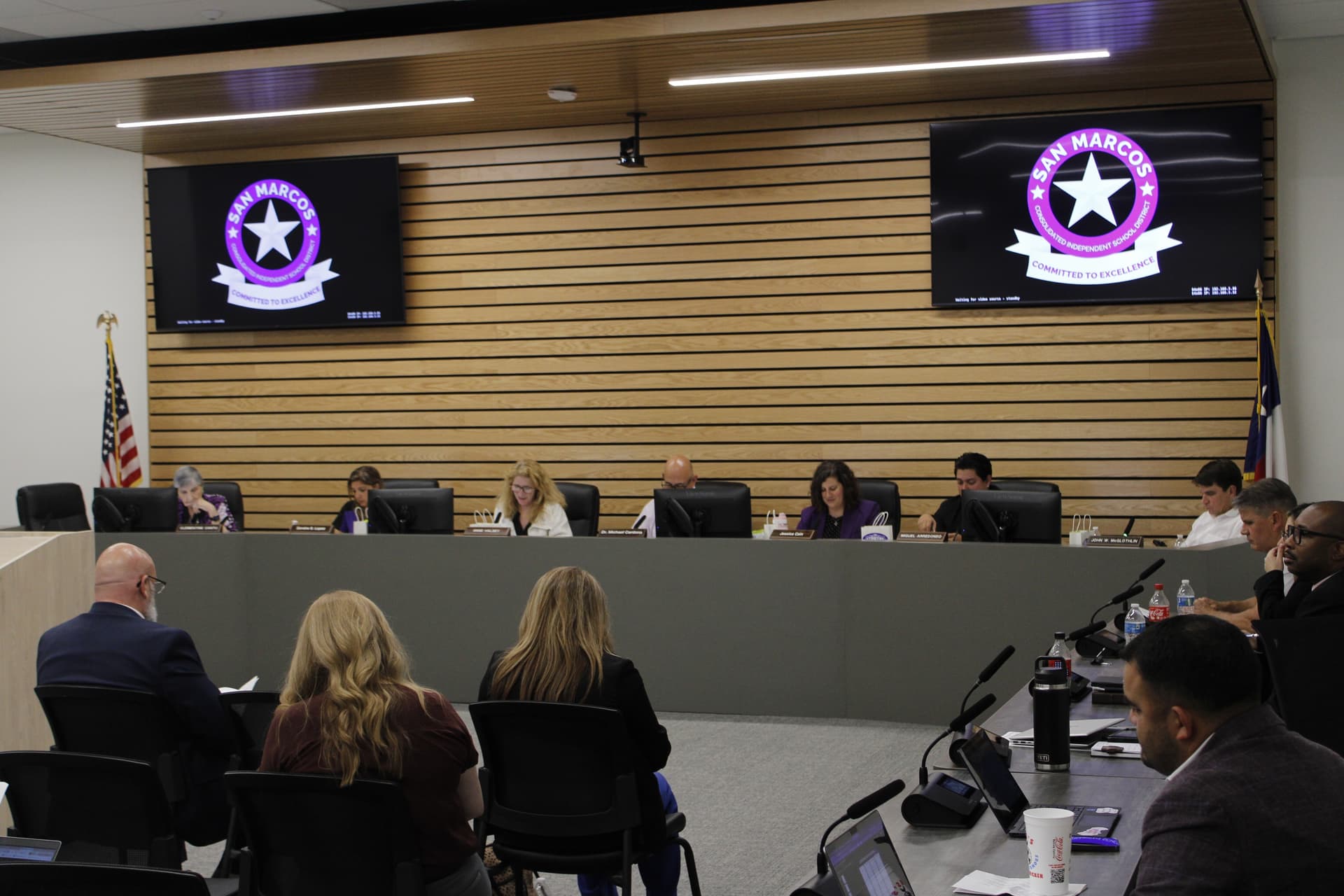
During an Aug. 17 meeting, the San Marcos CISD Board of Trustees reviewed the district’s 2026 accountability rating from the Texas Education Agency, or TEA. The district earned an overall score of 76, or a 'C' rating, with no change from its 2025 score.
While SMCISD’s overall score remained the same, individual campuses saw change, with many facing significant rating increases or decreases.
The overview
The TEA utilizes four categories when calculating its A-F accountability ratings for districts and campuses:
- Student achievement
- School progress
- Academic growth
- Relative performance
- Closing the gaps
The "school progress" domain is determined by taking the higher score a district or campus receives between "academic growth" and "relative performance."
The higher score between "student achievement" and "school progress" then makes up 70% of the district’s or campus’s overall accountability rating, according to the TEA 2026 Accountability Manual. The "closing the gaps" score makes up 30% of its accountability rating.
SMCISD received four 'A' ratings, one 'B', two 'C' ratings, five 'D' ratings and no 'F' ratings, according to the 2026 accountability scores. Most campuses received a different rating in 2026 than in 2025.
“I'm very alarmed and concerned at what this data shows us,” said SMCISD District 4 trustee John McGlothlin. “It's not about singling people out; it's just collectively owning a problem.”
“I think there's a lot here to celebrate,” said SMCISD board President Anne Halsey. “I think there's a lot here that we need to address and consider our challenges. I think that we don't do anything good unless we address it head-on."
Next steps
District staff identified systemic issues that may have contributed to some declining scores, including below-grade-level expectations and inconsistent practices across campuses.
Students may move into new grades below the necessary grade level due to various gaps, and teachers may then view the assigned work as too difficult, SMCISD Chief Academic Officer Twila Guajardo said.
“That's a mindset, or [instructor] not knowing the standards well enough,” Guajardo said. “Whether that is an administrator or maybe a first-year teacher, our job is to make sure that we train them and teach them so that they do know the level of work.”
To address inconsistent practices across campuses, the district has brought the middle schools into better alignment, Guajardo said. The district also aims to align practices more closely across its elementary schools.
“Our job at the district level is working with principals to break down some of the natural barriers that occur because we're in different buildings and setting the culture to be one of support and creating synergy among the adults that we have on our campuses,” Guajardo said.
Quote of note
“We had years where our district would do more poorly, and years where our district would do better, but we generally moved as a group,” McGlothlin said. “I see schools that should be lauded that did very well on the southwest side of town, but I want everyone in the school district to feel good about the chance their kid has. If you don't live in that region right now, and you look at these scores, it's alarming. If you live over there, you don't feel like you're living in the same school district.”