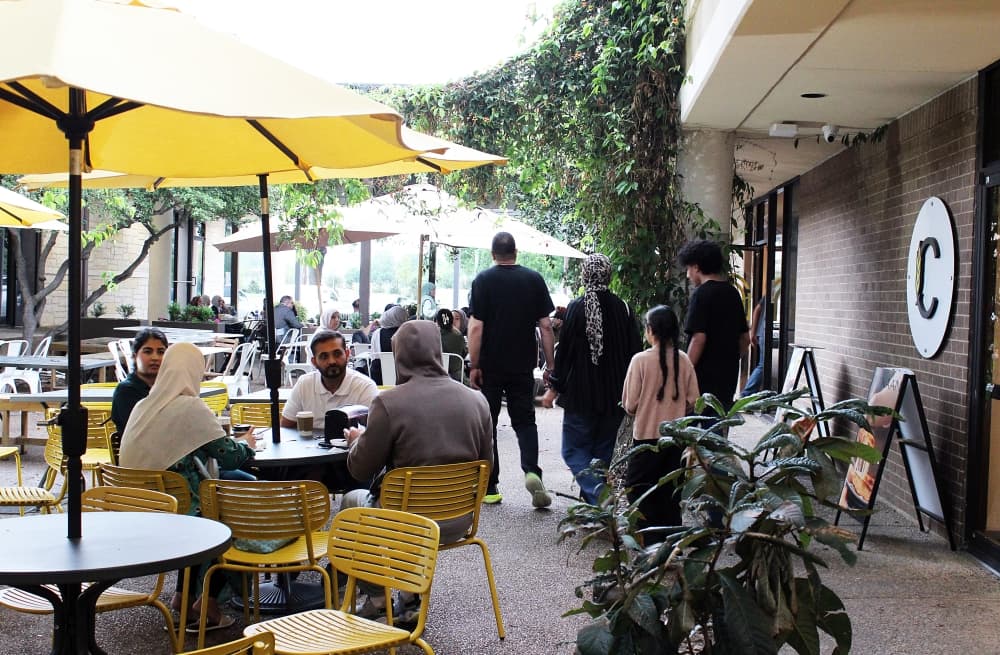
Starting with The Arabian Village, several shopping centers in south Richardson are developing around Middle Eastern businesses. Several developers aim to make Richardson a landing spot for Middle Eastern and Arab business in Dallas.
The big picture
When Adam Shawish moved to Dallas in 1998, he found just a handful of Middle Eastern restaurants. He said he dreamed of creating a center for Middle Eastern businesses in the area.
“There is Little Palestine in Orange County, there is Little Arabia,” Shawish said. “My dream was to create something like that.”
With its diverse residents and several established Middle Eastern businesses—including Afrah Mediterranean Cuisine and Sara’s Market & Bakery—Shawish said he knew Richardson could become that go-to center. He bought the first building in The Arabian Village in 2019 and began recruiting businesses.
Kareem Jibrin said the same vision motivated his father Sammy to begin developing Al Ameera Plaza a few years later.
“We would go to all these Arab cities in other states—like for instance, if you go to New Jersey, all the Arabs are in Patterson,” Jibrin said. “We wanted people to come to Dallas and say, ‘We have to go to Richardson.’”
The background
Within the last several years, The Arabian Village and Al Ameera Plaza have welcomed international businesses opening their first American location as well as businesses already established in Texas or Richardson. Shawish also said he brought Texas’ first Yemeni coffee shop to The Arabian Village.
“We wanted things that were different, things that people would drive [for],” Jibrin said.
Jibrin said a woman flew in from California for the opening of Jordanian restaurant Khashoka Middle Eastern Cuisine, while Shawish said he meets customers who drive in from Oklahoma.
Dania Allan, the listing agent for the planned Habibi Market Plaza, said that although the new development isn’t seeking specifically Middle Eastern businesses, many have flocked to the center due to the nearby developments and neighboring Sara’s Market and Bakery, a 30-year Richardson staple.
“[The development] builds on the idea that we’re a foodie city, and that one step beyond that, we’re an international foodie city,” City Manager Don Magner said.
Zooming in
Emad Saif said his new restaurant in The Arabian Village, Salam Juice & Mutbaq, is the first place many Arab customers can try mutabbaq, a Yemeni crispy stuffed flatbread, outside of the Middle East.
“This is like a memory for them,” Saif said.
Ammar Alashwal said the same is true for his Yemandi Yemeni Cuisine, also in The Arabian Village.
“The Arab community feels represented,” Alashwal said, when they are able to eat food at his restaurant that they haven’t been able to find in Dallas before. In addition to the Arab residents, Alashwal said that it was all of Richardson’s diverse and international communities that made the city the right place for his restaurant.
“At first there was a lot of curiosity from people who didn’t even know about Yemeni food,” Alashwal said. “Once they tried it, the curiosity turned into excitement.”
While Saif, who also operates businesses in North Carolina, said the shopping center growth makes it easier for business owners to find a place to open in Richardson, he said he is also concerned about the growth in competition if too many similar restaurants open nearby.
“Two locations, no problem, but if everybody around the area opens the same [thing], it’s going to be difficult,” Saif said.
Put in perspective
Dallas and Collin counties are home to some of Texas’ largest Arab American populations, but Shawish and Jibrin said it is also Richardson’s growing diversity across the board, with the city’s mix of cultures and international dining and retail options, that fuels the success of their businesses.
Mayor Amir Omar said that diversity in the business community is one of Richardson’s “greatest strengths as a city.”
“It’s about creating spaces where businesses can thrive together, not just individually,” Omar said.
Magner said that the impact of individual businesses on city sales tax revenue is relatively minor. Sales tax is a primary funding source for public safety, the library, parks and recreation, animal services and other city programs, per the city website.
Magner added that the city sees a larger benefit when businesses come together to “create a place,” similar to DFW Chinatown near downtown Richardson.
“It’s when they begin to cluster that people start to come from all over to experience it,” Magner said. “They create something bigger together.”
Looking ahead
Since he started development in The Arabian Village, Shawish said he has seen rents for retail spaces in the area jump significantly, outpacing increases he sees in other cities.
“We did make this area special,” Shawish said.
Shawish said he is planning the second phase of his project, developing nine buildings along Business Parkway and Spring Valley Road. Jibrin said more business openings are also lined up in Al Ameera Plaza, and the first restaurant in Habibi Market Plaza will open this spring.
“It’s great that [Al Ameera Plaza] is starting to grow, but we want people to focus on the vision and what we were able to do in a span of two years,” Jibrin said. “Imagine what all of us could do together in the next three to four [years].”