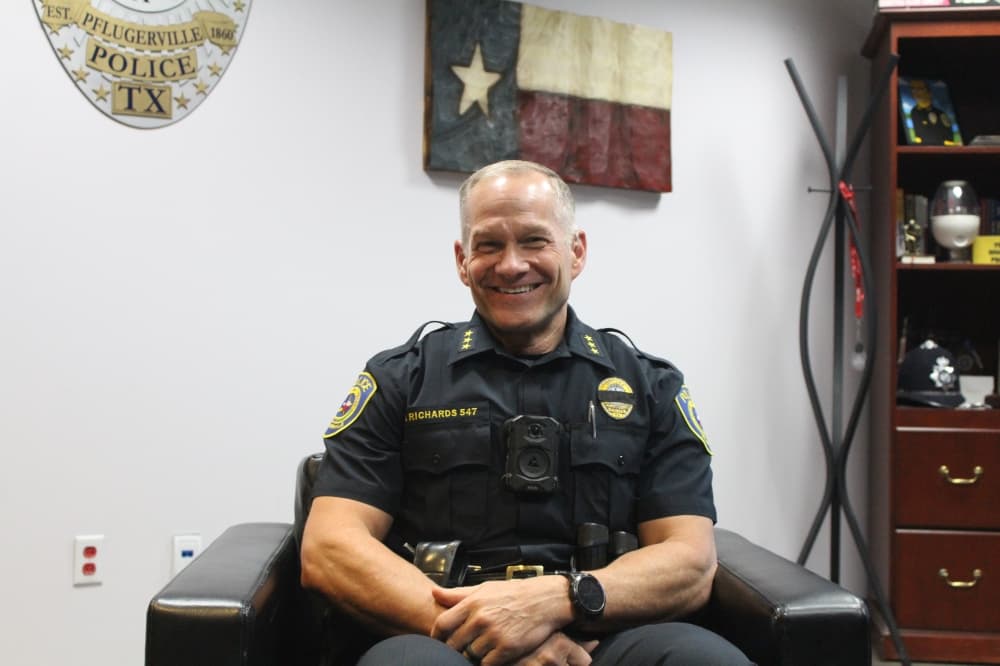
Pflugerville Police Chief Willie Richards stepped into his role in December 2025, bringing years of experience to the city. Community Impact sat down with Richards to discuss his first six months in the role and what the future holds.
Tell me a little about yourself, your background, and your experience.
I'm a born-and-raised Austin kid. I have been married for 34 years. I have three sons and six grandchildren. Two of my boys are in law enforcement.
I spent a couple of years in the Army Reserves, went to Travis County, worked in the jail for almost two years back in the day, and left there to go to DPS. Spent almost two years at the Texas Department of Public Safety. I was the first Capital Police Academy that went through and got assigned to the Capital Extension, and I got really, really bored and ended up in Round Rock in 1995. I spent 30 years, a little bit more, in Round Rock before getting chosen for the chief police job here. And I had no plans on leaving. I was completely content and happy with what we built there and what we've done. This job came open, and I'm like, ‘I'm going to go take a shot at it.’ And I find myself sitting here six months later going, ‘What an amazing experience.’ I'm so glad I took the leap to go from Round Rock to here and be part of what we're doing.
You've been here for a little over six months now; can you tell me about your time so far and what you've accomplished?
I would say that in the first six months, I set a goal for myself for the first 90 days to make no changes or do any big moves. That lasted about 35 to 40 days. We started making some adjustments. A lot of it, the time, was just spent listening and understanding the internal strengths and what we were doing as an organization and then really evaluating in that initial onset of time what our policies were, what the practices were, how we were doing and how that lined up with modern-day best practices, and looking for any efficiencies or process improvements that we can make internally. That's probably [what] about the first 60 to 90 days is really doing that and looking for best practices, what do we already meet, what's the up and coming trends, and how can we incorporate that into our policing model, and how we interact with our public, and how we treat each other inside the the business, and how go out and do effective policing with the community, not to the community.
Some of our previous reporting said that you guys are shifting toward technology-assisted policing. Could you talk about that?
When I think about technology-assisted policing, some of the trends or the buzzwords, or agencies having real-time crime centers [set] up, and the hard part of that is if you've got a huge major metropolitan area where you have specific crime patterns and trends that are recurring over and over, you need a real-time crime center that's actively monitored. That's one component. But we're a midsize city connected to a major metropolitan hub right here in Austin. So what I looked at is maybe your real-time crime center is more of a technology-assisted policing model. And so when I say technology-assisted policing, it's about finding the assistance of technology to leverage or be a force multiplier for the organization. So that can be everything from partnering with communities and how they share their information and knowledge base, to how one of our businesses—just consider Home Depot or Dick’s Sporting Goods or Target—they have technology to assist them. So how do we collaborate with them when we know that they have an occurrence of theft that comes into their business? We work with our business partners and our community partners on the technology side of how we police, and we can't have a police officer on every street and every corner and every crime trend. But what we do have is [that] our community has Ring cameras. Our community has technology devices attached in their cars, and people video their drives to and from work and the store now. So, as they witness or see things, they may not even know they have it. So, leveraging that technology that's out there to assist us in the policing method is a force multiplier.
Another one of the priorities that had been highlighted was continuing recruitment and retention efforts. Is that something you're focused on?
It is. We just opened about a week and a half ago the process for both cadets and for lateral police officer entry into the organization. We'll keep them open for 30 days. And so we're doing very specific recruitment efforts towards historically unrecruited populations. So a simple example would be that we're not only hitting LinkedIn or Facebook advertisements, but how do we go after a 30- or 90-second reel on a TikTok advertisement to recruit a younger population into the organization, right?
Advertising through the National Association of Black Law Enforcement Executives, getting our interfaith council groups and going back to our community and asking them, 'hey, if you know somebody who's interested in being a servant with the police and serving their community, refer them to us.'
We're going after recruits that are getting out of the military right now. So, the best recruiters that we know we have are people that are already working in the organization, and they've identified somebody or they met somebody on a call that would be a great candidate for recruitment, and they're actually going out, and I've seen like six already where officers or other staff come join us as a cadet or as a lateral police officer.
There are some changes in the works about how policing is done in Pflugerville. Could you explain that?
A couple of things I looked at when I got to the organization were: what's our evidence, procedures, and laws? How's that managed, and can we do an audit? So, we got an audit done, identified some clerical needs that needed to be tightened up a little bit, and corrected those.
Then the next thing I led us into is, let's evaluate the pursuit policy in our response to resistance or aggression, or what many people refer to as the use-of-force policy. How are those applied? What are the baseline rules and principles that we follow, and when do we chase somebody or when do we not pursue a fleeing vehicle? So really setting some best practices standards of following what the courts have ruled on Graham v. Connor, that there needs to be an immediate need to apprehend because the risk to the public outweighs the risk to let the person go. Anytime we deal with an individual who resists our officers in an attempt to arrest them or detain them, and it's a result of injury or a reported injury, observed injury or the potential of an injury, there's a critical review that's done by sworn staff members, as well as professional staff, and it's really been eye opening for our team and it creates a consistency in how we evaluate the work that the officers are doing in the field, and it has a way of encouraging positive response and a willingness to say, 'hey, I can do better in certain critiqued areas.'
What are your priorities for the police department in the next six months?
The next six months really look like what we've done these first six months: the implemented changes, bringing them to having a solid footing and staying consistent with it, because one of the trends I recognized coming in is there was a degree of inconsistency in application of policies and practices. So the next six months for me is looking at consistent practice, consistent behavior being demonstrated in the field and internally, is how we treat each other. That next six months will encompass a recruit class coming in and going to an academy and trying to fill our remaining eight vacancies of the swarm between recruits and lateral officers. So there's a lot still on the horizon, and getting through our reaccreditation process, and then they will more than likely maybe be making some structural changes to the organizational structure—not new staff, just how we use resources and people and how we're deployed.