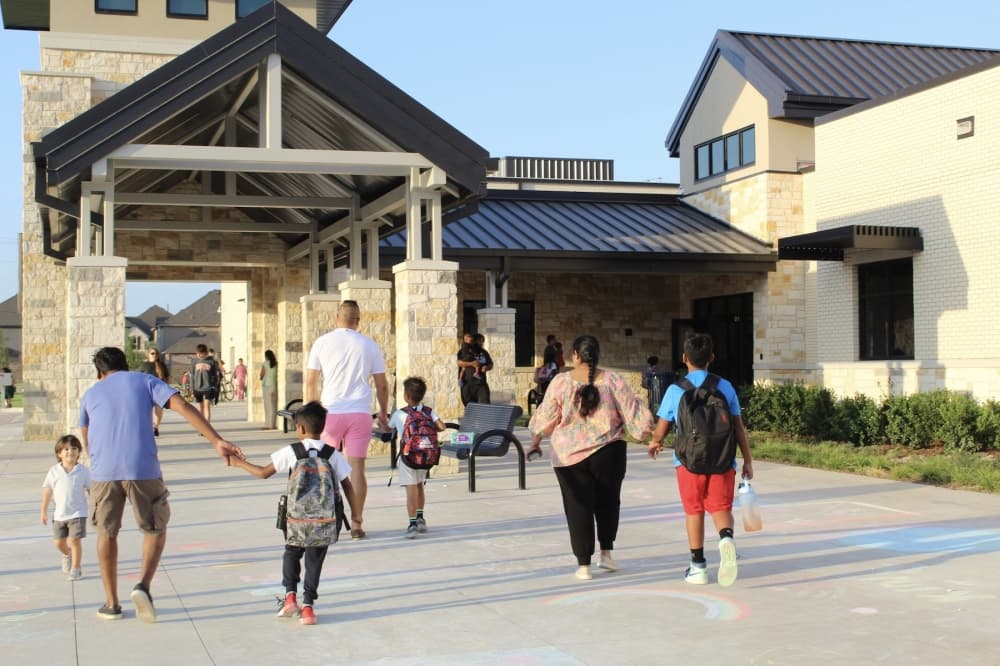
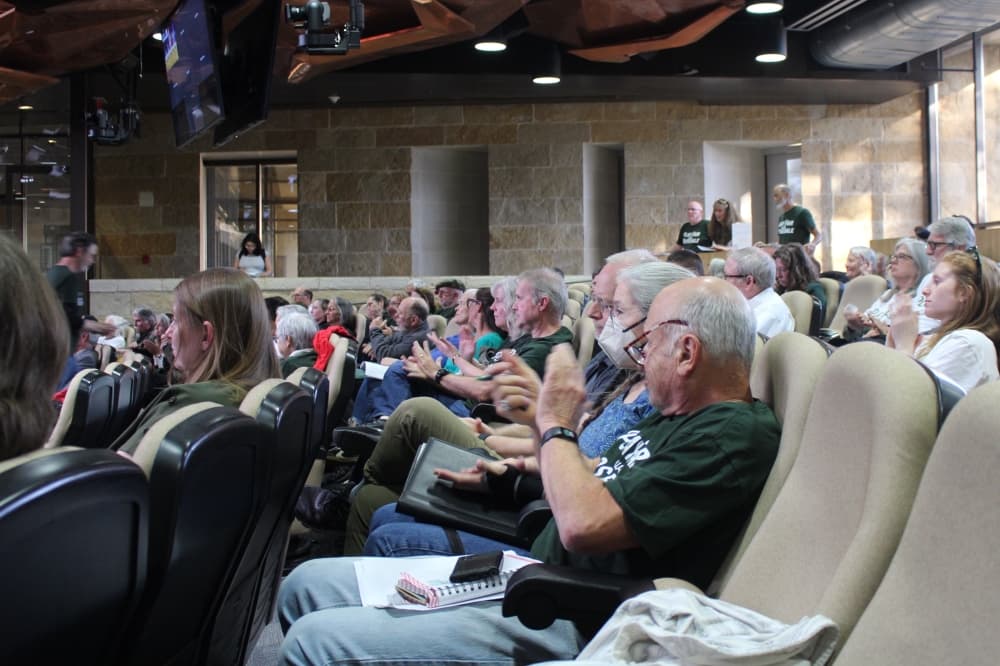
Rosedale neighborhood residents applauded after community organizer Chris Allen spoke against the development of a high-density apartment complex at a March 17 Zoning and Platting Commission meeting. (Chloe Young/Community Impact)
Austin ISD’s former Rosedale School site in North Central Austin is one step closer to becoming a six-story apartment building.
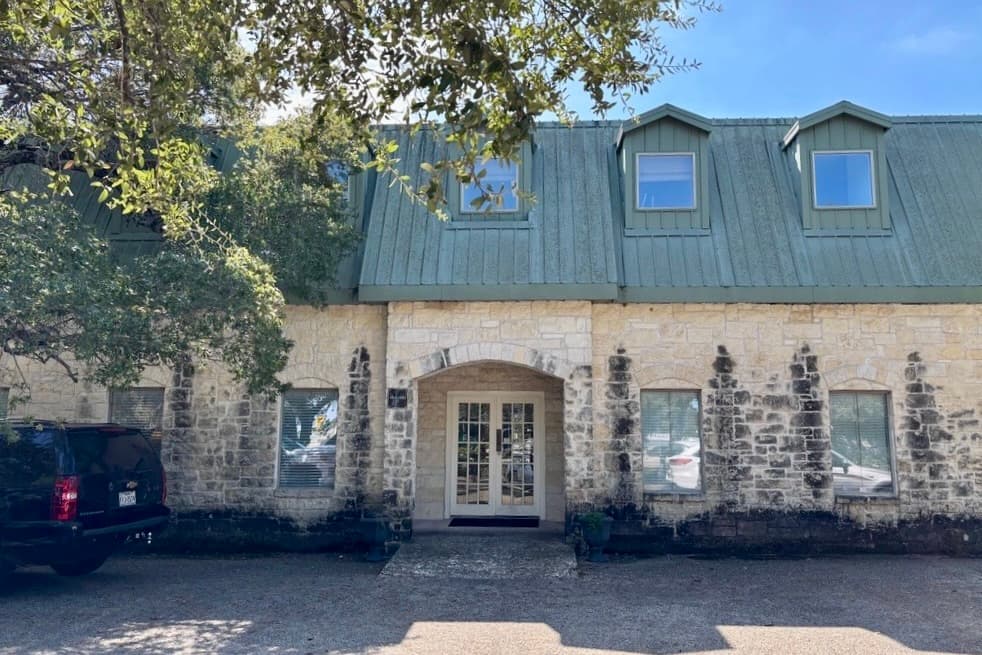
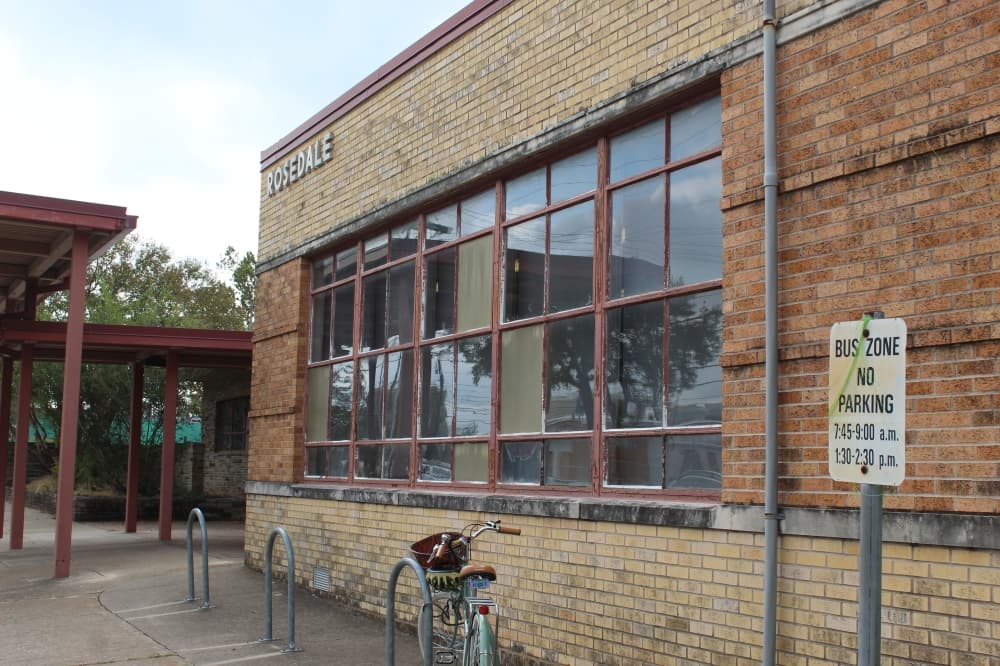
The Rosedale School, which serves students with severe special needs, moved to a new campus in 2022 and has since served as a training facility for law enforcement officers. In October, AISD shared its plans to sell the former campus for $26 million to multifamily housing development OHT Partners as the district works to reduce a mounting budget shortfall.
Dozens of Rosedale neighborhood residents spoke in opposition of the rezoning at the March 17 meeting, citing concerns about the proposed development being too large and negatively impacting traffic and safety. AISD has sued more than 100 Rosedale residents, asking the Travis County District Court to determine whether a 1938 deed restriction would allow the development to continue.
The former Rosedale School campus is currently being used as a training facility for the Travis County Sheriff's Office. (Chloe Young/Community Impact)
The update
The city's zoning commission recommended rezoning the 4.6-acre property at 2117 W. 49th St. from single-family residential use to the highest density multifamily use. If approved by City Council, the rezoning could make way for a 435-unit apartment development by OHT Partners.
The proposed zoning would limit the six-story development to a height of 75 feet. To reach six stories, the building would need to be at least 75 feet away from any single-family homes, District 3 Commissioner Lonny Stern said.
The project would be located near multiple CapMetro bus stops and planned stops for the future Project Connect light rail, said David Hartman, a lawyer representing OHT Partners.
“It adds robust, rich multimodal connectivity where transit-supported density should go,” Hartman said.
In October, the developer planned to offer market-rate units. At the March 17 meeting, Hartman said the developer may offer some affordable units through partnering with the HomeBase nonprofit.
OHT Partners would dedicate 0.25 acres of the property as public parkland, Hartman said. The developer would construct sidewalks, add a pedestrian crossing across 49th Street and pay street impact fees, he said.
What they're saying
Several Rosedale residents said they were not opposed to redeveloping the site but that the proposed apartment building would be too large and disruptive to the neighborhood.
Rosedale resident and architect Michael Alley referenced other AISD developments with lower densities. The Anita Ferrales Coy Facility apartments will bring almost 700 apartment homes to about 18 acres in East Austin.
Chris Allen, a resident and land development expert who has organized neighbors in protesting the apartment development, said the neighborhood was previously working with AISD to build affordable housing for teachers.
“There is no precedent for this scale of development in Austin, even though we saw other examples, especially embedded in on three sides by single-family homes,” Rosedale resident John Fretwell said.
Many residents shared concerns about the neighborhood's streets not being able to handle increased traffic from the development.
The proposed apartment complex is anticipated to increase the number of daily vehicle trips in the area from nearly 500 to almost 2,000. City of Austin officials have recommended the developer reduce the amount of daily vehicle trips to 1,580, according to city documents.
Kathy Fretwell, a resident and civil engineer, said the city’s recent traffic analysis did not account for a current lack of traffic in the area.
“The locations in which the traffic were collected were not representative of the entire neighborhood,” Fretwell said. “The site has never had 489 trips. ... It was a school and then it is now a training facility where maybe 50 cars a month come from this site.”
District 10 Commissioner Betsy Greenberg voted against the rezoning alongside the mayor’s representative Luis Osta Lugo. Any potential financial gains by AISD from the Rosedale development would be delayed by ongoing litigation and outweighed by traffic safety issues, she said.
“The small financial benefits for AISD do not justify the resulting damage to the neighborhood, not to mention the precedents that will be created that will affect the additional school sites that are being closed,” Greenberg said about 10 AISD campuses that will close next school year.
The other side
Zachary Faddis, a resident at The Triangle development, said he supported further developing the Burnet Road corridor. The project could increase housing affordability, decrease dependency on cars and improve the walkability of the area, he said.
“By allowing homes to be built here, we will be helping to both bring in more children to attend our schools and shoring up its finances—a win for our city, our schools and the many new neighbors who will get to call Rosedale home,” Faddis said.
In response to residents’ concerns, Stern said the city of Austin has “plenty of multifamily homes” on one- or two-way streets. Smaller roads with more constraints or potential conflicts "are actually much safer because they force people to be more alert,” District 2 Commissioner David Fouts said.
Additionally, Stern said he believed many of the development’s residents would use public transportation.
“I think these types of sites are unique opportunities for us to promote density in areas where we have multimodal transportation and or foresee that there will be that transportation there in the future,” District 4 Commissioner Andrew Cortes said.
OHT Partners will continue working with community members to find “common provisions that we can weave into the development,” Hartman said.
“We appreciate the input and the feedback to enhance the project to date,” Hartman said. “We look forward to that ongoing dialogue and continuing improvement on the project as we move forward.”
The background
In late October, the district filed a lawsuit against many Rosedale neighborhood residents asking the Travis County District Court to interpret a deed restriction on the property and issue a declaratory action. The deed restriction, which originated in 1938, states that “no lot of this subdivision shall ever be used for any other purpose than that of a residence.”
Some community members have argued that the deed restriction limited developers to building one house on a singular lot in the neighborhood and would not apply to a large apartment complex development.
Chair Hank Smith said the Zoning and Platting Commission could not consider the merits of the lawsuit and focus solely on the property’s rezoning request at the March 17 meeting.
The rezoning request now heads to City Council, which may conduct three readings before voting. At a Feb. 11 community meeting, Austin City Council member Mike Siegel said he would like City Council to wait on making zoning changes until the AISD lawsuit is heard.
"It would be a waste of city resources to involve all our peers in negotiating all the fine points if the court is going to go ahead and say the restrictive covenant prevents the project altogether," Siegel said.
Looking ahead
AISD has identified six of the 10 closing campuses as surplus, meaning they could be leased, sold or repurposed.
“We need to get the word out so that people in other neighborhoods realize that this is a problem,” Allen told Community Impact. “We're going to have to try to find a way to get enough people concerned that it influences City Council members more than we were able to influence that board tonight.”
Bond-funded air-conditioning upgrades delayed at 4 Austin ISD schools