Officials from McKinney and Frisco ISDs highlighted student successes and talked about current challenges at a State of Education event.
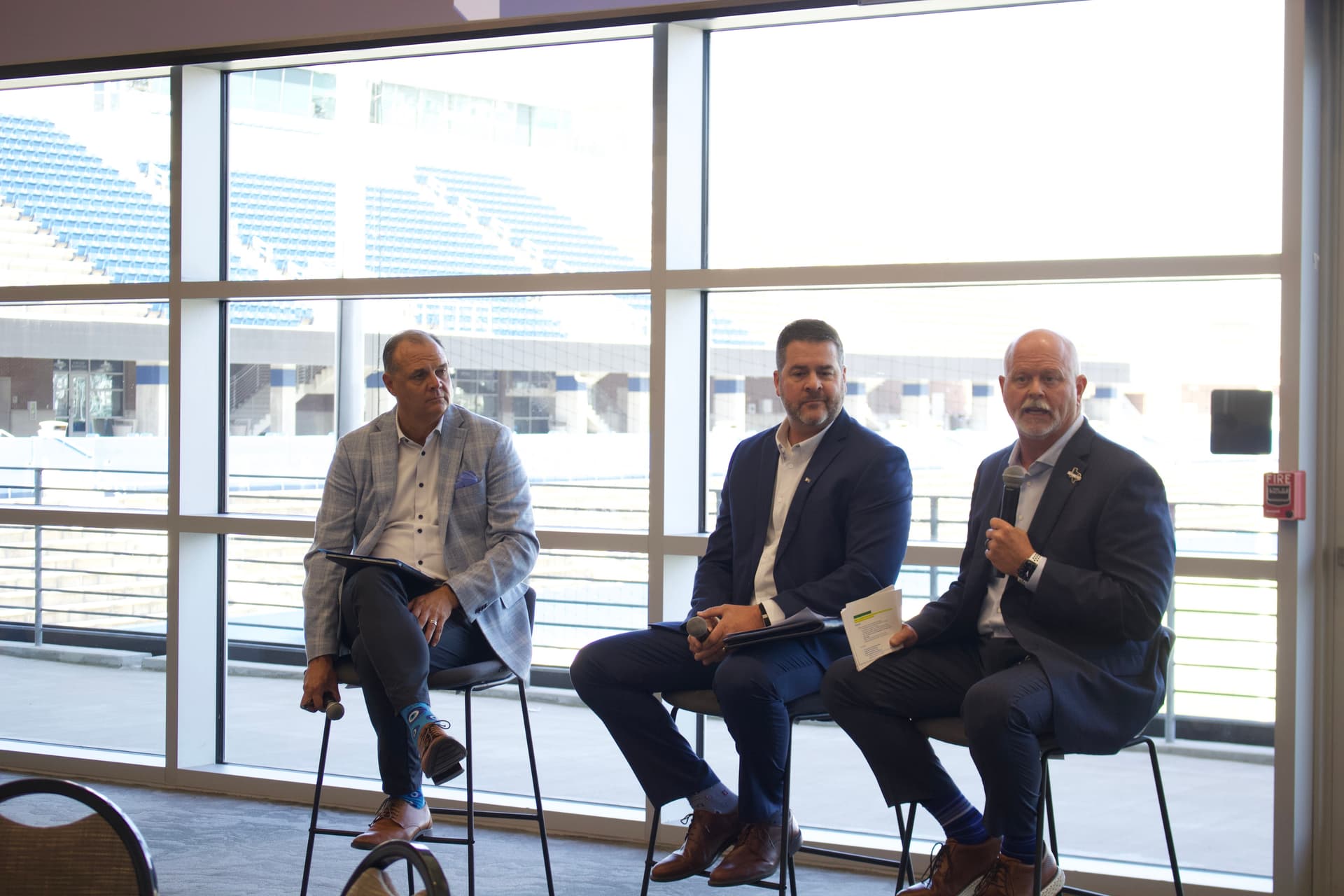
The McKinney Chamber of Commerce hosted the event Sept. 16, where a panel including MISD Superintendent Shawn Pratt and FISD Superintendent Todd Fouche discussed workforce development, accountability ratings and school finance.
At a glance
Although all three MISD high schools received an A rating from the Texas Education Agency for the 2025-26 school year, Pratt said that is not the only way to define student success.
“We can't ignore it, but it truly is a one-day test,” he said. “We believe that we have students that demonstrate success in a lot of other ways.”
One of the indicators of success both MISD and FISD are focusing on is college, career and military readiness.
“I am much more concerned about the students who leave our schools coming out and being ready to be employees in your organizations than I am if they got an 'A' on a test or not,” Fouche said.
Students can also learn soft skills by participating in extracurricular activities that will benefit them when they enter the workforce, Pratt said.
MISD was ranked No. 1 among the top 100 largest Texas school districts in college, career and military readiness scores, according to a presentation district staff gave at a February board meeting.
“The more engaged a student is in high school, the more employable they're going to be when they get out of high school,” Fouche said. “Whether they're involved in the chess club or football or band or whatever it is, I think my goal is always to have as many opportunities as humanly possible for students to engage in when they're in high school.”
Diving deeper
Fouche compared the current state of education in the two districts to a swimming duck.
“On top of the water you see this nice, smooth, pretty duck and underneath the water the feet are churning like crazy,” he said. “If you're a student in McKinney or Frisco, you've got so many opportunities, you've got so much that is available to you, but underneath the water, we're churning like crazy to make sure that we can keep those experiences relevant for young people.”
Both districts have experienced funding challenges due to inflation and increasing local property values. This has led to closing and repurposing campuses, decreasing staff and cutting programs in an attempt to minimize the negative impact on students.
Property taxes are one of the main funding sources for public schools and the tax rate can be split into two parts: maintenance and operations, or M&O, and interest and sinking, or I&S. The M&O rate funds the district’s daily operations and is set by the state. The I&S rate funds projects like campus refreshes and is set by the school board.
Pratt said it's a common misconception that MISD is raising residents' property taxes.
“Since 2015, we have dropped the tax rate that we control by 18 pennies, so the taxes are not going up because of the school district raising the tax rate,” he said. “It's because property values are going up, but we've been tagged with that responsibility.”
Former Denton ISD Superintendent Jaime Wilson, who moderated the panel, said the quality of schools in the region is contributing to Collin County’s fast growth.
“We are just blessed in North Texas and in this region to be a part of it, but all of it is in peril when you start thinking about how we fund our schools,” he said.
MISD has called a bond election and VATRE this November in an attempt to address these challenges.
One more thing
Wilson asked the panel how they are navigating the negative rhetoric surrounding public schools and leading through divisive times.
“We’re still doing it despite the rhetoric and despite the hurdles,” Pratt said. "There’s still great things, great kids, great teachers and great things happening.”