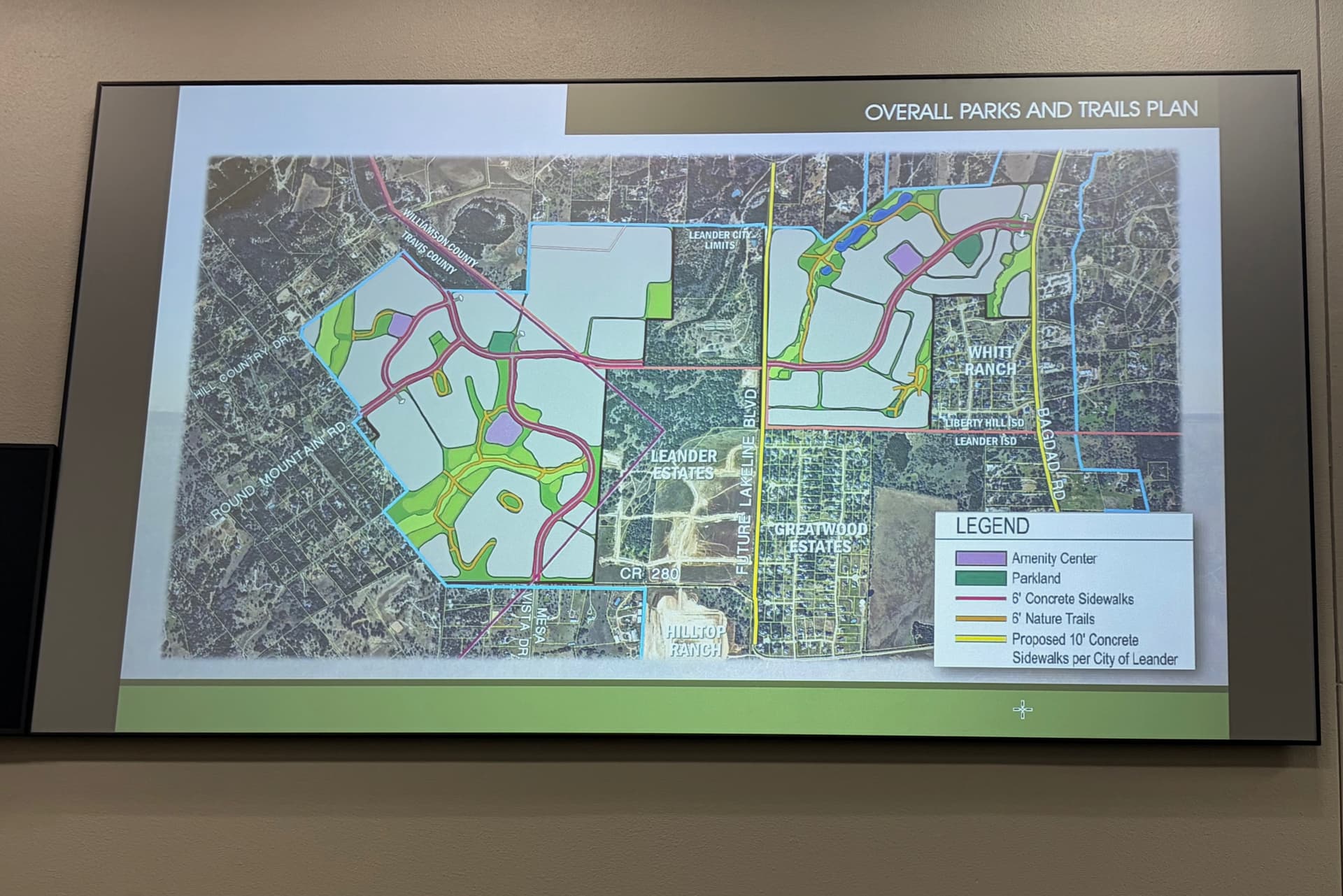
Developers presented conceptual plans during the Leander City Council’s Aug. 20 meeting to build 2,250 single-family units on two tracts spanning 833 acres near CR 280.
Genteos Developments LLC proposed developing the 524.5-acre Friou Tract and 308.5-acre Sullivan Tract while adding infrastructure through the creation of municipal utility districts, also known as MUDs.
“There's no action,” City Manager Todd Parton said. “There's nothing that council is committing to tonight. It's really kind of looking at this and saying, ‘Is this a concept that you would look at?’”
The framework
Developers are proposing to build 1,400 single-family homes on 50 to 80 lots in the larger Friou tract while the Sullivan tract would see construction of 850 units on 50- to 70-foot lots, according to city documents. The majority of both tracts are currently zoned for single-family rural purposes.
While another proposed development on the Sullivan Tract is seeking to construct 214 one-acre lots that rely on septic infrastructure, Mark Baker of SEC Planning LLC said increasing the density of development provides support for infrastructure improvements across the area.
“What we're proposing to you this evening is an alternative ... [a] different pattern of growth than all rural in this part of town,” Baker said. “With that alternative comes the ability to extend some infrastructure to this area, to improve some of the transportation network in the area and also bring some higher amenities to this portion of town.”
Genteos Developments LLC’s plan for the Sullivan tract includes 6.5 acres of commercial development along Bagdad Road, a five-acre amenity center, 50 acres of parks and private spaces and a mile and a half of natural trails. Meanwhile, the larger Friou Tract would feature a three-acre amenity center, a six-acre adult-specific amenity center, two miles of nature trails and 100 acres of private parks and open space.
Developers are seeking to add an active-adult component to the Friou tract, which Baker said will reduce stress on infrastructure by lowering traffic and school enrollment impacts.
“Leander is a very family-friendly city,” Baker said. “People want to be here. [What we see] across the country with active adult communities is grandparents wanting to move closer to where the kids are and where the grandkids are, but they still want to live in an amenity-focused community that doesn't have the high school kids racing down the street.”
Developers said they would incorporate native and low-water landscaping while looking to reduce irrigated turf areas and preserve existing heritage trees.
Mapping it out
To support the required infrastructure improvements, developers discussed the creation of a municipal utility district. MUDs are traditionally used to finance infrastructure like roads, water and drainage in outlying areas under development.
Developers for the Sullivan and Friou tracts are focusing on building out water infrastructure, transportation routes and parks. The MUD property tax rate for each tract could range from $0.50000 to $0.78000 per $100 valuation, according to city documents.
“A lot of developments are requiring major infrastructure improvements and extensions because the pace of growth in Central Texas and Texas has kind of outpaced the cities’ abilities to keep up with capital improvement projects,” Baker said. “So developments bring in MUDs, [Public Improvement Districts] and those types of financing mechanisms so that they can help cities extend some of that infrastructure and develop some of these properties in a faster manner than if the city had to develop it themselves.”
Planned improvements through the MUD financing would include $25 million in roadway improvements, $30 million in wastewater improvements, $11 million in water improvements, $20 million in drainage improvements and $4 million in private trails and recreation spaces, according to developers.
The team is also seeking to link Bagdad Road to Round Mountain Road through a planned extension of Lakeline Boulevard. Through this connection to Round Mountain Road, drivers could access Hwy. 1869 and the Hwy. 29 bypass.
This plan would provide “an east-west connector for this part of town” and avoid cut-through traffic through the Whitt Ranch neighborhood, Baker said, adding that plans are contingent on landowners' permission to construct the road connection.
“There's a growing need for circulation and access that needs to be addressed,” Parton said. “It takes fees and revenues to do that. If we go the lower the density, we have lower demand, but there's also less revenue that comes in to help address those things.”
Zooming in
Beyond transit, developers are eyeing the wastewater improvements required for hundreds of new homes. Michael Fisher of Pape-Dawson Engineers identified a planned water line in the northwest of the city and a lift station planned for north Bagdad Road as city projects the development would help support or seek to modify through the new MUD.
Developers said that the new proposal will provide more taxable value for the city. Numbers provided by the developer indicate that the previous plan brought before city officials for the Sullivan tract would have provided $214 million in taxable assessed value "with minimal infrastructure improvements." Meanwhile, the developer’s pitch for both the Friou and Sullivan tracts would create $1.3 billion in residential assessed taxable value and over $36 million in infrastructure fees.
“This is a pretty big development. It's a lot of units and so it's scary to look at once, but this is a 10-year project,” Baker said. “You have to put on your long-term glasses for what do you think this part of town is really going to become? What do you think Leander is going to grow into over time?”
The first phase of units, if approved, would not come online for roughly three years, Baker said.
What they’re saying
Since the presentation was intended to gauge whether the Leander City Council was interested in the project, no action was taken to approve any permits or other agreements. Along with a more detailed analysis of water infrastructure, Parton said the city would consider transportation elements of the project during the next step in this process.
Council member Annette Sponseller expressed concerns about the density of the housing, traffic infrastructure and water needs. Specifically, Sponseller said that developer-provided road improvements often exclude neighboring areas, which become “chaos and a mess and traffic-ridden.”
There's no plan for that prior to that development coming in,” Sponseller said. “So we're always five steps behind as far as road and traffic infrastructure.”
Council member Andrew Naudin said he was interested in seeing more information about how the developers plan to address the disparity between neighbors in Friou who may be paying different rates by being zoned in either Leander and Liberty Hill ISD.
While Mayor Pro Tem Becki Ross said she wanted residents to be informed about what buying a home in a MUD implied, she expressed interest in the project.
“I just needed to wrap my head around a few things, but overall, I am very much in favor of pursuing this more,” Ross said. “It adds more diverse housing to our community. I love the fact of the senior housing concept in it because I think it lends to what our community is. And infrastructure-wise, I think it can be mutually beneficial.”