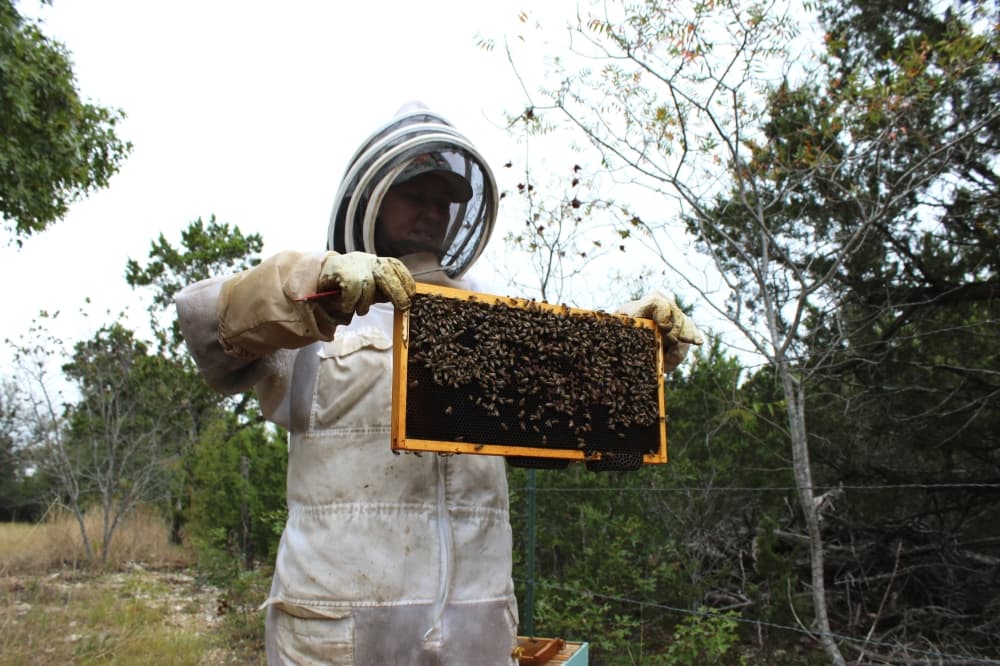
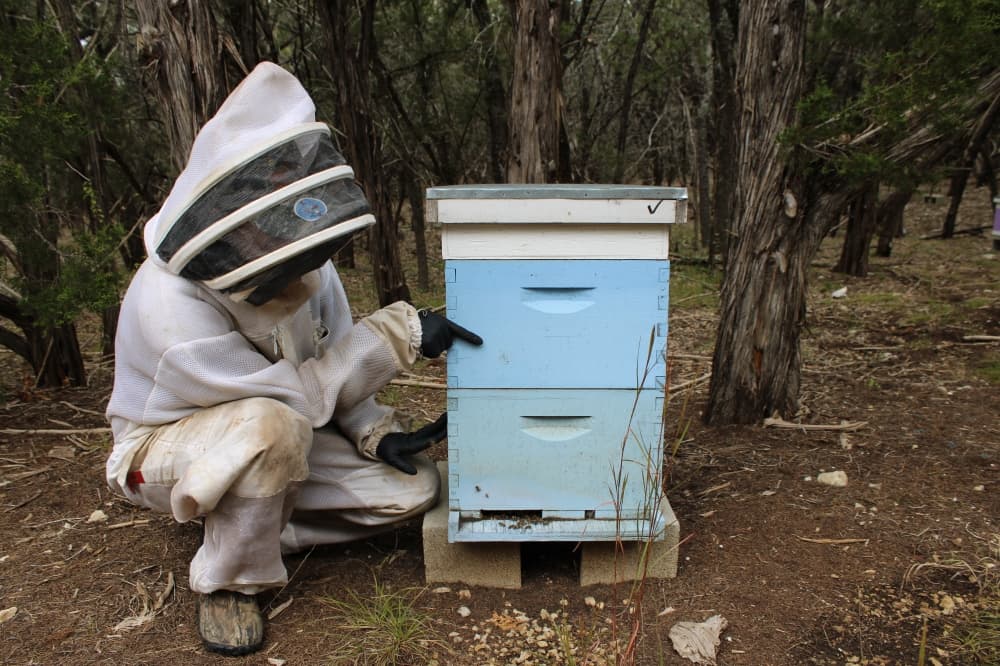
Jodi McCumber checks on her honey bees at her property in Liberty Hill while the insects fly around her. (Anna Maness/Community Impact)
Editor’s Note: This article has been updated to reflect a more accurate number of beehives the company manages and to specify the honey is not cleaned, but uncapped.
To Jodi McCumber, bees are one of the smartest creatures on Earth; the beekeeper’s 12-year journey studying the insect has only solidified her appreciation for them.
Meet the team
McCumber and her business partner, James, started beekeeping in 2012 with their business Jackass Honey Farms, located in Liberty Hill. The farm began selling products from its first harvest in 2014, McCumber said.
“People talk about the crazy cat ladies out there in the world,” McCumber said. “Well, I became like the crazy bee lady.”
Jodi McCumber points to a hive box, which can hold up to 10 frames each. When a colony expands, hive boxes can be stacked on top of each other to add space. (Anna Maness/Community Impact)
At first, the McCumbers managed just two hives, but now the two oversee 200-400 beehives throughout Texas, she said.
The company’s services include swarm and hive removals, beekeeping classes, and agricultural valuation consultations. The duo also offers agricultural exemption contracts, which can help property owners lower their property taxes, McCumber said.
How it works
The farm’s honey is typically harvested during the first two weeks of July after a colony spends several months inside colorful hive boxes that James McCumber assembles. Each box includes space for the bees to repopulate and build up their honeycomb, McCumber said.
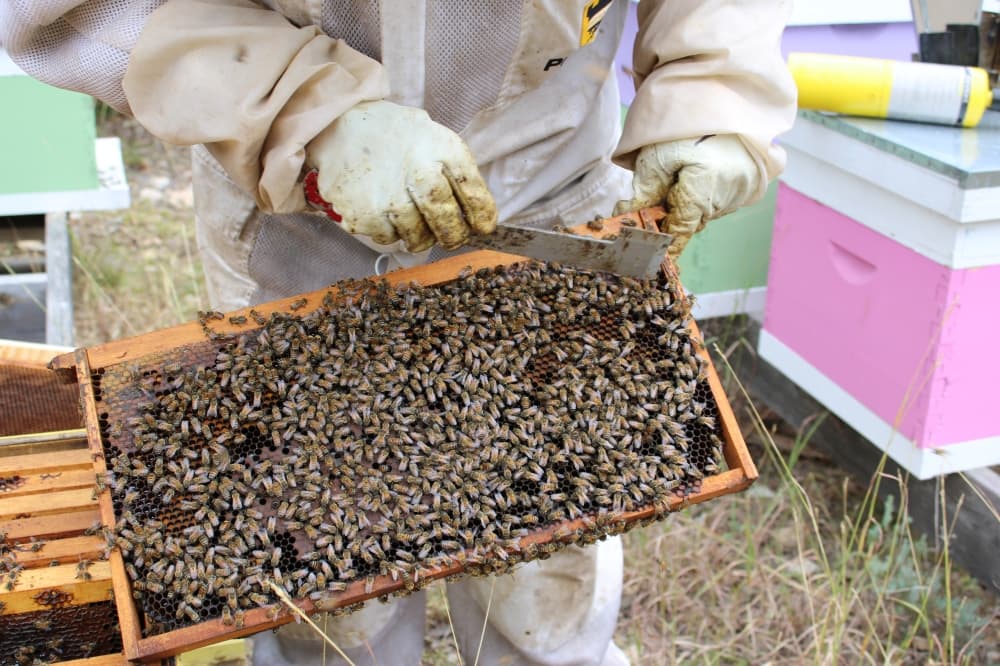
The queen bee lays her eggs within cells of the honey comb in a frame, which eventually hatch into larvae. (Anna Maness/Community Impact)
“The whole hive works together for the good of the colony,” McCumber said.
After clearing the bees out of the boxes, the wax cappings on the frames are uncapped, exposing the honey. The frames are placed in an extractor to extract the honey, and finally, the honey is bottled in a 94-96 degree Fahrenheit bottling room on the McCumbers' property, McCumber said.
“The cold temperatures can actually cause the honey to start to crystallize quicker, and we want to do everything that we can to prevent that,” McCumber said.
While some products can take months to make, McCumber said the process shouldn’t be rushed.
“I like to hold us at a higher standard,” she said. “I would never sacrifice quality for quantity.”
One more thing
McCumber enjoys teaching others about bees, from speaking at the annual Texas Beekeepers Association’s convention to setting up an observation hive for local Girl Scouts to view. At conventions, McCumber said she learns about new diseases or risks for bees.
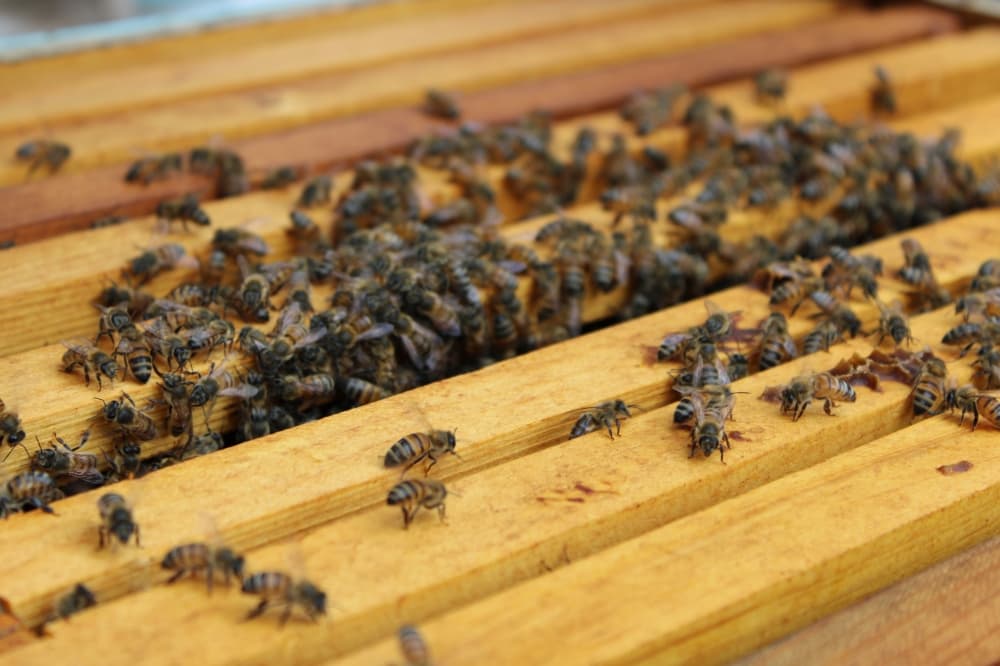
Worker bees get holes in their wings from flying miles in just one day, so their lifespan is around two weeks, McCumber said. (Anna Maness/Community Impact)
“There is always a new threat to the honey bee that makes it harder on not only the bees, but also the beekeepers, because we want to keep these bees alive,” she said.