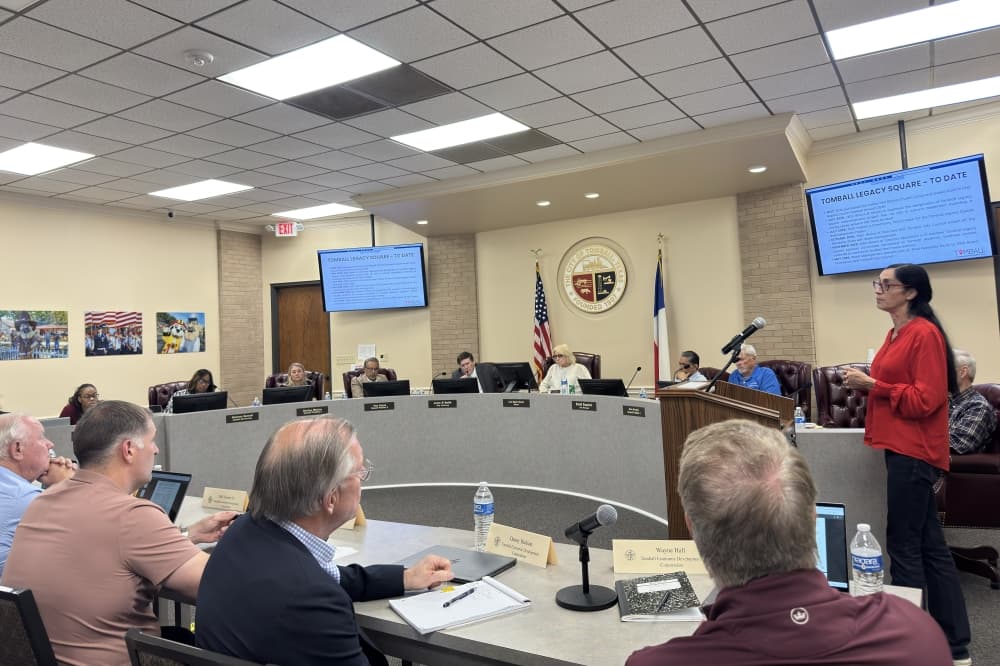
Tomball City Council and the Tomball Economic Development Corp. got a clearer look May 12 at what the former First Baptist Church campus could become, but nearby residents made one thing just as clear: they want a say before the project goes any further.
The joint meeting centered on Tomball Legacy Square, the planned redevelopment of the roughly 4.6-acre former church campus in Old Town Tomball. The TEDC engaged Webb Management in fall 2025 to study the site’s market demand, operations, economic impact and redevelopment potential for the former sanctuary, 1949 chapel and fellowship hall, according to the agenda packet.
No vote was taken at the meeting, as it was held for discussion only, and all items were presentation items.
The gist
The feasibility study recommends turning the campus into three main pieces: an 800- to 1,000-seat performing arts hall in the former sanctuary, a visual arts center in the 1949 chapel and an arts education center in the fellowship hall. However, officials repeatedly said the plans are still early.
Lisa Covington, TEDC board president and City Council member, said the TEDC is still working through details such as venue size, funding, parking, green space and operators.
“Just because something is in writing on a website does not mean decisions have been made,” Covington said during the meeting.
A TEDC presentation also stated that no final decisions have been made or approved beyond the purchase of the property and the designation of the project as an arts and cultural destination.
The presentation also stated taxes will not increase because of the project, and the TEDC is not tearing down the main sanctuary or the 1949 chapel.
While no final project cost has been approved, officials discussed a possible price tag of around $25 million during the May 12 joint meeting. However, TEDC and city officials also said the project could be scaled or phased, with prior discussions looking at what could be done at lower investment levels.
What they’re saying
One of the biggest questions during the meeting was whether the city could end up financially tied to the project if it does not work.
“I do not want the city of Tomball tied to this anyway,” council member Dane Dunagin said during the meeting. “I don’t want 10 years, 20 years somewhere down the road [someone] goes, ‘Oh, we can’t pay for this anymore.’”
Covington addressed concerns that the TEDC plans to tear down the main sanctuary or the 1949 chapel.
“The Tomball Economic Development Corporation is not going to tear those down,” she said. “Now, as we’ve said, if it works out that the EDC is unable to develop it due to the economics and funding and fundraising and the whole deal, we may need to sell it.”
Wayne Hall, a TEDC board member, said keeping the property under TEDC control gives the community more certainty than selling it to a private buyer.
“If we just let this open and someone else was to buy it, it could very well be a hotel, it could be houses, it could be an apartment complex,” Hall said. “So at least with the EDC controlling it, then we’ll kind of know what’s going to go on there.”
Diving in deeper
The venue size is still one of the biggest sticking points for residents. The study recommends a flexible performing arts hall with 800-1,000 seats, a large stage and seating area, but without a full fly tower, orchestra pit or fixed-proscenium setup.
“What we’re looking at right now is no fixed seating, because we want it to be as adaptable as possible,” a project representative said during the meeting.
The feasibility study lays out a long timeline, with operator selection, fundraising, design, construction and commissioning stretching through 2030.
Parking was one of the biggest issues discussed by officials and residents. According to the TEDC presentation, the corporation is addressing parking through a parking and mobility study for Old Town Tomball. The study is expected to examine the existing parking supply and shortfall, shared parking opportunities, traffic circulation, pedestrian connectivity, event management strategies and future growth needs.
TEDC officials said no parking garage is proposed, and all parking would be surface parking.
“We are not proposing a parking garage,” Covington said. “They’re way too expensive ... no one likes them.”
The presentation also stated that the former playground area is not a public pocket park. According to the presentation, the area is fenced in on private land, has never been open to the public and had aging equipment that the TEDC board approved removing because of liability concerns.
Parking could be proposed for the former playground space and an adjacent TEDC-owned single-family lot if needed, totaling about 21,000 square feet, according to the presentation.
Officials also said the project could add green space overall. The presentation states that about 30,000 square feet of existing space could be demolished, with new green space created in the middle of the site as part of a family-friendly design.
“If we are able to do exactly what we want to do, we will actually add green space,” Covington said. “We’re adding 10,000 square feet of green space, ... net for the entire facility.”
Drainage will also be addressed as part of the redevelopment, according to the presentation, and officials said the city’s tree ordinance will be followed.
“We are not cutting trees down that are on the protected list,” Covington said. “We are going to save Tomball trees.”
What about zoning?
Officials also discussed the likelihood of creating a planned development district for the campus.
According to the TEDC presentation, planned development districts are commonly used for unique redevelopment projects, mixed-use environments, historic or adaptive reuse projects and sites that do not fit traditional zoning categories.
The presentation stated a planned development district would require city oversight, public hearings, council approval and specific development standards.
Officials also pushed back on concerns that a planned development district would remove public input or give the project special treatment. The presentation stated that a planned development district is not: an independent district separate from the city; a project exempt from City Council approval; a removal of public input or public hearings; a way to ignore safety, drainage, traffic or development standards; or a “special privilege” without conditions or oversight.
Also of note
Food and beverage service, including alcohol, was also discussed during the meeting.
According to the TEDC presentation, food and beverage service is recommended as part of the project’s financial pro forma and is common for event and entertainment venues.
The presentation states that sales could help support operational sustainability and improve long-term financial viability, and that alcohol service does not redefine the project’s primary cultural and community purpose.
Covington said food and beverage is already part of Old Town Tomball and could be worked into the project without competing with existing restaurants.
“Food and beverage is already an enormous part of Old Town,” Covington said.
What residents are saying
Several nearby residents said they were not opposed to preserving the church property or adding arts programming, but they worried the project’s current scale could overwhelm the surrounding neighborhood.
Residents raised concerns about parking, traffic, noise, drainage, trees and the possibility of homes being removed for parking.
Kristin Heck, who said she lives on Hicks Street, said her home sits directly beside the project, and flooding is already a concern.
“When it rains, I can’t decipher where my pool ends and the grass begins,” Heck said. “I lost animals to drowning.”
Heck said she was not against the project, but asked officials to consider a smaller version.
Another resident, Christina Black, said the project backs up to her home on Commerce Street and raised concerns about noise, crowds and parking.
“It does bring safety concerns along with noise concerns, crowding concerns,” Black said. “Parking is certainly an issue, because during these big events, I do have to actually block off my yard just to keep people from parking in it.”
Casey Berry, who lives on Mason Street, asked officials not to forget the people living around the site.
“I’ve heard a lot about the benefit economic[ly] and to Main Street businesses. What about the residents?” Berry said. “It is a residential neighborhood. ... Please remember we live here. We like living here. Don’t drive us out.”
Others spoke in favor of the project, saying Tomball lacks a venue for larger local gatherings.
Brandy Beyer, with the Greater Tomball Chamber of Commerce, said several local organizations have to leave Tomball for events because there is no facility in the city that can hold them.
“The fact that this would open up some new doors and maybe gives us an opportunity to stay in our community, to have big events, not huge events ... I think it fills that community spirit maybe a little bit more,” Beyer said.
What happens next
The project remains in the concept stage. According to the TEDC presentation, conceptual recommendations are being presented, studies and evaluations are ongoing, committee meetings are monthly and public input remains important.
Future steps include continued community engagement, parking and circulation analysis, development refinement, public hearings and City Council review and approval, according to the presentation.
The next steps outlined in the feasibility study also include deciding the best use for each structure, estimating renovation costs, finding operators, determining how much money can be raised and deciding what should happen in Phase 1.
The city's meetings page also lists a Tomball Legacy Fund meeting for 5 p.m. June 1.