Construction remains on schedule for the new Texas A&M Space Institute, Director Nancy Currie-Gregg said in an email Feb. 18.
What you need to know
The institute will be the first building in NASA’s new Exploration Park, a 240-acre commercial property with space-related goals neighboring NASA's Johnson Space Center.
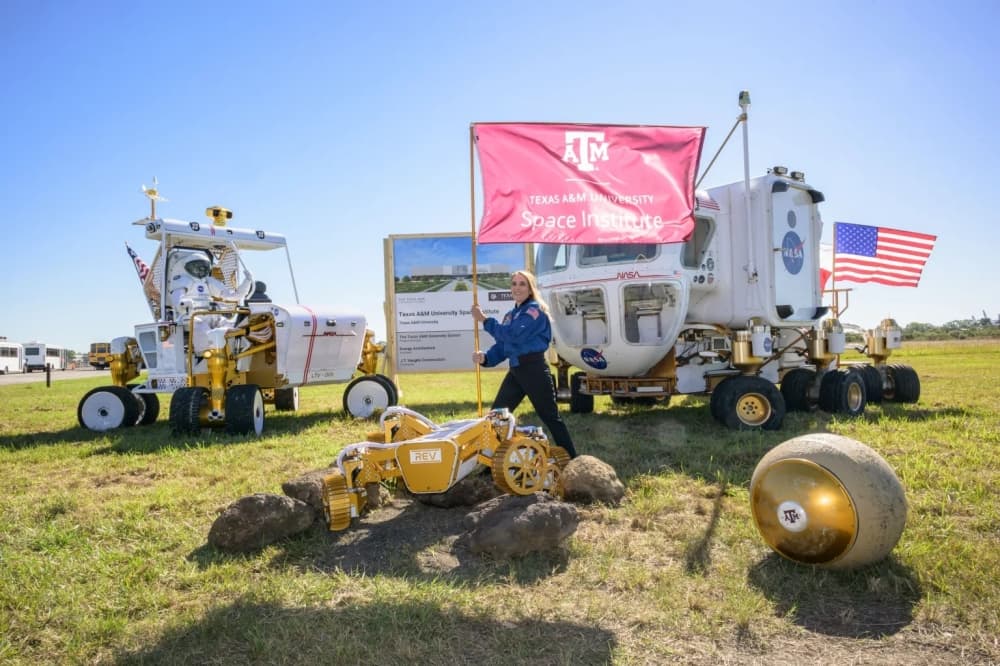
The institute will serve as a resource for researchers to explore beyond the lower Earth orbit, back to the moon and on to Mars, according to documents from Texas A&M University.
To date, the institute has signed leases with U.S.-based robotics company Venturi Astrolab, which develops lunar rovers to operate on the moon’s surface, and Houston-based aerospace company Intuitive Machines, which builds lunar landers and space systems for NASA.
Since the new institute broke ground in November 2024, “significant progress has been made,” Currie-Gregg said. This includes:
- All concrete work
- Installation of metal wall panels on the moon and Mars scapes
- Completion of the primary steel structures
A closer look
The project will cost $200 million, which will be paid for through the state’s Texas Space Commission, which was passed in the 88th Texas Legislature and allotted $350 million for space programs in Texas, including $200 million for the institute, according to documents from the university.
The institute will be a 400,000 square foot, four-level facility, documents show.
While details were not disclosed about the fourth floor, the institute will include the following:
- Level 1: moon and Mars surface simulation, secured research garages and common technical support areas
- Level 2: garage mezzanines with collaboration spaces and prefunction space for the Level 3 auditorium
- Level 3: lecture and instructional auditorium, and flexible project rooms, including labs, classrooms and office spaces
Looking ahead
The institute is slated to open in October, university documents note.
“One of the primary objectives for the Texas A&M University Space Institute is to engage with universities, commercial entities and government entities in space research,” Currie-Gregg said. “The idea is to be a vibrant collaboration hub for space research in the state of Texas.”