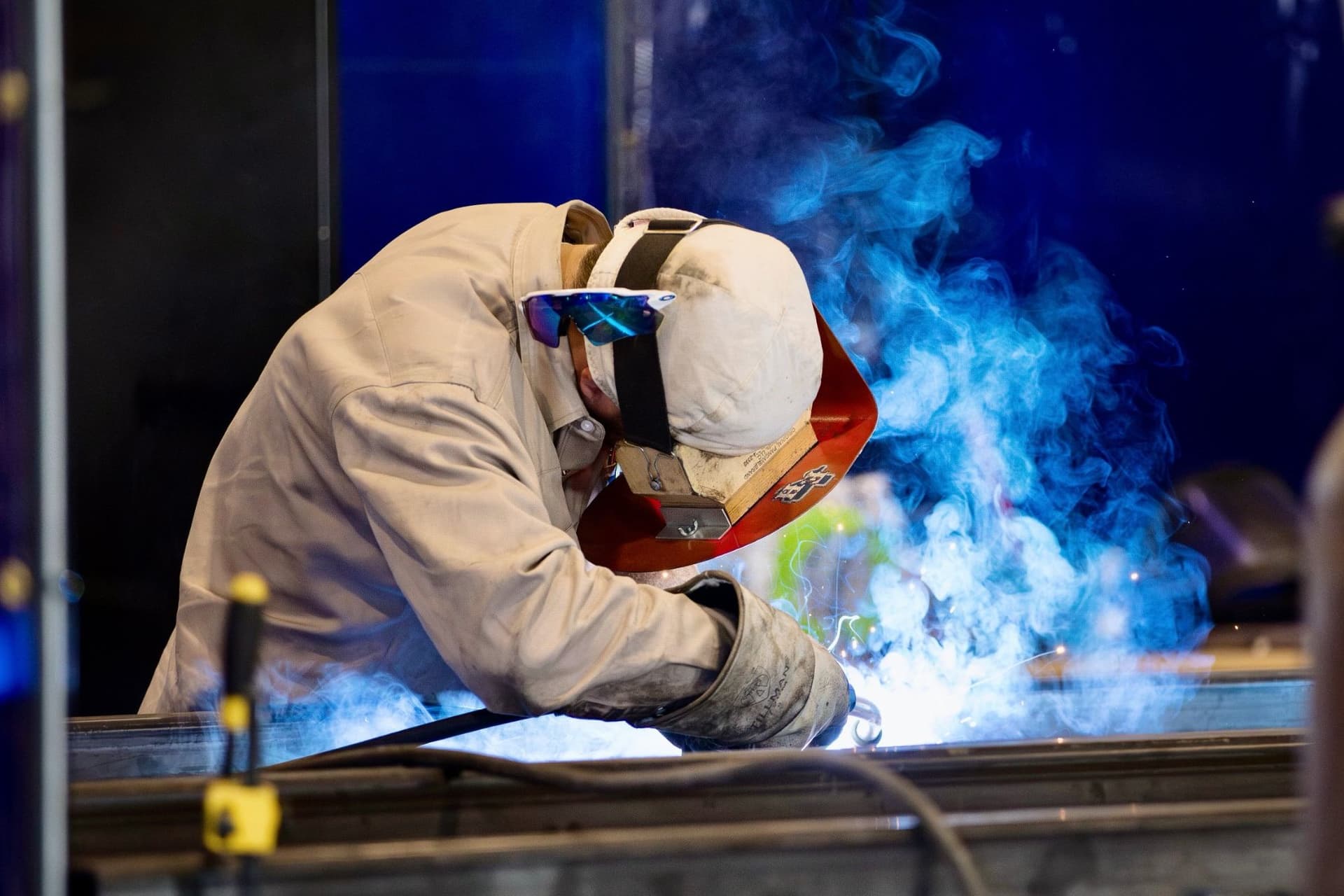
A welder works on steel components in Aalo Atomic's Austin facility. The energy manufacturer signed a lease for a 204,350-square-foot facility in Georgetown and anticipates to start utilizing it early next year. (Courtesy Aalo Atomics)
More than $600 million in investment and 3,000 new jobs could be headed to Georgetown as the city's advanced manufacturing sector experiences a surge in growth.
The figures represent projected activity for this year alone, Economic Development Director Cameron Goodman said.
Companies like Aalo Atomics, Baer Manufacturing, Compal USA and Pegatron Corp. plan to establish facilities in Georgetown, and more are in the works, mirroring the larger trend across Central Texas.
“Just in terms of projects we're working on now, it's the biggest our pipeline's ever been,” Goodman said.
The big picture
Compal and Pegatron are both Taiwanese manufacturers that chose Georgetown as the site for their first U.S. facilities, and will be among the top five largest employers in the city once operational, Goodman said.
Both companies design and build electronic hardware for other technology brands. Compal will finish construction by February of next year, and Pegatron will follow in May 2027.
Wisconsin-based Baer Manufacturing recently expanded its operations to Georgetown for its electrical construction work. The company is temporarily occupying a smaller facility with plans to move into a 606,000-square-foot facility next summer.
Aalo Atomics, an Austin-based energy manufacturer, signed a lease for a 204,350-square-foot facility in Georgetown, and anticipates to start utilizing it early next year, representative Jeff Rauh said.
The facility will focus strictly on high-end metalworking, with no nuclear or radioactive materials involved, Rauh said.
The why
Georgetown won the Compal and Pegatron projects after competing against 15 locations across the U.S., Goodman said.
A combination of factors has helped the city successfully recruit in the advanced manufacturing industry, including power and infrastructure capability, local job force, and competitive incentives, city officials said.
For Aalo, Rauh said the interest in Georgetown came from an already curated environment that welcomes companies in the advanced manufacturing industry, as well as a “skilled and talented workforce.”
“We look forward to working with schools in the area to help develop that pipeline that can help us with our manufacturing,” Rauh said.
While a local talent pipeline and utilities get companies to the table, Georgetown's historic downtown square seals the deal for executives looking to recruit talent, Mayor Josh Schroeder said at a Sept. 22 event.
“Folks come down to our square, and they're like, ‘Oh yeah, I can sell this,” Schroeder said. “And so it's really neat to kind of see it through their eyes. Something that we've all seen and loved … and then to see it actually help sell it is great.”
The impact
The vast majority of jobs at the companies will be hired locally, Goodman said. While companies bring a few key staff members, local hiring is supported through partnerships with Georgetown ISD, Austin Community College, Texas State Technical College and The University of Texas.
"What we're working on is helping to partner with the school district to make sure that high school students who have the opportunity to choose if they're going to go to college or maybe a technical school know about these opportunities where they can come out and ... have a good quality of life, make a good living working at these facilities," Goodman said.
Schroeder said that the city pushes to have local hiring requirements and incentives to build an environment where people can grow up, go to school, and work in Georgetown.
“Generation upon generation can all live in the same community,” he said.
In addition to creating new jobs, the opportunities in modern advanced manufacturing include engineers and computer scientists, which have "almost doubled [Georgetown’s] average wage in the community in the last eight years," Schroeder said.
Why now?
Georgetown is capturing broader Central Texas momentum in electronics and semiconductor manufacturing, which has accelerated with Samsung's expansion of its semiconductor fabrication plant, or fab, in nearby Taylor, Goodman said.
"We had a really strong year just with a lot of the activity we're seeing here in Central Texas with electronics manufacturing and semiconductors really heating up now that Samsung's expanding to their second fab, too," Goodman said.
What these companies all have in common is that the products they manufacture support the artificial intelligence industry.
"We benefit from bringing [companies in the AI industry] in when we could also see some of their vendors and supporters potentially located in this area in the coming years too," Goodman said.
Something to note
Data centers require massive amounts of electricity, water and infrastructure to run and cool thousands of computer servers—the technology that processes AI activity. Companies like Pegatron, Compal, Baer and Aalo make up the ecosystem of support industries that provide the hardware, framework and energy capabilities needed.
Aalo in particular is working to find new ways to power AI data centers because the energy needed often outpaces the expansion of local utility grids.
Goodman said that the city aims to manage growth responsibly, and enforces environmental stewardship measures, such as mandating closed-loop cooling systems for data centers to conserve water.
“While we do always look at what the capital investment is going to be and the impact that's positive for the taxpayers, we always want to make sure it's still a good fit for the community and won't cause any disruptions,” Goodman said.
“There's going to be tons of data centers, and so let's make the guts of what's going in them. … We'll be recession-proof [because] they're going to continue needing servers no matter what.”
Josh Schroeder, Georgetown mayor
Zooming out
Outside of Georgetown, other cities in Williamson County are also attracting advanced manufacturing, such as Blue Origin—Jeff Bezos' space technology company—in Hutto and the Samsung Austin Semiconductor in Taylor. Pegatron will also establish another Williamson County facility in Taylor.
Blue Origin will utilize approximately 1.3 million square feet of space in an existing industrial park along Hwy. 79 between Innovation Boulevard and Alliance Boulevard. The project, called Constellation Park, will invest almost $555 million in capital and create more than 2,000 jobs, according to a state news release.
The Samsung Austin Semiconductor in Taylor is on track to open by the end of the year, according to the company. Samsung has committed a minimum $17 billion investment in capital, and plans to create 1,800 jobs within 10 years, according to a company news release.
Samsung has been constructing a semiconductor plant in nearby Taylor.Gracie Warhurst/Community Impact