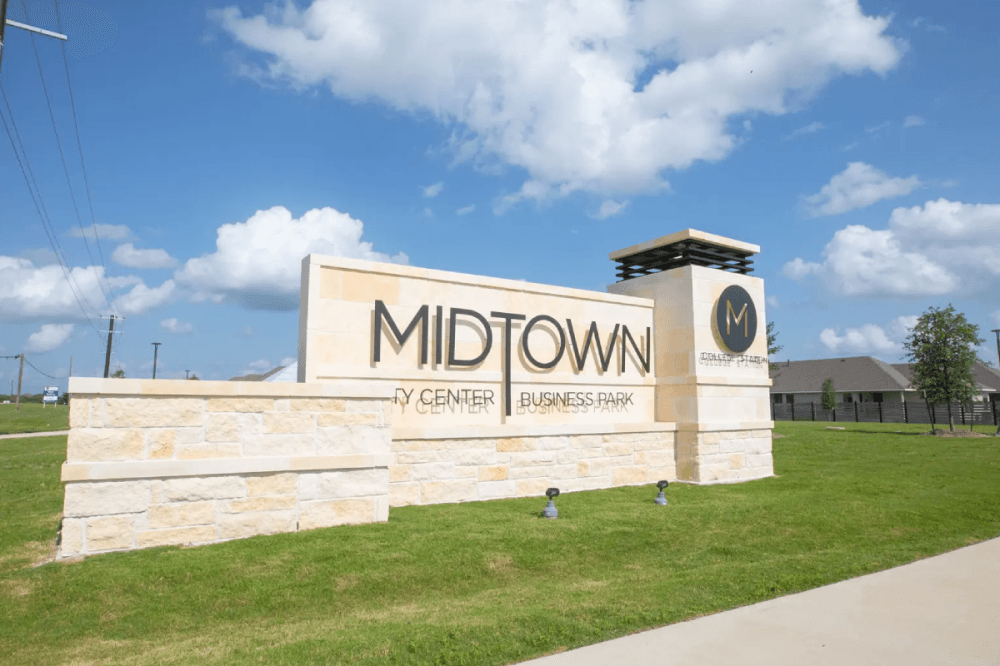
Once envisioned primarily as a corporate business park, Midtown is now a mixed-use district with ambitions to combine a public park, sports tourism, housing and commercial development in College Station. (Courtesy Visit College Station)
College Station leaders say the future of Midtown could help answer a long-standing question for the growing city: What comes next beyond its university identity?
Once envisioned primarily as a corporate business park, Midtown is now a mixed-use district with ambitions to combine a public park, sports tourism, housing and commercial development in College Station.
Brian Piscacek, assistant director of economic development for the city, told Community Impact, “This is an intentional transition from light industrial to, as our council views it, something that is... kind of in the DNA of College Station, which is sports tourism, sports recreation.”
“Ultimately, Midtown is designed to serve any resident or visitor to the City of College Station,” he said.
Current situation
Two major public projects are expected to anchor Midtown’s next phase.
The city approved plans in Aug. 2024 for Texas Independence Park, a $20.9 million city-owned project to include biking and walking trails, open space and recreation amenities, including:
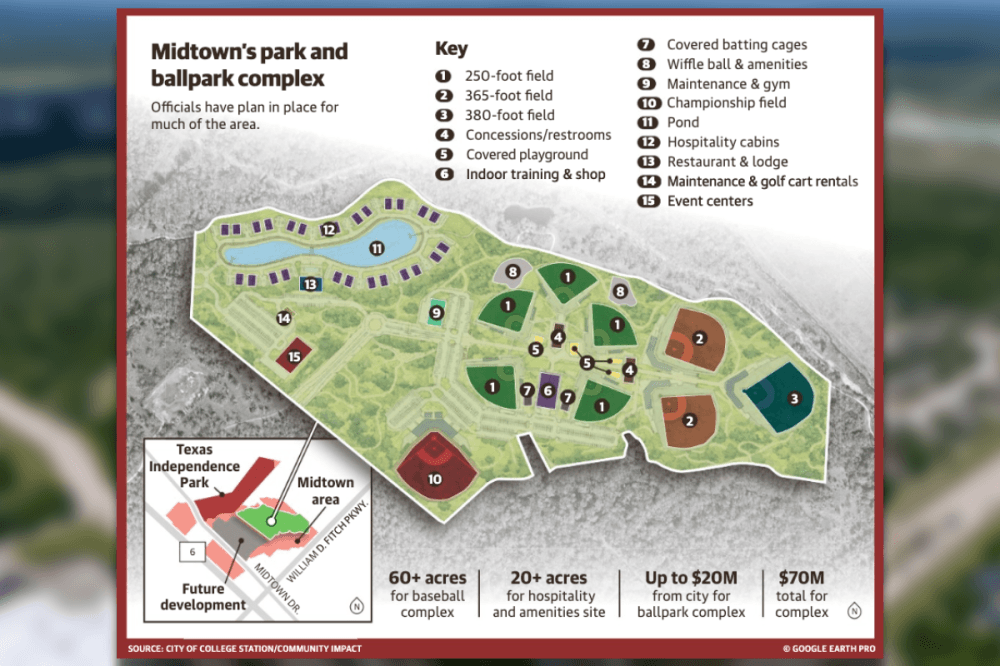
The city is also entering agreements tied to a proposed 90-acre baseball/softball complex, which would feature:
Nine fields, including a championship venue
Lodging
Future event space
Public access to fields, city access on the weekends
Brazos Valley Bombers to play at Championship Field
The city entered a letter of intent with The Station Hospitality and Athletic Complex in February to build the complex. Officials estimate the complex could host 30 tournaments annually to generate $28 million in economic activity while producing 60,000 hotel stays within Bryan-College Station city limits.
“It’s going to be an absolute, top-of-the-line development, and something that I think is really going to catalyze the rest of that development,” Piscacek said.
The city is considering up to $20 million in investments and incentives tied to the complex, which Piscacek called a “massive economic engine.”
Why it matters
For developer James Murr, Midtown represents an opportunity to create something College Station has historically lacked.
“Our city needs an area that has city identity, not Texas A&M identity,” said Murr, an A&M graduate who has worked to develop the area for more than a decade.
More than 550 homes have already been built in the area, with hundreds more planned alongside restaurants, hotels and entertainment concepts surrounding an existing body of water and trail system.
Murr said housing affordability remains a challenge driven largely by land and infrastructure costs.
“Builders can’t build $300,000 houses on a $100,000 lot,” he said.
He told Community Impact the proposed baseball complex and surrounding develop will rely on continued public-private cooperation.
“Our vision is to be a highlight place– a special place in the city– for the next hundred years,” Murr said.
Two major public projects are expected to anchor Midtown’s next phase: Texas Independence Park and a ballpark complex. (City of College Station/Community Impact)
What residents are saying
Midtown residents say they support growth but want the city to follow through on earlier promises.
Homeowner Shelby Behm became involved in city discussions after she said she’d received a high property tax bill, tied to a special taxing district despite declining property values.
“I was shocked to find that our property tax bill actually increased,” Behm said. “I just fired off to every person that represented me.”
Addressing resident concerns, College Station City Council Member Mark Smith said in an email to Community Impact, “That development model is unique to Midtown and is not under the control of the City. I do not think that the developer is misusing District and its taxing authority.”
Behm said many residents view Midtown as a needed space for young professionals and families who want amenities outside the university environment.
“I love College Station,” she said. “I need something to do besides Northgate.”
She said she believes the city supports Midtown but differs on how much public investment it deserves.
“There is a split on council, from my perspective, of those that do want to do something for Midtown. It’s just a matter of how much, and I think there’s another half that sees investment in Midtown as a way to make one developer richer.”
The context
Midtown’s direction has shifted several times, including last year when a proposed data center was squashed after residents raised concerns about environmental impacts and compatibility with the area’s long-term vision.
City Council Member Bob Yancy told Community Impact the evolving plans reflect wider goals for the city’s future.
“My vision for Midtown is College Stationers of all ages, from young families to retirees, having diverse housing choices, amenities, entertainment and shopping in a mixed use district that’s close to quality healthcare,” he said. “This is just the kind of dynamic community that can achieve something special if we put our minds to it and commit to that vision.”
Looking ahead
Construction timelines for major projects remain uncertain, but the city said these projects are moving forward and construction and infrastructure work are expected to take place simultaneously.
For now, Midtown represents a larger civic ambition as a place where residents, visitors and businesses could gather in a city still defining its center.