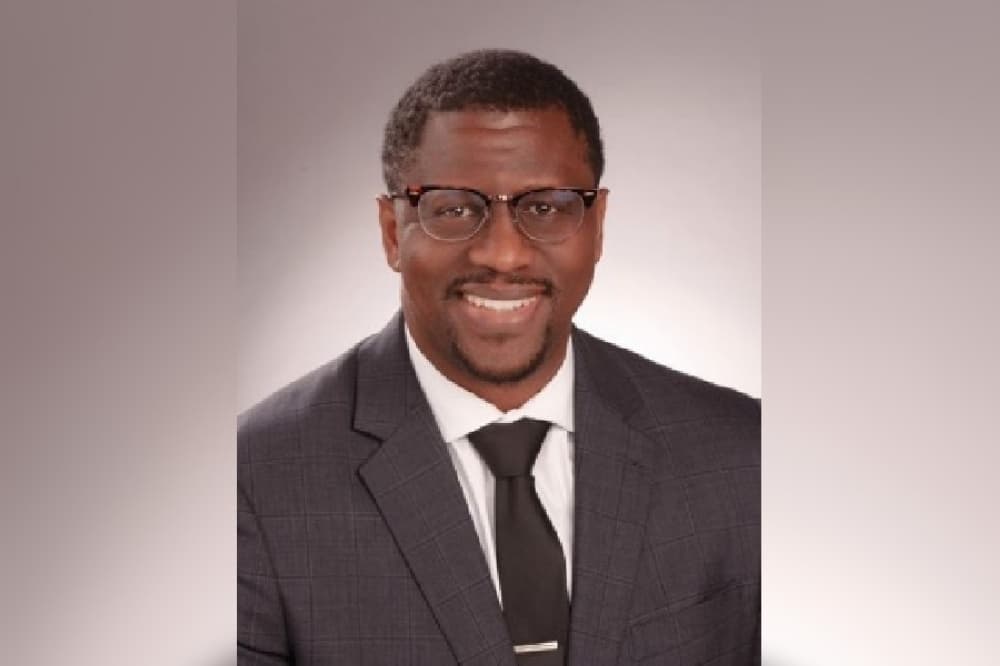
Marcus Stuckett, executive director of the county’s flood control district, was appointed to his role in June in the wake of the former director’s resignation.
A survivor of Hurricane Harvey, Stuckett said the position is an opportunity to protect residents’ homes, livelihoods and sense of security.
His appointment comes as the district is under pressure to meet spending deadlines for 28 federally-funded disaster recovery and flood mitigation projects in February 2028 and March 2029, respectively. If the roughly $868 million in combined funding isn’t spent on time, the Texas General Land Office could move to reclaim it.
In an interview with Community Impact, Stuckett discussed transitioning into his role, priorities for the district and the plan to keep projects on track.
Tell me about your responsibilities as director and what your day-to-day looks like.
As the executive director of the flood control district, I’m in charge of planning, engineering, design and construction and maintenance of flood damage reduction projects. My role is to help the team produce those projects and remove roadblocks and make decisions to help them move forward as rapidly and efficiently as we can.
Broadly speaking, can you explain what the flood control district is and how your work impacts county residents?
We are a special-purpose district created in 1937 to help with some flooding that happened in a very short span in the early ‘20s and ‘30s. It gives the district some ability to acquire right-of-way, to collect taxes and to develop flood damage reduction projects. Our goal for the residents of Harris County is to try to develop projects that remove that flood risk from homes, as well as reduce the risk.
You stepped into your role at a time when the flood control district is under pressure to wrap up 28 projects funded through the federal Community Development Block Grants. How have you adjusted to the role since your start in June, and what are your priorities?
Right now, my priorities are to deliver the projects. But also, I want us to get to a point where we (have) increased responsiveness when it comes to resident requests, or service requests, as well as being transparent. What that looks like is sharing our progress on projects, using our social media, having interviews such as this, as well as communicating our challenges, as well as our successes.
You worked for the flood control district for seven years before making your return as director. How has your experience and institutional knowledge shaped the way you approach your current role?
It’s helped a lot because a lot of the projects that we’re working on now are projects that were, when I was engineering division director, that we were sort of starting to develop. It’s helped reduce some of the unknowns. I’m at a point now where I can ask the right questions. I can recall a project saying, ‘Hey, this is (where) I recall we were in the project and this is where we are now.’ And I think that that’s been one of the biggest helps in me being in this role.
How did you make the decision to come back?
I love public works; I’m a huge public works advocate. I love public service. I like helping people. That’s where I feel like I’m fulfilled in the role. Having experienced Harvey myself, I understand that the work we do is more than just doing flood damage reduction projects. You’re affecting people’s homes, not only their homes, but their livelihoods and just that sense of security. Being in this role, I want to be able to provide that benefit and say, ‘This is how we help the residents of Harris County.
What would happen if funding isn’t spent for these projects by the deadlines? Is there a repercussion for Harris County or taxpayers?
For Harris County, the funding essentially goes back. But as the district, we have considered all of our options — if that were to be the case — to make sure that we complete these projects. Every single project that we’ve identified — that I will speak to in October — we intend to execute every single one of those projects regardless of funding source.
In addition to those projects, what do you think the flood control district needs to tackle over the next few years to make the county more flood resilient?
I think that we are doing some of that now. We need to spend the funding that we have for projects efficiently. We need to make sure that we are continuing to maintain our infrastructure, which the voters approved in 2024 — the maintenance plan. Right now, what we’re working on is increasing staffing, vehicles and equipment to take care of some of this, what we’re referring to as ‘deferred maintenance,’ so that as we develop new projects and we finish these projects that are part of the CDBG [Community Development Block Grants] and part of the bond, that our path forward is simply just maintenance of projects. But we’re also trying to look forward and start developing a planning level of effort that includes resiliency, which the Harris County Flood Resilience plan — which we are working on — includes some aspects of flood damage reduction. That plan will include ways for us to work with the different organizations in Harris County to make Harris County more resilient.
What do you think Harris County residents need to know about the flood control district, or what would you like them to know?
I’d like the residents of Harris County to know that we are committed to delivering the projects that we promised, that we are committed to being responsive and we are committed to being transparent with the funding and the responsibility that they’ve charged to the district. I’d also like the people of Harris County to understand that these projects take time, and sometimes it feels like they aren’t moving as fast as people would like, and we understand that frustration, and we’re going to work on doing a better job of communicating where we are in our progress and when we expect things to be done.