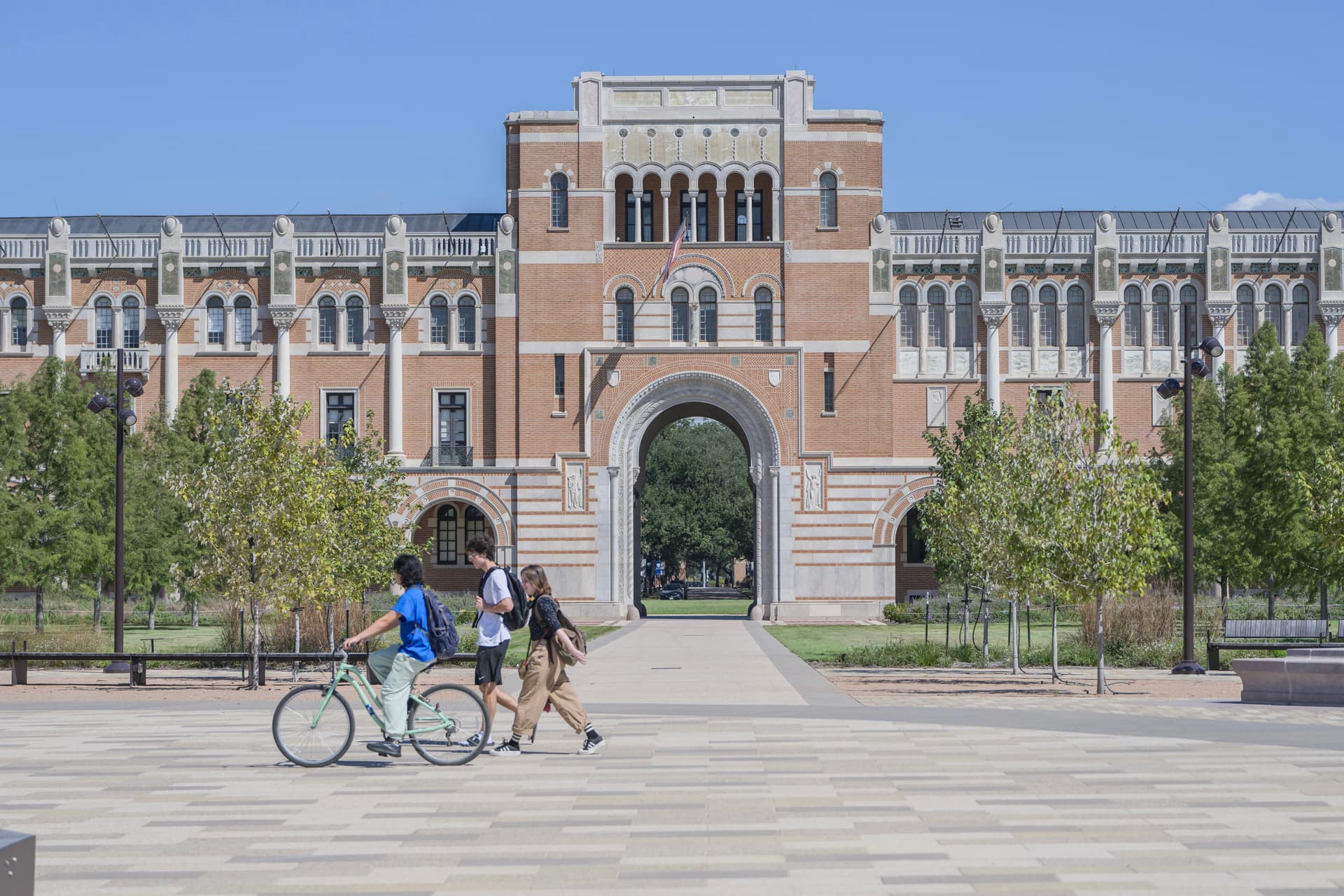
On Oct. 13, Rice University officials launched a university-wide artificial intelligence initiative that seeks to advance the institution’s placement as a global leader in enhanced computing and responsible AI, according to a news release.
The university’s method for achieving this feat involves hiring 75 interdisciplinary faculty members whose most recent work centers on modern machine learning, in addition to offering new programs and facilities.
Two-minute impact
Officials said via news release that Rice faculty have played a vital role in several foundational advancements of AI over the last few decades.
From early pioneering in robotics to gaining expertise in large-scale scientific computing, past exploration by Rice researchers, and by extension, the institution itself, has brought them to the forefront of AI development and deployment in fields such as health, energy and education.
“Artificial intelligence is reshaping virtually every field of research and sector of society. Rice is uniquely positioned to help shape that future,” Rice University President Reginald DesRoches said in the announcement. “We have an opportunity to build a community of scholars who will advance the foundations of AI, apply it to consequential challenges and help ensure that these technologies are developed and used responsibly.”
Dig deeper
Prior to the initiative’s launch, AI-focused hiring was already part of the university’s broader strategy to expand its faculty, with more than 200 tenure-track faculty hired in 2021, per release information.
Officials clarified that the university has already reached half of its hiring goal by recruiting 35 faculty members in recent years. An additional 40 faculty will allow the university to cross the desired threshold for strategic depth.
The remaining faculty will be selected through coordinated hiring and committee-led searches. This process will be guided by an “interconnected cluster approach” to ensure that recruits’ expertise aligns with the areas that Rice is positioned to lead both nationally and internationally, according to the news release.
Campus entities at Rice collectively identified a total of four clusters:
More details
Each of the interdisciplinary clusters encompasses several schools and departments across the university’s campus.
The ‘Applied AI’ cluster, for example, will bring together the George R. Brown School of Engineering and Computing; the Wiess School of Natural Sciences; and the School of Social Sciences. This is in addition to engaging other schools like the Jones Graduate School of Business and the Virani Undergraduate School of Business, per the release.
Plans for fall 2027 show that the university intends to launch a new Master of Artificial Intelligence program within its engineering and computing college. The program aims to train recent computer science graduates and working professionals for roles related to the deployment of AI systems, according to a Sept. 23 announcement.
A sneak peek
Rice officials are also looking to expand the university’s physical infrastructure that currently supports AI development.
The university will embark on the construction of a nearly 200,000-square-foot research and innovation hub, officially named “The Arc,” in Houston’s Ion District. This space will serve as a connector between Rice’s research enterprise and Houston’s rapidly growing innovation ecosystem, officials said.
Rice officials similarly intend to advance planning for the AI Foundry, which is a new component of the institution that will be housed at The Arc and facilitate future industry partnerships for emerging AI research and experimentation.
Construction on The Arc is slated to begin later this fall, according to release details.