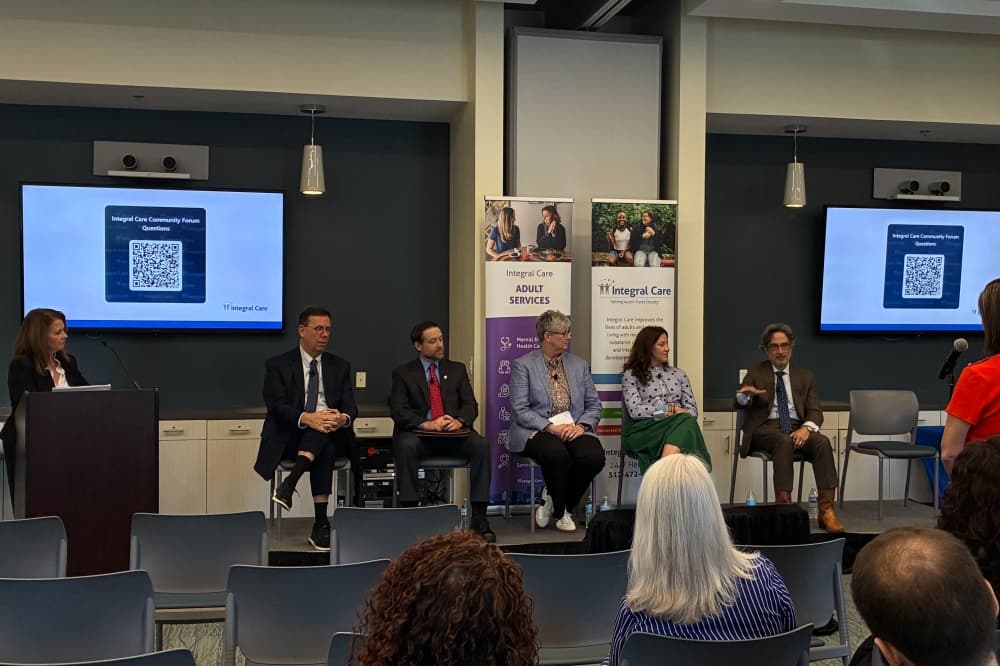
From left, panel members Jeff Richardson, Kathleen Casey, Sgt. James Turner, Dawn Handley, Sydney Harris, Mark Escott and Judge Andy Brown (not pictured) discuss the state of mental health services in Central Texas at the Integral Care community forum May 6. (Jessica McLaren/Community Impact)
As Integral Care unveils a rebrand aimed at making mental health services more accessible, Travis County is moving forward with plans for an $86 million mental health diversion center—a permanent facility that would build on the success of pilot programs the local mental health authority has been operating since 2023.
The facility will offer an alternative to incarceration for nonviolent offenders with mental health or substance abuse issues while providing treatment and stabilization services.
Why it matters
The push for a diversion center stems from a 2023 report from the Travis County Forensic Mental Health Project, which found roughly 40% of all people in Travis County Jail—and 70%-80% of those with substance abuse disorders—have mental illnesses.
The report identified a cycle where people become trapped in jail while waiting for behavioral health services rather than receiving treatment. And according to NAMI Texas, 1 in 5 Texans experience a mental illness in a given year.
County officials want to create one centralized drop-off point where law enforcement can bring people to the sobering center, diversion center or jail booking without driving across town.
Travis County Judge Andy Brown said at a May 6 Integral Care community forum that people without mental health care access end up interacting with law enforcement.
"This is the biggest challenge that the county has in Travis County," Brown said. "We just need more. That's why it's so important that the county and the city and Central Health and the state—everybody who has the dollars—keeps looking at ways to increase the work Integral Care is doing in this area."
The timeline
The project will unfold in three phases: about a year of pre-design work, costing $2 million; one and a half to two years of formal design; then approximately three years of construction.
While the permanent facility is years away, Travis County launched a three-year pilot program in June 2023 to test diversion strategies through partnerships with Integral Care—Travis County’s local mental health authority since 1967—the city of Austin and other agencies.
The pilot includes:
Expanded 24/7 Psychiatric Emergency Services at Integral Care's Richard E. Hopkins Behavioral Health Building, providing immediate care for mental health crises
A 25-bed therapeutic diversion center at the city-owned Genevieve Tarlton Hearon building, formerly the Ronald McDonald House, where adults can stay up to 90 days for treatment
A $2 million data-sharing system connecting Austin Police Department, Travis County Sheriff's Office, medical entities and homeless organizations
Williamson County launched a similar diversion program in 2022 and is seeing financial returns. By diverting first responders, the county saves an average of $1,367 per call, according to county documents.
Integral Care served 29,000 clients last year, with 97% living in poverty and 19% experiencing homelessness.
"Behind every statistic, there's a person, there's a family, there's a community that we care for," said Jeff Richardson, Integral Care CEO, at the May 6 forum.
By the numbers
Travis County's 911 Call Center Collaboration has shown significant impact, according to a 2025 LBJ School of Public Affairs and Cornell University study that analyzed over 20,000 mental health-related calls:
43% reduction in involuntary emergency detentions
34% reduction in arrests
Over 50% reduction (26 fewer minutes) in officer time on scene
"Since the inception of the program, we've seen around 34,000 cases transferred from law enforcement to some other resource," Sgt. James Turner of the Austin Police Department said at the panel. "Every diversion from law enforcement provides us the opportunity to address those officers to be available for those high-profile calls."
Also of note
Integral Care is preparing to launch its third mobile behavioral health van in June to bring crisis care services directly to residents. Commissioners approved $337,497 in startup funding for the van Feb. 3.
The mobile clinic will be staffed with mental health professionals trained in crisis intervention and will target those experiencing homelessness, those recently released from jail or hospitals, and disaster situations. Services include psychiatric evaluations, medication management and connections to ongoing treatment.
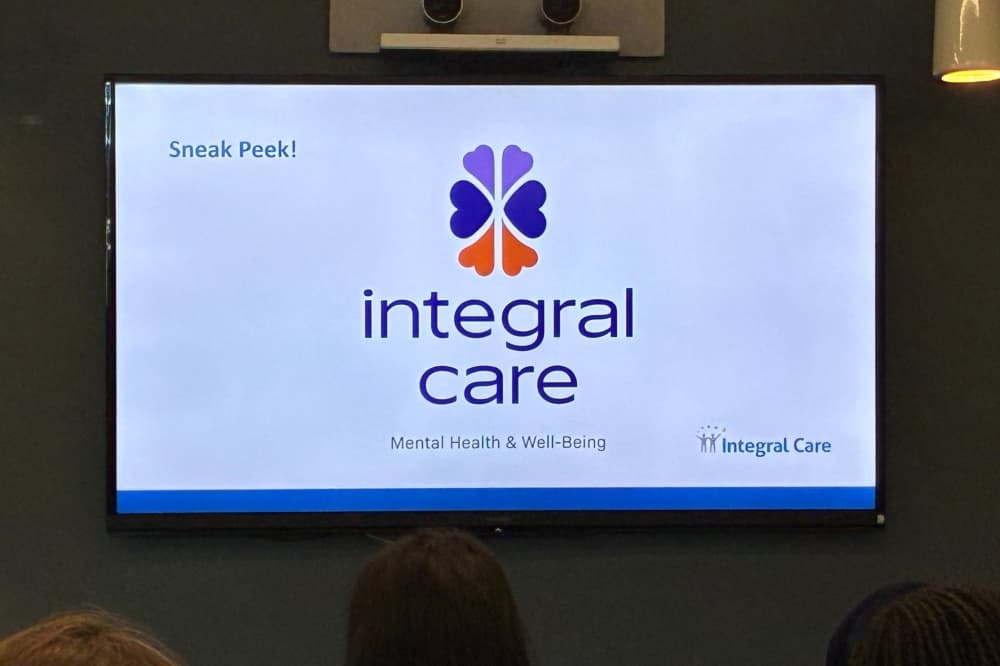
Integral Care also unveiled a rebrand at the forum featuring a new logo and website designed to better represent the organization's holistic approach to mental health care.
Integral Care shared a sneak peek of their rebrand at the May 6 forum. A previous slide described these colors in their new visual identity as 'combin[ing] red's energy with blue's calmness for introspection, meditation, and a harmonious balance' and with 'yellow's happiness for enthusiasm without aggression.' (Jessica McLaren/Community Impact)
Dawn Handley, Integral Care's vice president and chief operating officer, emphasized the importance of building sustainable systems.
"We're building the thing that works. It's showing the results. The data is there," Handley said. "But it's not to scale. It's not at capacity."
The forum also included Kathleen Casey, chief strategy and innovation officer for Integral Care; Sydney Harris, a senior health systems design consultant for Central Health; and Mark Escott, chief medical officer for the city of Austin.
Get involved
Integral Care has trained 20,000 people in mental health first aid, which helps community members identify signs of mental health struggles and connect people to care. Officials emphasized the need to expand this training significantly as part of upstream prevention efforts.
Anyone experiencing a mental health crisis or seeking resources can call the 24/7 helpline at 472-HELP (512-472-4357) or 988 to reach Integral Care's trained clinicians.
Esperanza Community grows East Austin transitional shelter complex with new cabins, community center