A senate bill passed during the 2025 Texas Legislative session requires all Texas school districts to equip its school bus fleet with three-point seat belts by 2029.
The Leander ISD board of trustees considered two potential options to bring its bus fleet up to compliance during its April 23 meeting.
Current situation
Per district documents, Senate Bill 546 requires school buses have three-point seat belts, which feature both a shoulder and lap buckle, for every passenger and operator. Districts must fully comply with the law by Sept. 1, 2029.
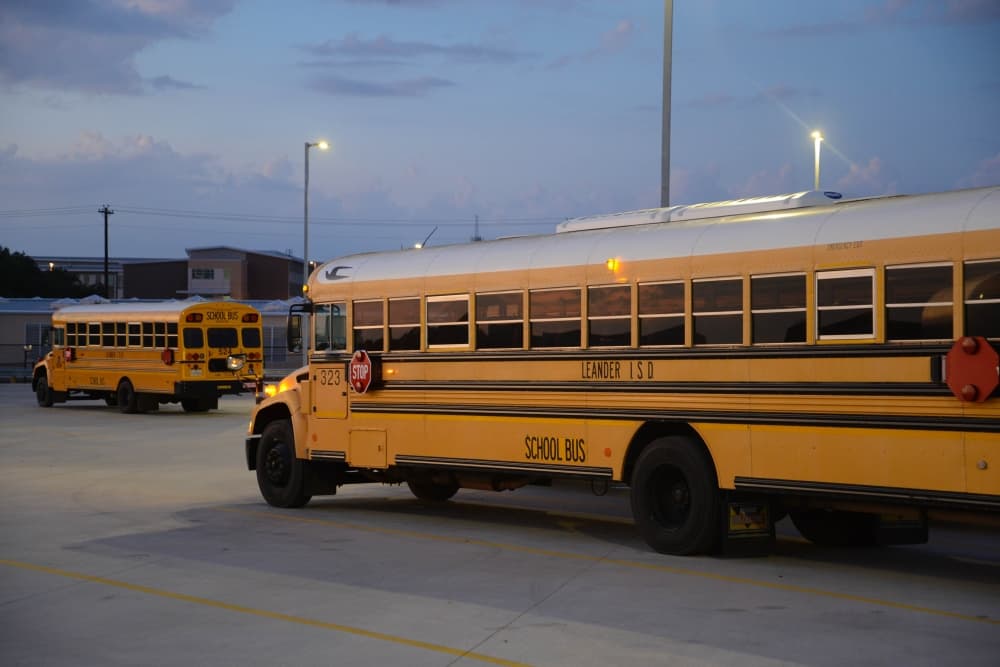
Of LISD's current fleet of 318 buses, 212 are equipped with three-point seat belts. There are 79 general education buses not equipped with seat belts, and 27 special education buses equipped with two-point seat belts. Buses not equipped with three-point seat belts are not deployed for daily school routes, per district documents.
Senate Bill 693, passed in 2017, required all newly purchased buses with a model year of 2018 and after to be equipped with three-point seat belts. As such, the LISD buses not equipped with three-point seat belts were manufactured between 2007 and 2018, documents state.
Breaking it down
Officials said the district observes the industry standard of a 15-year replacement cycle for buses. In order to comply with SB 546, LISD has two potential options:
- Retrofit the 79 general education and 27 special education buses at a cost of $30,000-$45,000 per bus, equating to a $4.2 million budget impact. However, officials noted that the district's bus manufacturer will not warranty retrofitted buses.
- Purchase 79 general education and 27 special education buses before Sept. 1, 2029, equating to an $18 million budget impact. This would provide a longer runway to full compliance and allow for a more staggered replacement cycle, officials said.
Chief Operations Officer Jeremy Trimble said retrofitted buses would not be under warranty as the way the three-point seat belts work requires retrofitting the entire frame, including the seat itself and the floor structure.
"All the buses have to meet federal motor vehicle safety standards," Trimble said. "If anything is changed on that bus, that manufacturer gets out of the picture. ... You're changing how that worked from the manufactured standard. While a retrofit company would have warranties associated with the work that they do, just understand if something was to happen then a lot of that risk and liability comes back to the district. ... There's still a modification made to that vehicle, and it's not standard, and it doesn't necessarily meet the manufacturer's design of that bus."
The funding source
DeWayne Street, senior executive director of facilities, said funding for the mandate could come from the general fund budget but would require additional expenditure reductions or allocations from the fund balance.
Future funding considerations could include a Citizens' Facility Advisory Committee process for a potential future bond or utilizing active bond project savings, Street said.
Something to note
Street said LISD must make a formal determination on whether the district's general fund budget can comply with the requirement before May 29.
Trimble said this process "typically doesn't happen" with mandates like this, saying the May 29 deadline is so the state can gather information from districts and make a determination if there's any associated funding that could come in the future.
"Typically they don't do that, so that is one thing I want to carve out there that could benefit districts," Trimble said. "I can probably guarantee it won't be fully funded, but there may be some associated funding that could come through the [Texas Education Agency] later on."
Going forward
The board will take action at its May 7 board meeting on how to fund the mandate if district officials determine that LISD's general fund cannot permit compliance.