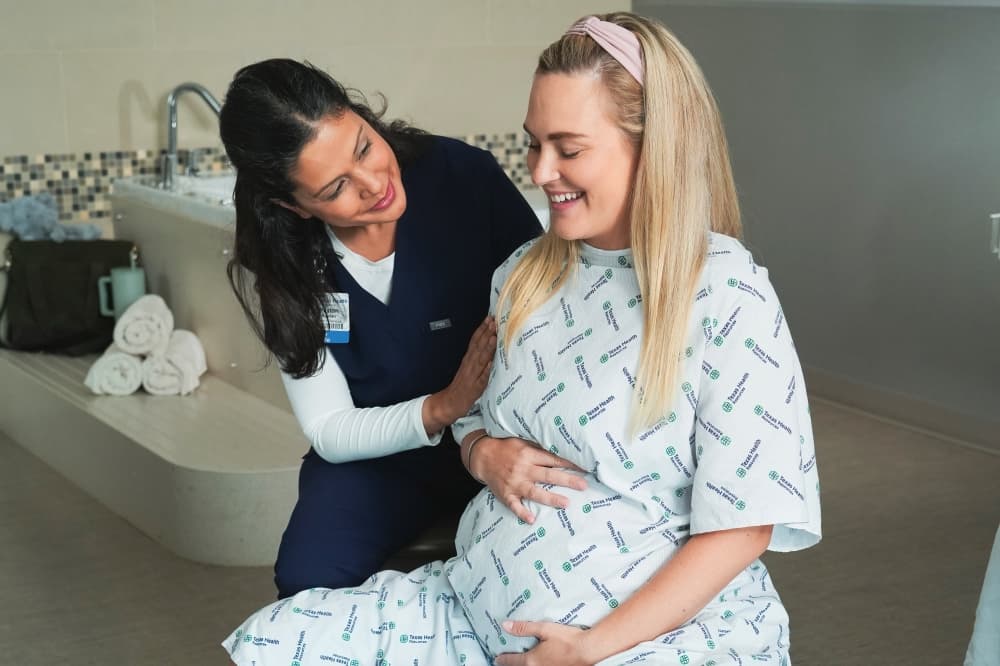
As birth rates decline in Texas, an initiative to bring midwives into the hospital delivery room is increasing the number of births taking place at Texas Health Presbyterian Hospital Allen, hospital officials say.
Texas Health Allen officials launched a partnership with New York-based comprehensive women’s health care provider Diana Health in late 2024 that integrates certified nurse midwives into women’s care before, during and after pregnancy. The hospital saw a 29% increase in births in 2025 compared to the three-year historical average.
The partnership also brings other women’s health services offered by Diana Health to the Allen area, including gynecological care and mental health treatment.
“People have a lot of interest in that more hands-on, natural birth but still wanting the safety nets and the resources of a hospital,” said Kari McCord, chief nursing officer at Texas Health’s Allen hospital. “We’re able to provide that.”
The big picture
More than a year after the program was launched, hospital officials say the partnership has resulted in a 29% increase in child births and a 17% decrease in cesarean section rates at the Allen hospital.
The program is attracting expectant mothers amid a local decline in birth rates, which follows statewide and national trends. In Collin County, the fertility rate, which assesses the number of reproductive-age women having children, declined by more than 25% during the 20-year period from 2005 to 2024, according to data from the Centers for Disease Control and Prevention. In 2024, about 51 out of 1,000 women of reproductive age in Collin County gave birth.
Prior to implementing the program, officials saw a decline in births at the hospital, which McCord attributed to a number of factors, including population changes and competing facilities.
However, the Diana Health partnership and integration of midwifery care is the “right niche” for the facility and contributed to revitalizing the women’s health services at the hospital to meet community needs, McCord said. The growing demand has on occasion pushed the 14-bed labor and delivery unit and six-bed neonatal intensive care unit toward capacity, she said.
“We have had the success of ... growing our overall volume within that partnership [and] really finding what our community needs,” McCord said.
By the numbers
From 2022-24, Texas Health Allen averaged 415 deliveries annually. In 2025, 536 babies were delivered at the hospital, representing a 29% increase compared to the prior three-year historical average.
In 2025, Texas Health Allen observed a 17% reduction in the C-section rate among mothers presenting with low-risk deliveries compared to the prior three-year average from 2022–24.
How it works
Margaret Buxton, Diana Health’s vice president of clinical operations, said having midwives involved in obstetrics care increases rates of vaginal birth and improves patient satisfaction. Buxton attributed the outcomes and patient experience to the “power of presence” that a midwife brings.
While patients may choose to work with a midwife during delivery, Diana Health’s team includes both a midwife and a physician on each shift, which Buxton said offers “the best of both worlds.”
“Midwives are experts of labor support and they really specialize in a relationship-based model for low-risk pregnant women. ... OB-GYN’s are fantastic support when birth does move into those high-risk moments,” Buxton said. “When you have them both together on shift, then everybody gets the best care.”
As part of the partnership, Diana Health established a women’s health office at the Allen hospital where patients can begin working with a certified nurse midwife prior to becoming pregnant and continue receiving care through their postpartum period. Midwives at the practice collaborate with physicians to provide “whole health care” for patients, the clinic’s website states.
Paths to care
When pursuing care at Diana Health, patients can choose from various provider options to join them in the delivery room, according to the clinic’s website.
- Obstetrician-gynecologist:
- Licensed physician
- Ideal for high-risk patients, patients with a potential need for surgery or patients with complex gynecological needs
- Certified nurse midwife:
- Hold a bachelor’s degree in nursing and a post-secondary degree in midwifery
- Ideal for low-risk pregnancies and routine gynecological care
Put in perspective
When Emilee Smirl was planning for the birth of her second child, she prioritized seeking out the care of a midwife, which brought her to Texas Health Presbyterian Hospital Allen.
Smirl, who had previous experience giving birth under the care of a midwife, said her delivery experience at the Allen hospital blended the hands-on care and support of a midwife with medical support and oversight.
“To have the support of someone there laboring with me, helping me, moving me around the room, getting me in the best position I can with their knowledge ... and then at the same, knowing that if something does go wrong, if a heart rate starts dropping, everything is being monitored,” Smirl said of working with a certified nurse midwife at Texas Health Presbyterian Hospital Allen.
Why it matters
McCord said the program focuses on collaborating with patients and putting decision-making “into the patient’s hands.”
“We want her to feel like she is in the driver’s seat of her care,” Buxton said. “All the different program elements are meant to bring her into that sense of being feeling empowered, embodied, and able to reduce that fear and friction.”
Diana Health’s services extend beyond the delivery room, with the clinic offering care for general gynecology needs, menopause and wellness, its website states. The clinic also offers mental health care services, which Buxton said can help patients that may otherwise avoid seeking out care.
“Stress and fear degrades health,” she said. “If you are dealing with a health problem ... and you don’t get care, that can lead to much bigger problems downstream.”
Jen Biundo—senior director of Policy and Research for Healthy Futures of Texas, a nonpartisan, nonprofit organization that promotes sexual health education and resources for young Texans—said that outcomes that occur without access to comprehensive maternal care can cause a “ripple effect” from the mother to the baby by passing along health complications.
“The components of having a healthy baby are providing high-quality maternity care, so we see things like gestational diabetes that impacts the mom but can also impact the health of the baby,” Biundo said. “These things can make it harder for the child to thrive and excel, and when we look at the long-term impact of this, we can see things like poor educational outcomes for the children.”
In addition to improving health outcomes in a clinical setting, access to comprehensive maternity care can contribute to the health of the broader community, said Coda Rayo-Garza, senior director of research and data for nonprofit, nonpartisan policy institute Every Texan. Access to that care can translate to driving regional economic stability, Garza said, including through preventing medical debt and minimizing long-term productivity losses.
A 2021 study by The Commonwealth Fund, a nonprofit, nonpartisan health policy reform foundation, found that maternal morbidity costs from conception to the child’s fifth birthday for all domestic births in 2019 surpassed $32 billion. While 58% of the cost was shouldered by the health care system, the remaining costs were distributed among employers, social services programs and other nonmedical sectors, the study states.
“In the U.S., failing to provide high-quality parent and infant care creates immense financial burdens for local areas and state budgets,” Garza said in a statement, referring to the study.
Quote of note
“The foundation of a healthy citizen is making sure that mom is healthy before, during and after pregnancy,” Biundo said.
Looking ahead
As the partnership continues to grow, McCord said the facility is approaching its capacity.
Hospital officials plan to expand both the NICU and the labor and delivery unit, McCord said. Both maternal and neonatal services at the hospital have a Level 2 designation, meaning the facility can care for low-to-moderate-risk obstetrics patients and stable-to-moderately-ill infants, according to Texas Health and Human Services’ website.
Buxton said future growth of the women’s services departments could elevate the hospital’s care designations.
“We would love to grow to the extent that we can increase the level of care designation and grow our footprint with being able to take care of more babies in the NICU,” she said.
The hospital also uses a model that combines labor and delivery and recovery and postpartum care into the same space. McCord said future upgrades to the facility would separate those areas into dedicated spaces for labor and delivery and for recovery and postpartum care.
“We will probably do that within the next couple of years, as well as ... adding that luxury to the postpartum area. That is always something that the community really enjoys is ... having that little bit of luxury in that postpartum period,” McCord said. “We do have some big plans ahead in regards to expansion.”